The ruler everyone ignores
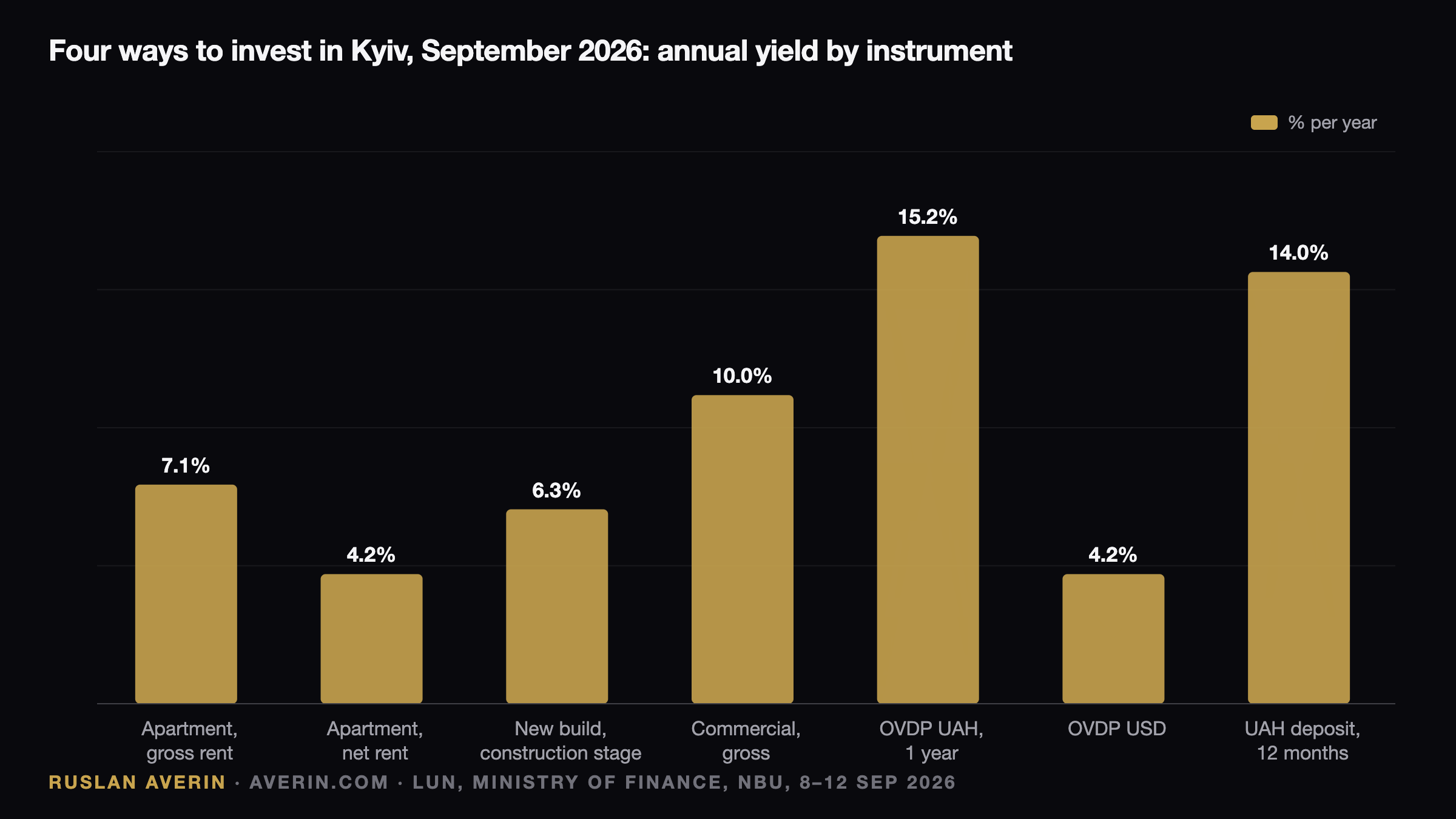
Before any apartment is priced, one number should be fixed: a one-year hryvnia government bond pays 15.16%, a two-year 16.09%, and neither the personal income tax nor the military levy touches that income. Dollar-denominated OVDP pay about 4.2%, also tax-free, with an entry ticket of $1,000 and exit measured in days. Every property decision in Kyiv in 2026 is a decision to accept less liquidity than this.
The backdrop for the comparison is September 2026 data: an NBU policy rate of 15.5%, August inflation of 8.1%, an exchange rate of UAH 44.55 per dollar and a median one-room apartment at $68,500. Those four figures explain most of what follows, because a double-digit rate pulls current income out of bricks and into paper.
Five options on one screen
| Instrument | Entry ticket | Yield per year | Liquidity | Tax | Main risk |
|---|---|---|---|---|---|
| Buy-to-let apartment (secondary) | from $44,000 | 7.1% gross, about 4.2% net, plus price growth | 41 days on market | 23% on rent or FOP 6% | vacancy, falling rents |
| New build at construction stage | from 30% of price (deposit) | 25–40% over 2–3 years, 15–28% after tax | assignment only | 23% of profit | delayed commissioning, freeze |
| Commercial premises | from $100,000 | 9–11% gross | months | 23% or FOP | vacancy, tenant |
| OVDP in hryvnia, 1 year | from UAH 1,000 | 15.16% | days | 0% | devaluation |
| OVDP in dollars | from $1,000 | about 4.2% | days | 0% | — |
Rows matter more than columns here. Only the apartment carries a two-part return — rent plus capital appreciation — and only in that case is the second part neither guaranteed nor realised until the object is sold. Comparing headline yields alone hides the exit terms entirely.
Where 7.1% turns into 4.2%
The median one-room flat lets for UAH 18,000 a month, or $404 at the current rate, which produces 7.1% gross on $68,500. From that figure come one vacant month per year, the single tax with the military levy and the social contribution if the owner works through a FOP, roughly 1% of value annually in maintenance, an agent's commission whenever tenants rotate, and utilities while the flat sits empty. Around 4.2% survives.
Capital growth is the other half of the case. Over the past year one-room apartments gained 5% in dollars, two-room 2%, while three-room prices were flat. Rents told a different story: one-room rates did not move over the same period, and three-room rents fell 5% in the month to September. A rising denominator against a static numerator compresses rental yield mechanically, without anything happening in the tenant market.
Add the two parts and a buyer collects roughly 9% in dollars — provided appreciation continues and the sale happens no sooner than three years out. Sell earlier and the 10% tax on the price consumes the entire gain.
The widest spread and the narrowest door
The gap between the launch price at the pit and the finished-apartment price in Kyiv projects of 2024–2026 runs to 25–40% in dollars, shrinking to 15–28% after tax. Primary-market prices rose 15.3% in hryvnia over the year, reaching UAH 63,300 per metre in August. This is the most profitable segment in the city and also the thinnest: only 6 new residential complexes launched in Kyiv in January–July 2026 against 10 a year earlier, with 23 in the region.
What the headline spread omits is the cost of getting out. The developer charges an assignment fee of $1,000–3,000, or 1–3% of the price. Profit is taxed at 23%. Between commissioning and title registration two to eight months elapse, and construction itself rarely arrives on the announced date. In Kyiv region 12% of residential complexes stand frozen — a reminder that the downside is not a lower return but a stalled site.
An instrument for operators, not savers
Street-retail units and class B offices in Kyiv change hands at gross yields of 9–11%, close to double the residential figure. That premium is compensation, not generosity. Vacancy in commercial space can run six months, a business tenant exits faster than a family does, and finding a buyer for a $200,000 unit is materially harder than for a $70,000 apartment. The entry ticket starts at $100,000 and the exit is measured in months.
Allocating $70,000 over three years
With that capital and a three-year horizon, three shapes are available. One secondary apartment let out delivers 4.2% net plus whatever prices add, with the money locked for three years by the sale tax. A 30% deposit in a new build combined with dollar OVDP on the balance offers 25–40% upside on the deposit against the risk of a frozen construction site. Everything in bonds yields 15% in hryvnia or 4.2% in dollars, liquid within days, taxed at zero.
Analyst Ruslan Averin notes that the situation reflects the normal behaviour of a market under a double-digit central bank rate: while the NBU holds 15.5%, hryvnia paper takes current income away from apartments, leaving housing as a bet on capital rather than on rent. The property premium in 2026 sits entirely in expected appreciation, because the net rental figure matches dollar bonds exactly.
The allocation that keeps winning
The hybrid option — a construction deposit plus bonds on the remainder — produces roughly the same expected return as a buy-to-let apartment while using half the capital and offering twice the liquidity. By the analyst's estimate, that is how most private investors entering Kyiv in 2026 for a second or third time structure their money. The apartment has not stopped working; it has simply stopped being the default answer.