A vacancy rate that measures loss, not demand
In a normal market, a vacancy rate under 1% describes an economy running hot. In Kyiv at the end of August 2026 it described something else entirely: there was barely any modern warehouse left to lease. The indicator fell 2.5 percentage points over eight months, yet the driver was not tenant appetite. Buildings were being struck, written off and removed from the statistics faster than anyone could replace them.
Eight months that undid a full recovery
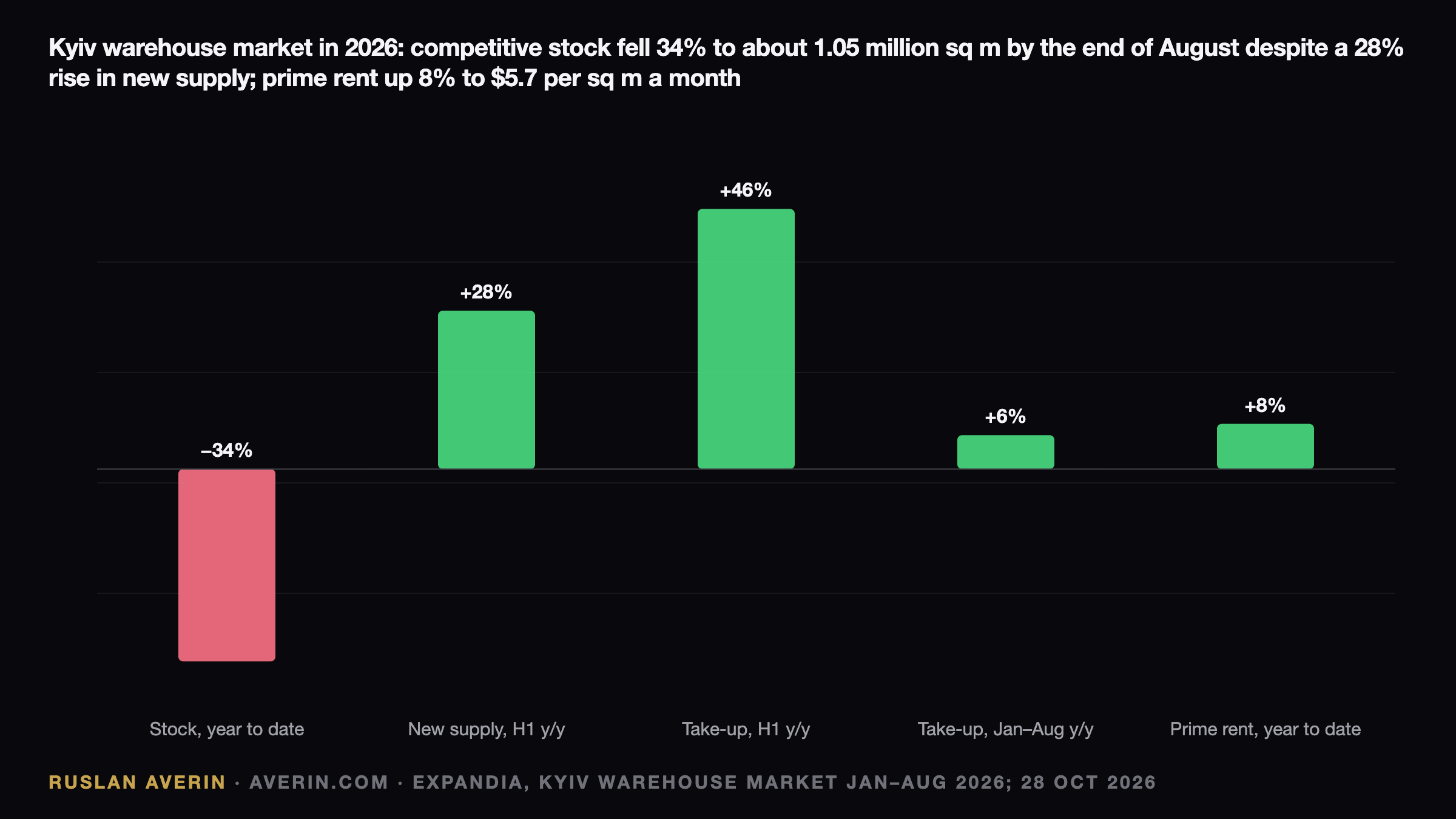
The capital's competitive warehouse stock had, by the end of June 2026, finally returned to its pre-war 2021 benchmark of roughly 1.6 million square metres. Two months later the same indicator stood at about 1.05 million square metres — 34% below the January level. The reversal is attributed directly to intensified missile attacks on warehouse assets during July and August.
The data were published on 28 October by EXPANDIA, the largest commercial real estate company in Ukraine and CBRE's Country Service Partner in the country. A concrete illustration cited by Dilo (delo.ua) is the 28 September strike on warehouses of the ATB retail chain in Brovary district, immediately outside Kyiv.
The eight-month scoreboard
| Indicator (January–August 2026) | Value | Change |
|---|---|---|
| Competitive stock | about 1.05 million sq m | down 34% since January |
| New supply (first half) | around 150,000 sq m | up 28% year on year |
| Take-up | about 180,000 sq m | up 6% year on year |
| Vacancy | below 1% | down 2.5 percentage points |
| Prime effective rent (ambient) | $5.7 per sq m a month | up 8% since January |
Rent is quoted net of VAT and operating costs. The combination is unusual: construction volumes improved, leasing volumes improved, and the market still finished the summer substantially smaller than it began.
Building to stand still
EXPANDIA frames the paradox bluntly, noting that new development "increasingly served to replace the lost stock rather than increase supply." Destroyed and damaged buildings exit the count immediately, while reconstruction takes years. Each successful strike therefore produces an instant statistical contraction that no construction schedule can offset within the same calendar year.
Half-year supply numbers deserve caution. At a Confederation of Builders of Ukraine panel on 7 August, Yaroslav Horbushko, EXPANDIA's director of capital markets, placed first-half deliveries at 98,000 square metres, 16% lower year on year, according to Interfax-Ukraine. The October research reports roughly 150,000 square metres. The trajectory of the stock count is not disputed; the precise supply figure is still being refined.
The same August panel underlined how thin the forward pipeline is. Developers had planned only about 21,000 square metres of speculative warehouse space for the whole of 2026, with most remaining projects built for an identified tenant.
Leasing that reshuffles rather than expands
Take-up of about 180,000 square metres over eight months looks robust until the composition is examined. Relocations and relocation-driven expansions accounted for 82% of transactions in January–August, leaving just 18% for genuine expansion. Much of the July and August activity consisted of companies evacuating damaged premises.
An averin.com calculation drawn from EXPANDIA's two releases sharpens the picture. First-half take-up was 160,000 square metres, up 46% according to the August figures. That implies roughly 20,000 square metres leased across July and August combined — a near-freeze, caused not by hesitation but by the absence of available space.
By occupier type, leasing was led by logistics and 3PL operators at 42% of take-up, wholesale and retail trade at 38%, and FMCG companies at 20%. Larger groups are distributing inventory into western Ukraine to protect business continuity. Scarcity is sharpest in multi-temperature warehouses, a segment already undersupplied before the summer.
Pricing power has moved to the owner
Prime effective rent rose 8% in eight months to $5.7 per square metre a month. Contracts remain predominantly hryvnia-denominated, although dollar deals have grown more common. Dilo, citing the research, reports asking rents of $4.7–6.0 per square metre a month, equivalent to UAH 210–270.
A second adviser describes the same shift. In mid-October Yevheniia Loktionova, director of UTG, told Dilo that rents for quality warehouses in Ukraine had risen 12–13% in recent months and that conditions had become "a landlord's market." She placed class A effective rents in the Kyiv region at $5–5.5, with the most protected buildings reaching $6. In the Lviv region rents already stand at $6–7.
Market experts quoted by Dilo expect rents in new quality buildings to rise a further 15–20% in dollar terms during 2027. UTG estimates total logistics costs for producers and retailers could climb 30–40% as warehouse networks fragment and migrate westward.
Two methods, one conclusion on damage
Loss estimates diverge by methodology. WINHUB data cited by UTG count about 2.2 million square metres of class A and B space in the Kyiv region before the full-scale invasion, of which roughly 1.5 million square metres, or 68%, has been lost. Nationwide, WINHUB records 2.1 million square metres destroyed out of 4.2 million square metres at the start of 2022, against about 800,000 square metres of new construction since.
EXPANDIA's August estimate was more conservative: approximately 950,000 square metres lost across Ukraine, including more than 650,000 square metres in the Kyiv region, before an early-August attack that had not yet been counted. Different stock definitions, identical verdict — Kyiv carries the heaviest losses in the country.
Reading the market from three seats
In analyst Ruslan Averin's view, Kyiv warehouses now represent the purest example of war risk being priced straight into commercial real estate: surviving assets command premium terms precisely because of strikes that could reach them next.
- Owners of standing warehouses enjoy sub-1% vacancy and rising rents, offset by concentration risk that insurance and location must absorb.
- Developers face a market where EXPANDIA expects build-to-suit and owner-occupied schemes to dominate, with speculative projects waiting for improved security.
- Occupiers needing 10,000–20,000 square metres in the Kyiv region may simply fail to find it, UTG warns; pre-leasing and western sites are becoming standard practice.
The security premium is visible in housing too, where Kyiv buyers pay more for flats with backup power and autonomous heating, and where developers' new-build sales fell 62% in September even as prices rose.
Four indicators to track
Attention should centre on EXPANDIA's full-year 2026 report and whether stock recovers above 1.05 million square metres or erodes further through autumn strikes. A decisive migration from hryvnia to dollar leases would cement the 2027 rent growth analysts anticipate. Lviv rents at $6–7 will show how much tenant demand keeps leaving the capital. Finally, the availability of war-risk insurance cover will determine how much speculative construction returns.