The fork that is really two tax bases
A buyer who entered a Kyiv project at the pit stage faces a decision that the market frames as a pricing question: is a square metre worth more before or after commissioning? The Tax Code frames it differently. Before commissioning the charge lands on profit; after commissioning it lands on the entire contract price. The two amounts frequently differ by a multiple, not by a few percent.
The arithmetic that settles the argument
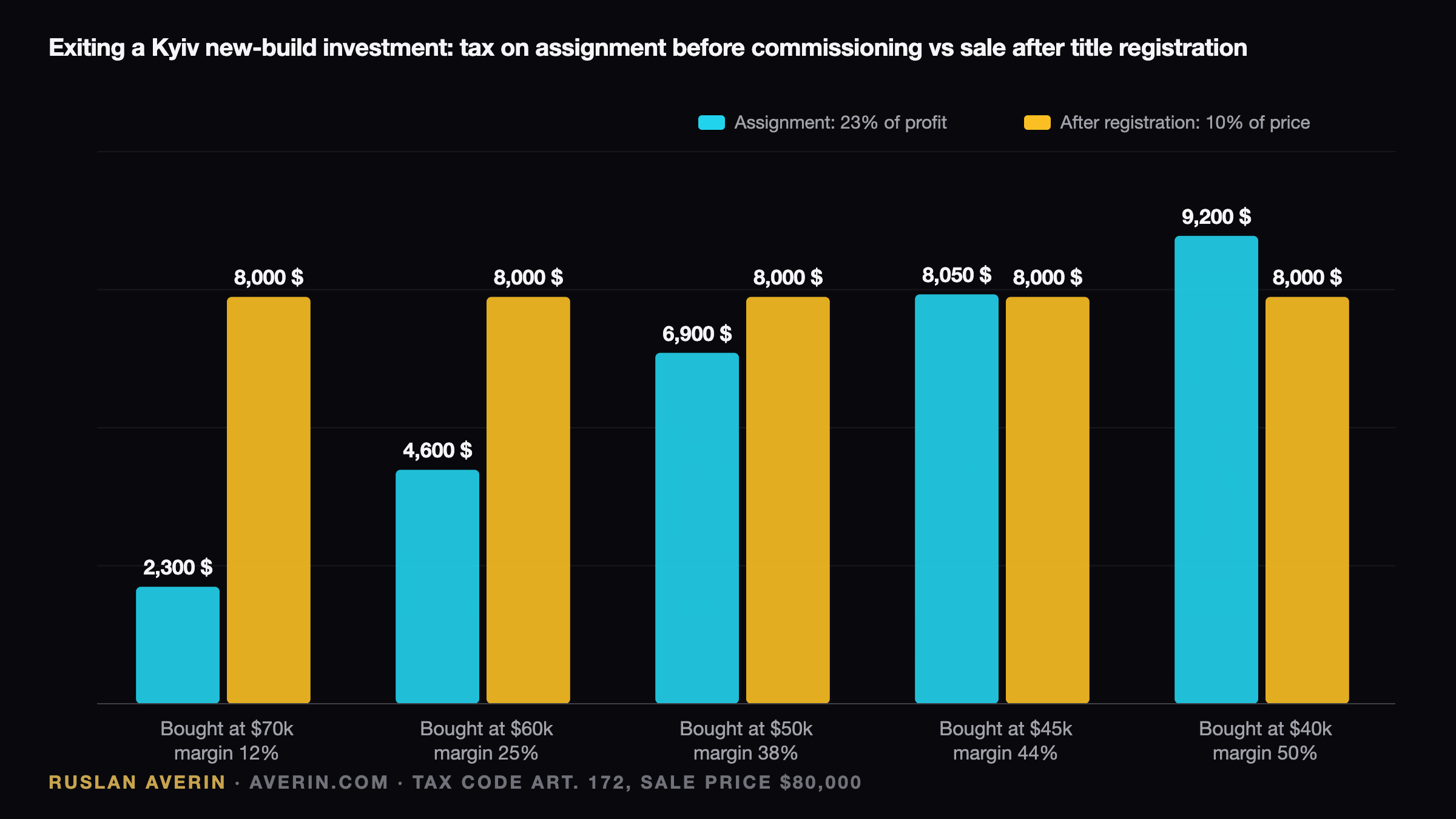
Let the sale price be P and the documented acquisition cost be C. Assignment before commissioning costs 23% × (P − C). A sale after registration costs 10% × P. Setting the two equal gives 0.23 × (P − C) = 0.10 × P, which resolves to a profit equal to 43.5% of the sale price. That single figure, not the calendar, is the real decision rule.
| Bought for | Sold for | Profit | Tax on assignment (23% of profit) | Tax after registration (10% of price) | Cheaper |
|---|---|---|---|---|---|
| $60,000 | $75,000 | $15,000 | $3,450 | $7,500 | assignment |
| $50,000 | $80,000 | $30,000 | $6,900 | $8,000 | assignment |
| $45,000 | $80,000 | $35,000 | $8,050 | $8,000 | almost equal |
| $40,000 | $85,000 | $45,000 | $10,350 | $8,500 | after commissioning |
What Kyiv price dynamics imply
Listing platforms and developers themselves put the typical rise from pit to commissioning in Kyiv projects of 2024–2026 at 25–40% in dollars. That sits under the 43.5% threshold, which means assignment taxed on profit is the cheaper exit for the majority of investors currently holding contracts.
The conclusion reverses for those who bought in 2022–2023 at "wartime" prices and are now looking at a 50–70% margin. In that band the whole-price charge of 10% is smaller than 23% of a large gain, and waiting for registration pays.
Which legal form the apartment sits in
Since October 2022, Law 2518-IX has provided for a special property right to a future property object: the right to one identified apartment in a building under construction is entered in the State Register of Property Rights before commissioning. Most Kyiv developers that launched sales after 2022 operate on this basis.
Older instruments have not disappeared. Construction financing funds, forward contracts, derivatives and cooperative shares still govern projects that began earlier, and they are taxed on a different logic.
The profit base before commissioning
Article 172 of the Tax Code expressly addresses the sale of a future property object and the assignment of rights under its sale contract, where the price has been partly paid and an encumbrance has been registered in the buyer's favour. The headline rate is 18% personal income tax plus the 5% military levy.
One paragraph reshapes the outcome: income from such a sale may be reduced by documented costs of acquiring the object or the property rights. Provided payments are evidenced and a return is filed, the charge is 23% of the difference between sale price and the sum paid to the developer.
Holders of the older structures face a harsher reading. The tax service treats an assignment of a claim under a construction financing fund participation agreement as other income at the general 18% rate, and the Code does not spell out cost deduction there as directly. Until a tax ruling states otherwise, such sellers should plan on the full amount being taxed.
The whole-price base after registration
Once title to the completed apartment is registered, the transaction becomes a sale of housing under clause 172.2. The holding period starts at registration rather than at the investment contract, so the object is almost always "under three years old". The first sale of the year attracts 5% personal income tax plus a 5% levy, that is 10% of the contract price and not below the appraised value, with no cost deduction available at the 5% rate.
Costs that never appear in the tax calculation
An assignment usually triggers a developer re-registration fee: Kyiv projects charge a fixed $1,000 to $3,000, or 1–3% of the price. Some contracts bar assignment outright before full payment or before a defined construction stage, which removes the choice altogether.
Selling after commissioning brings title registration, appraisal and notary expenses, plus 1% to the pension fund and 1% state duty paid by the buyer, amounts that a finished-apartment negotiation normally absorbs into the price.
Time is the heaviest hidden cost. In Kyiv during 2025–2026 the gap between commissioning and title registration ran from two to eight months, covering the technical passport, address assignment and registration itself. An investor "waiting for commissioning" is in fact waiting for registration, earning no rent throughout.
Paperwork is the deciding asset
No deduction applies by default. The seller computes the base, submits the property and income declaration by 1 May of the following year with copies of payment documents, and settles the tax by 1 August. Where the buyer of the rights is a company, it withholds as agent at 18% on the full amount and the seller reclaims the deduction through the return.
The encumbrance in the buyer's favour also has to be registered. Without that entry the transaction slips outside the future-object paragraph and risks reclassification as other income with no deduction attached.
Reading the decision in order
The choice is not merely about timing but about which base applies. Analyst Ruslan Averin recommends a fixed sequence: measure the margin as a share of the sale price before signing anything; below 43%, exit by assignment and claim the cost deduction; above that, hold for registration and accept the 10% charge. In either route, proof of payment to the developer outranks any finishing package in value.