A negotiation, not a settlement
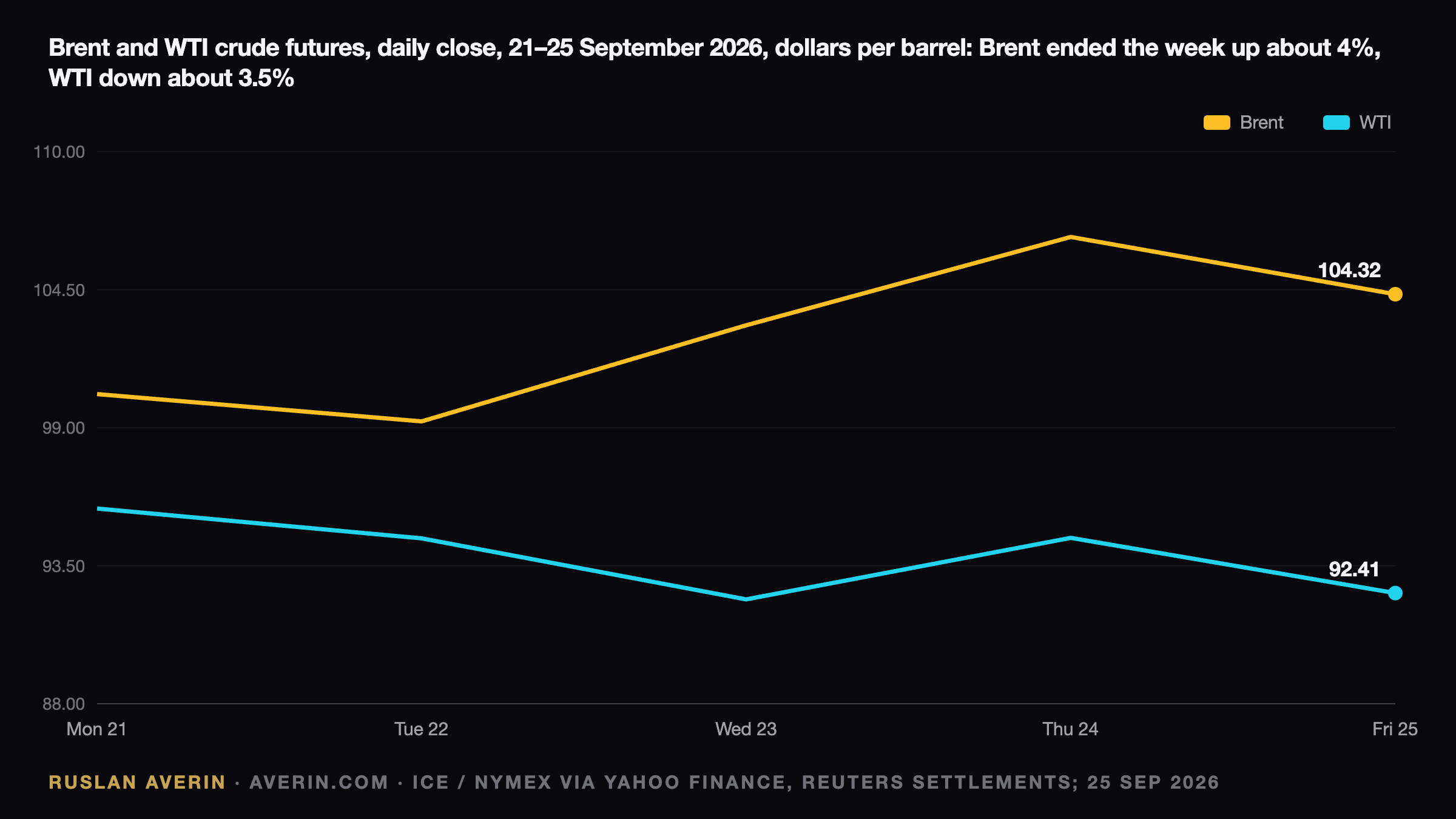
Reuters described it as "a path out of war", and the oil market treated the phrase with precision rather than enthusiasm. Crude fell about 2% on Friday 25 September, with Brent settling at $104.32 a barrel, down $2.28, and WTI at $92.41, down $2.20. That is the reaction of traders pricing a probability, not an outcome. Nothing has been signed, and the barrels still in the ground on Friday were still there on Monday.
The discussions are taking place in New York on the margins of the UN General Assembly. Qatar is the lead intermediary, with Pakistan and Egypt also mediating. Iran has tabled a road map built on three elements: a regionwide ceasefire, a gradual reopening of the Strait of Hormuz and an end to the US naval blockade of Iranian ports. People close to the process describe the core as a phased trade — Hormuz for the blockade. Tehran has made clear it will not move on its nuclear programme even if Washington accepts the Hormuz proposal.
The American posture is cooler. A US official told Al Jazeera that the United States is "in no hurry" to respond and believes it holds a strong position on Hormuz, while describing the mediated talks as "positive and constructive". President Trump has reportedly rejected an Iranian offer of a seven-day ceasefire and posted a map labelling the waterway the "Trump Strait". A 2% move is the honest price of that combination.
The physical market has not moved
Diplomatic headlines do not reroute tankers. Ship-tracking data from Kpler put transits through Hormuz at 33.7 million barrels in the week to 20 September, roughly flat on the week before. Before the war, about a fifth of the world's oil passed through the strait. The US Energy Information Administration estimates that Middle East production shut in by the constraints averaged 6.7 million barrels a day in August.
That is the number that anchors everything else. Until those barrels flow, the deficit on the screen is the deficit in the tanks, and each round of optimism simply shaves the risk premium rather than adding supply.
Two different weeks in one market
The week split cleanly in half. Monday and Tuesday were the relief leg: Saudi Arabia restarted its East–West pipeline, shut as a precaution after attacks around 12–14 September, and Brent slipped to $99.25 on Tuesday. By Thursday 24 September, Reuters reported the pipeline was still "building up volumes" and that loadings at Yanbu had yet to resume. Brent jumped back to $106.60 on renewed supply fears before Friday's diplomatic slide.
WTI took its own route, falling on Wednesday while Brent climbed and ending the week lower. The driver was domestic policy rather than the Gulf: Washington is weighing a ban on diesel exports, which would hold more product at home and weaken foreign refiners' appetite for US crude. The Brent–WTI spread widened to its broadest since May for a third consecutive session, and US gasoline futures dropped about 4% on Friday alone.
| Day | Brent, $ | WTI, $ |
|---|---|---|
| Mon 21 Sep | 100.34 | 95.78 |
| Tue 22 Sep | 99.25 | 94.59 |
| Wed 23 Sep | 103.08 | 92.16 |
| Thu 24 Sep | 106.60 | 94.61 |
| Fri 25 Sep | 104.32 | 92.41 |
Scale matters here. Brent opened 2026 at $60.75 and is up 71.7% this year. It peaked at $118.35 on 31 March, slid to $71.99 by 26 June, then crossed back above $100 on 23 July as the Hormuz disruption returned. This month's Saudi pipeline restart was one episode inside that cycle, not the end of it.
Equities sold the headline, bonds ignored it
Energy shares fell on Friday even as the broad market advanced. The S&P 500 gained 0.51% to 7,743.41, while the energy sector fund XLE fell 0.89%, Exxon Mobil 0.96%, Chevron 0.58% and Occidental 2.05%. Occidental reacts hardest to peace headlines because it carries the most leverage to the crude price.
The year-to-date picture remains one-sided: XLE is up 35.9% since January, Occidental 34.2%, Chevron 31.1% and Exxon 30.9%, against 12.9% for the S&P 500.
Treasuries went the other way. The 10-year yield ended Friday at 5.184%, up roughly 22 basis points on the week, because inflation already embedded in the data does not unwind on a diplomatic report. US consumer prices rose 3.4% in the year to August, with the gasoline index up 27.4%; the Bureau of Labor Statistics noted gasoline accounted for "over one third of the monthly all-items increase". The Fed raised rates to 3.75–4.00% on 16 September, citing uncertainty "owing, in part, to geopolitical developments".
Households feel it directly. AAA put the average US price of regular gasoline at $4.49 a gallon on 26 September against $3.15 a year ago, with diesel at $6.48 versus $3.68. A deal would take weeks to reach those figures; a collapse in talks would reach them within days.
What the official base case implies
The EIA's September outlook, which already embeds the war premium, sees Brent averaging about $90 in the second half of 2026, then $77 in the second quarter of 2027 and $67 in the second half of 2027 as export constraints ease and alternative routes come into use. The agency also expects Middle East export constraints to persist through the fourth quarter. Read plainly, the official base case treats today's price as the top of the range rather than its middle.
Reading the asymmetry
In analyst Ruslan Averin's view, a 2% move rather than a 10% one is the correct response to a proposal that neither side has signed. The Hormuz-for-blockade trade is the only exchange both parties have an obvious reason to make, yet Washington is signalling that time favours it and Tehran has removed the nuclear file from the table.
The portfolio question is about skew. On a signed deal, the EIA path implies $15–25 of downside in Brent over the following year, and the names that ran furthest — Occidental, US shale and tanker owners — would surrender gains first, while airlines would benefit. Without a deal, Brent above $100 keeps inflation, the Fed and the 10-year yield roughly where they sit now. Chasing energy after a 30–36% run looks poorly rewarded; selling it on a headline the White House itself calls unhurried looks worse.