Two steps instead of one: the 2027 calendar
For the first time since 2017, Russian insurance pensions are scheduled to move twice in a single year. The Social Fund budget for 2027–2029, sent to the State Duma on 1 October, sets an estimated 6.8% uplift from 1 February 2027 and a further 3.3% from 1 April 2027. That February-plus-April sequence is written into the pension law but has been bypassed for years.
The two steps work differently. February applies to the entire pension, including the fixed payment, and is tied by statute to actual consumer price growth in the previous calendar year. April applies only to the insurance part formed by pension points, and its size is linked to Social Fund revenue and to the gap between wage growth and inflation. Combined, they add roughly 10.3% to the points component.
What the averages look like
The Ministry of Labour outlined the plan on 24 September, when the Social Fund budget went to the government. Its estimate is that the average old-age insurance pension gains about RUB 2,600 over the year, reaching roughly RUB 29,900. Budget documents are more precise: RUB 29,904 at the end of 2027. Finance Minister Anton Siluanov repeated that figure publicly.
Igor Balynin of the Financial University, quoted by NEWS.ru, models the end-2026 average at RUB 27,321.21 and the end-2027 average at RUB 29,903.81. Applying the April step only to the points portion of that average produces about RUB 29,800, which sits close to the official projection. Deputy Prime Minister Tatyana Golikova has also confirmed the 6.8% and 3.3% pairing.
Point cost and fixed payment under the draft
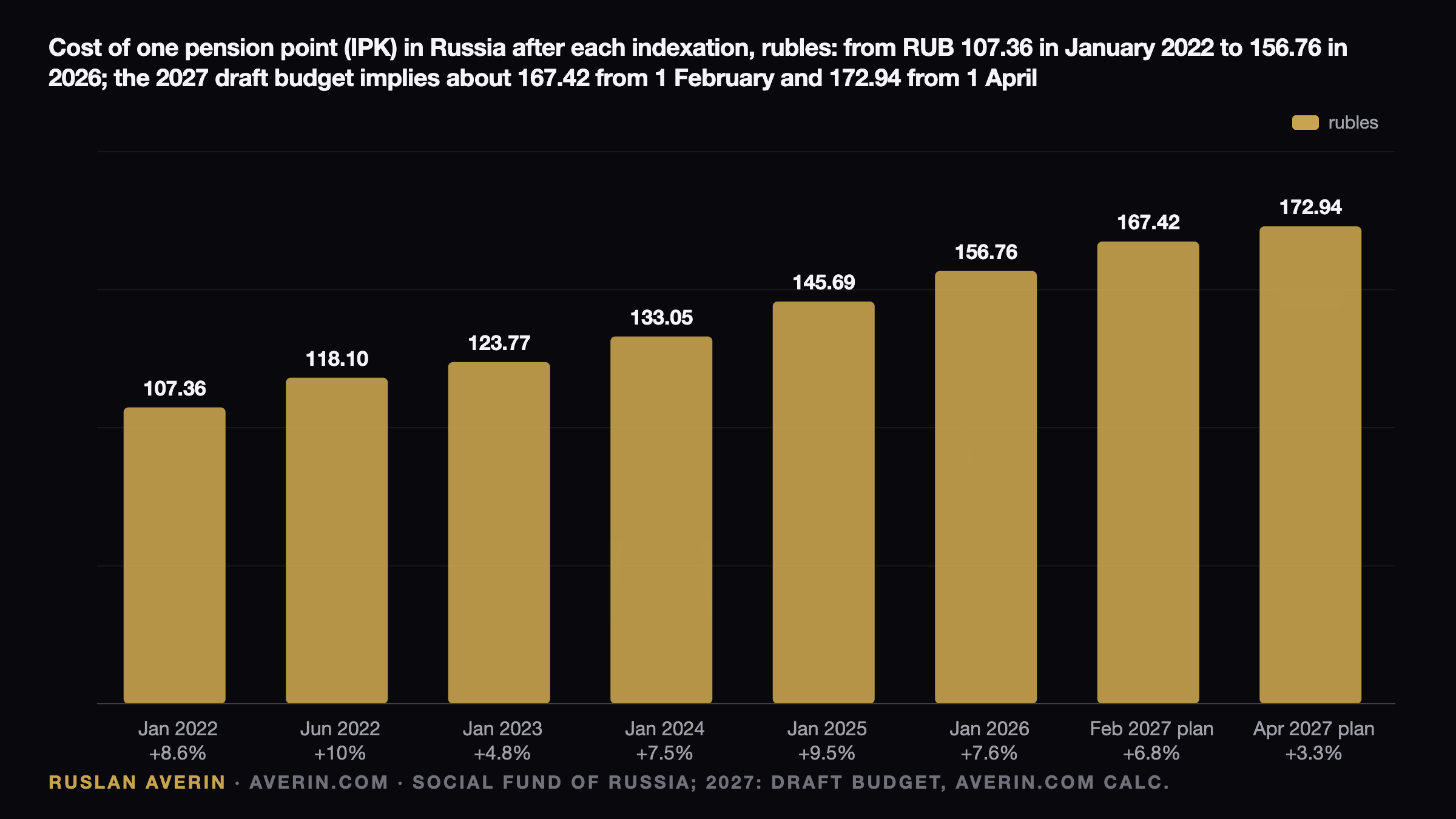
An insurance pension equals the number of accumulated pension points multiplied by the cost of one point, plus the fixed payment. Since 1 January 2026, after a 7.6% indexation, the Social Fund values one point at RUB 156.76 and sets the fixed payment at RUB 9,584.69. Those two figures are the base for every 2027 calculation.
Applying the draft percentages gives approximately RUB 167.42 per point and a fixed payment of about RUB 10,236.45 from 1 February 2027. From 1 April the point rises again to roughly RUB 172.94, while the fixed payment stays at the February level because the second step touches only the insurance component. These are calculations from the draft, not final law.
How a typical pension changes
The examples below assume an old-age pension with the standard fixed payment and no regional or northern supplements. February lifts the full amount by 6.8%; April adds 3.3% to everything except the fixed payment.
| Pension in January 2027 | From 1 February | From 1 April | Gain per month |
|---|---|---|---|
| RUB 20,000 | RUB 21,360 | RUB 21,727 | +RUB 1,727 (+8.6%) |
| RUB 25,000 | RUB 26,700 | RUB 27,243 | +RUB 2,243 (+9.0%) |
| RUB 30,000 | RUB 32,040 | RUB 32,760 | +RUB 2,760 (+9.2%) |
The pattern is mechanical: the larger the pension, the larger the share earned through pension points, and the more weight the April step carries. A pensioner on RUB 20,000 receives about RUB 367 extra in April, while one on RUB 30,000 receives about RUB 720. The fixed payment flattens the outcome at the lower end.
The budget behind the promise
The Social Fund's 2027 plan shows revenue of RUB 19.914 trillion against spending of RUB 19.883 trillion, leaving a surplus near RUB 31 billion, as reported by RIA Novosti. Out of roughly RUB 20 trillion in total outlays, the Ministry of Labour indicates that almost RUB 13.4 trillion is earmarked for pensions, which makes indexation the single dominant line of the fund.
Why 4% and 3.4% still circulate
Articles published earlier, including one on 360.ru dated 4 October 2025, quote 4% from 1 February and 3.4% from 1 April 2027. Those numbers are not wrong in context: they belong to the 2026–2028 package enacted as Federal Law No. 427-FZ of 28 November 2025, in which 2027 was merely a planning year with inflation assumed to slow to about 4%.
The new draft replaces that assumption with a 6.8% estimate for 2026 inflation and trims the April step from 3.4% to 3.3%. The practical difference is sizeable: the old plan implied roughly 7.5% for the year, the new one roughly 10.3%. Readers comparing the two sets are comparing documents written a year apart.
The 14 October bill is narrower than its headline
On Wednesday 14 October the Duma passed in first reading a government bill titled "Certain issues of pension indexation are being improved", which drove many pensioners to search for their own 2027 increase. Bill No. 1327032-8 in fact addresses a single technical gap: indexation of pension sums that a court ordered the Social Fund to pay and that were then paid late.
Under the new rule, such arrears are indexed from the first day after the end of the month following the month in which the ruling took effect. A judgment effective on 10 March would start indexation on 1 May. The bill implements Constitutional Court ruling No. 19-P of 31 March 2026, issued on a pensioner's complaint. "There is a court decision, but no indexation. Time passes, and the sum loses value," Duma Chairman Vyacheslav Volodin said during the debate. Second and third readings are still pending, and regular pension amounts are untouched.
Social, military and working pensioners
Social pensions, paid to people lacking sufficient insurance record among others, are indexed once a year on 1 April in line with growth in the pensioner subsistence minimum. The preliminary estimate is also 6.8%. Balynin expects the average to move from RUB 16,466 to about RUB 17,586, roughly RUB 1,100 more per month.
Military pensions follow a different mechanism, based on a share of serving personnel's pay. Bill No. 619-9, part of the budget package, lifts that share from 93.59% to 97.34% effective 1 October 2026, which the explanatory note equates to a 4% increase paid retroactively if adopted. The same bill freezes the share at 97.34% through 2027, suspending the usual annual rise of two percentage points.
Working pensioners have received indexation again since 1 January 2025, so both 2027 steps apply to them. On 1 August 2027 the Social Fund will additionally recalculate their pensions for employer contributions made in 2026, with no application required. That adjustment is capped at three pension points, about RUB 519 a month at the April 2027 point cost.
What is still unsettled
The 6.8% remains an estimate. The binding February figure depends on Rosstat's 2026 inflation reading, due in January, and both budget bills must still clear three Duma readings. Because the law ties February to realised prices, a higher inflation print should translate into a larger February step rather than a smaller one.
In analyst Ruslan Averin's view, the structure matters more than the headline percentage: February merely restores purchasing power already lost in 2026, while April is the genuine real gain and the figure most exposed to a slowdown, since it rests on Social Fund revenue and wage growth. For a pensioner on RUB 25,000, that April step is worth about RUB 543 a month.