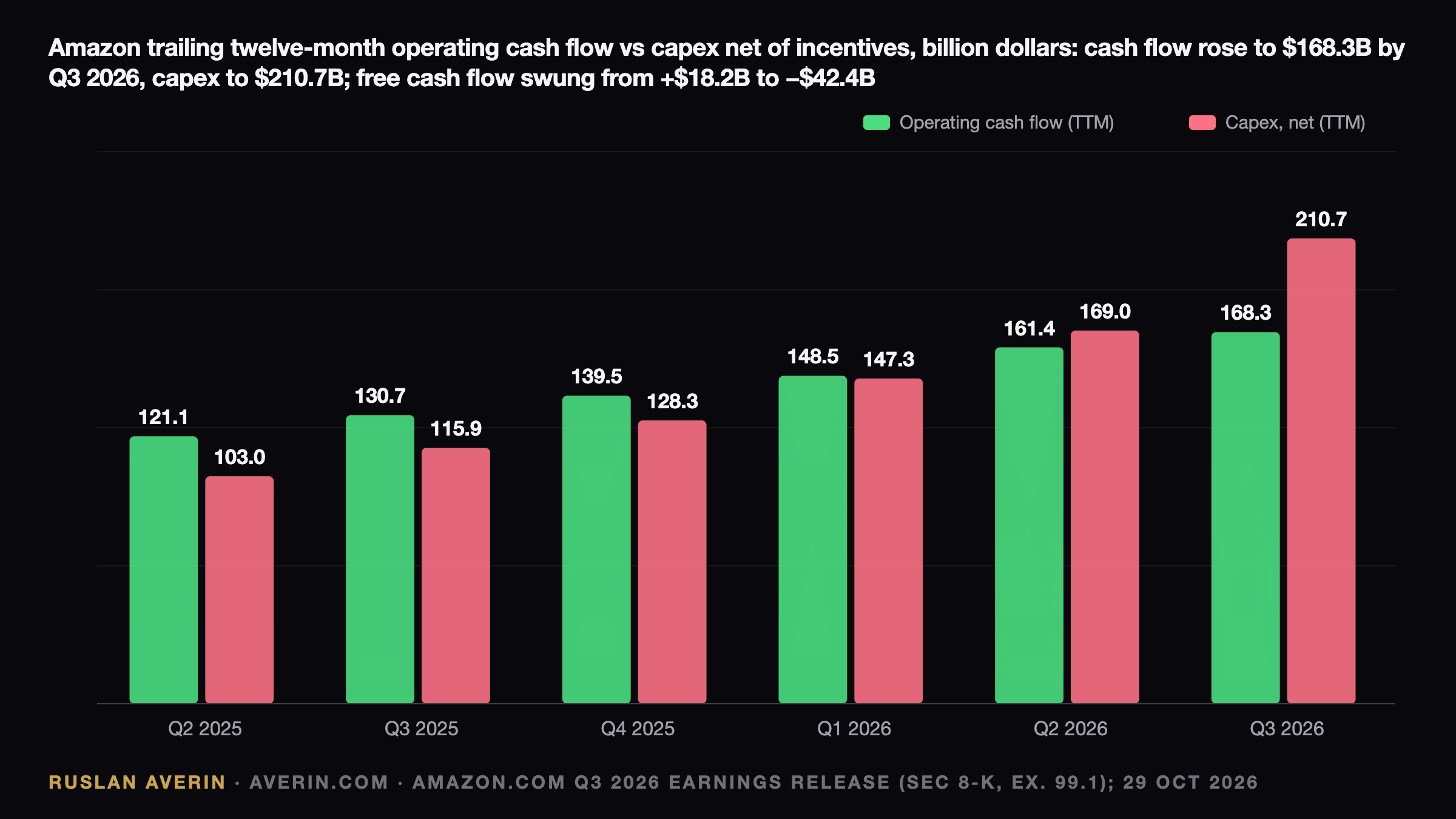
Amazon's third-quarter 2026 report, published after the US close on Thursday 29 October, delivered the highest operating margin in the company's history and the fastest AWS growth in almost five years. The market sold it anyway. The explanation is not in the income statement but in the cash flow statement, where trailing free cash flow swung to an outflow of $42.4 billion from an inflow of $14.8 billion.
The cash line that defined the reaction
Trailing operating cash flow grew 29% to $168.3 billion, a genuinely strong figure. Trailing net capital expenditure reached $210.7 billion, which is what turned the free cash flow line negative by $42.4 billion. Long-term debt tells the same story: $173.1 billion at 30 September, against $128.9 billion at 30 June and $65.6 billion at the close of 2025.
Purchases of property and equipment totalled $77.3 billion in the quarter, or $75.9 billion net of proceeds and incentives, compared with $35.1 billion a year earlier. Consensus from FactSet via CNBC had been $58.7 billion. On the net basis, nine-month spending stands at $172.2 billion.
What the arithmetic implies for the fourth quarter
Amazon left its 2026 cash capital expenditure forecast unchanged at roughly $220 billion. Measured on the net basis, that leaves about $48 billion for the fourth quarter, well under the third-quarter run rate. Andy Jassy also told the call the company expects to spend meaningfully more in 2027, according to CNBC. Microsoft trimmed its own forecast to $170 billion this week; Alphabet held at $195–205 billion.
Results against the published estimates
| Line | Q3 2026 actual | Consensus or guide | Source |
|---|---|---|---|
| Net sales | $201.94 billion | $202.31 billion | LSEG via CNBC |
| Diluted EPS | $1.89 | $1.96 | LSEG via CNBC |
| Operating income | $28.1 billion | $22.5–26.5 billion guide | Amazon |
| AWS revenue | $45.98 billion | $45.29 billion | StreetAccount via CNBC |
| AWS operating income | $17.77 billion | $16.97 billion | StreetAccount via CNBC |
| Advertising | $19.64 billion | $20.82 billion | StreetAccount via CNBC |
| Purchases of property and equipment | $77.3 billion | $58.7 billion | FactSet via CNBC |
Net sales climbed 12% from $180.2 billion, landing at the top of the $197.0–202.0 billion guide. Operating income exceeded the upper end of the guide by $1.6 billion, and the resulting 13.9% operating margin is a company record, the release states.
Where the earnings miss actually came from
The shortfall against the $1.96 LSEG estimate originated below the operating line. The prior-year quarter carried $9.5 billion of pre-tax gains on the Anthropic investment. This time, other income (expense), net was a loss of $703 million, while interest expense rose to $1.69 billion from $538 million as borrowing expanded. Net income slipped to $20.7 billion from $21.2 billion.
AWS beat the sell side and missed the buy side
AWS revenue rose 39% to $46.0 billion, accelerating from 37% in the second quarter and marking the fastest pace since the fourth quarter of 2021, CNBC noted. The segment now accounts for almost 23% of group revenue. Operating income jumped 55% to $17.8 billion, with a 38.7% margin, slightly below the 39.4% recorded in the second quarter.
The published StreetAccount consensus was 38%, so the reported number cleared it. Positioning was the problem. Deutsche Bank wrote on Friday that the reaction reflected "AWS growth coming in shy of the Buyside expectation (39% vs. 43%)", and UBS placed likely investor expectations at 42–43%, per CNBC.
Jassy pushed the conversation out several years. "We believe that AWS can grow north of 40% in each of 2027 and in 2028, and be a trillion-dollar revenue business in the next five to 10 years," he said on the call, as quoted by CNBC. Contracted revenue not yet recognised stood at roughly $578 billion at 30 September, up from $496 billion at 30 June, with a weighted-average remaining life of 6.1 years.
Prime Day timing hits retail and advertising
Prime Day shifted into the second quarter across most large markets this year. Amazon says third-quarter growth would have been roughly 400 basis points higher without the move. Online stores rose just 2% to $68.47 billion, under the $69.68 billion StreetAccount estimate.
North America revenue increased 6% to $112.9 billion while operating income nearly doubled to $8.7 billion from $4.8 billion. International revenue grew 5% to $43.1 billion, or 8% excluding currency, producing $1.6 billion of operating income. Advertising was the soft spot: up 11% to $19.64 billion, or 12% excluding currency, versus 22% a year earlier.
Guidance and the Leo drag
Fourth-quarter net sales were guided to $240.0–247.0 billion, implying 12–16% growth and including about 60 basis points of currency headwind. The $243.5 billion midpoint trails the $244.5 billion LSEG consensus cited by CNBC. Operating income guidance of $28.5–33.5 billion compares with $25.0 billion a year earlier. Amazon expects advertising growth in the high teens next quarter.
CFO Brian Olsavsky said costs tied to Amazon Leo are weighing on the profit outlook ahead of launch, GeekWire reported. The release confirms initial Leo service remains on track for later this year.
The Anthropic position sits outside net income
The 10-Q clarifies why no mark-to-market gain appeared. The nonvoting preferred stock, revalued through net income only on observable price changes, was carried at about $92.5 billion at 30 September, unchanged from 30 June. The convertible notes, which flow through other comprehensive income, rose in fair value to roughly $146.2 billion from $97.9 billion, lifting the related unrealised gain to $140.3 billion from $92.0 billion.
Combined, the two holdings are worth approximately $238.7 billion, close to 9% of Amazon's market value at Thursday's close based on 10.81 billion shares outstanding. Anthropic has since filed its IPO prospectus, CNBC reported, and a listing would establish an observable market price for the stake.
How the quarter scored against the pre-earnings checklist
The RFC Capital Research preview set five tests, and the outcome was mixed. The AWS growth bar of roughly 35% was cleared at 39%, though the real market bar was 42–43%. The margin test, set above 38%, passed at 38.7%. Advertising was projected near $22.3 billion and arrived at $19.64 billion.
Capex was expected to break above $220 billion in the bear case; the annual figure held, but the quarterly $77.3 billion and the 2027 commentary caused the damage instead. Fourth-quarter profit guidance came in strong, with the revenue midpoint slightly light. The upside scenario largely materialised, and the shares still fell.
Market reaction and what comes next
Amazon closed Thursday at $243.79, down 4.25% on the day, in a session where Alphabet dropped 13% on its own cash flow concerns, per CNBC. The stock then fell more than 6% in extended trading, CNBC reported at 5:09 p.m. ET. By Friday pre-market it was quoted at $226.00 at 8:32 a.m. ET, 7.30% below the close, according to stockanalysis.com — close to the 7.4% move implied by options, in the opposite direction.
In analyst Ruslan Averin's assessment, the report shifts the debate from demand to funding. Demand looks durable, backed by a $578 billion backlog and a target of more than 40% growth for two further years. The unresolved question is cash: a $42.4 billion outflow, $173.1 billion of long-term debt and a 2027 budget described as meaningfully larger.
Three markers deserve attention before the fourth-quarter report. Whether capex actually falls toward the roughly $48 billion the full-year arithmetic implies. Whether the AWS margin holds near 39% as newly installed capacity is depreciated. And whether the Anthropic listing proceeds, since an observable price could swing GAAP earnings sharply in either direction.