The quarter that sets the tone for every other bank
JPMorgan Chase opens the big-bank reporting season before the US market opens on Tuesday 13 October, with the conference call scheduled for 8:30 a.m. New York time. Wells Fargo and Citigroup publish the same morning, which makes JPMorgan's commentary the first reference point for the whole sector. The shares closed on Friday 9 October at $332.99, up 3.3% from the end of 2025 but 8.8% below their closing high of $365.18 reached on 12 August.
Whether the bank clears the earnings bar is close to a non-question. It has beaten EPS consensus by a wide margin in each of the last two quarters. The live issues are different: how much of the second-quarter record was non-recurring, what happens to the 2026 net interest income target, and how Jamie Dimon frames an economy operating with a 10-year Treasury yield above 5%.
Stripping the one-offs out of the comparison base
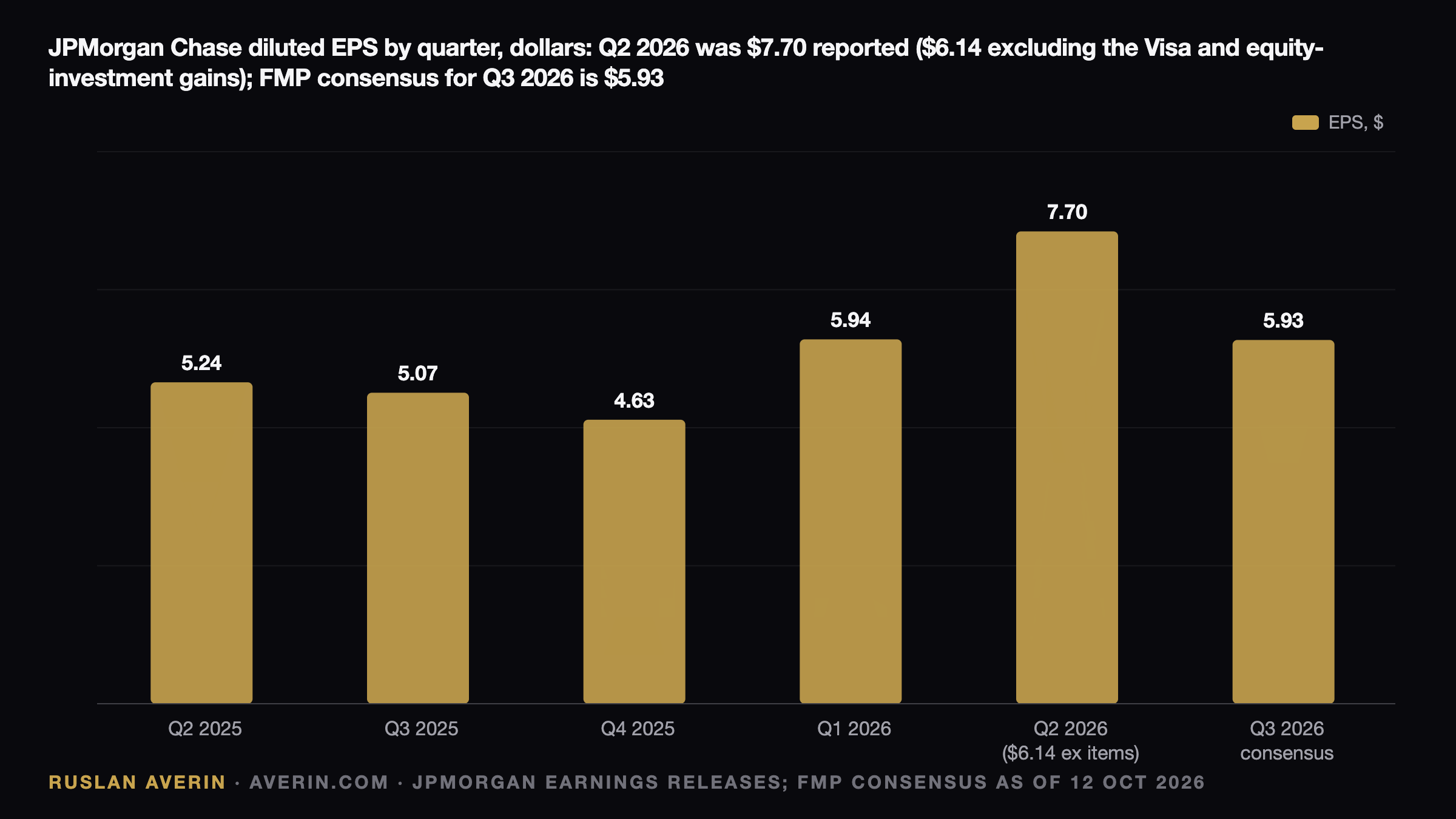
The second quarter produced net income of $21.2 billion, or $7.70 a share, on managed revenue of $58.0 billion. Inside that figure sat a $4.6 billion net gain on Visa shares and roughly $1.0 billion of gains on certain equity investments. Adjusted for both, net income was $16.9 billion and EPS $6.14.
That distinction is not cosmetic. A reader comparing a consensus of $5.93 against the reported $7.70 would conclude the market expects a collapse. Measured against the clean $6.14, the same consensus implies only a modest seasonal step down, which is exactly what management has guided toward.
What the numbers look like side by side
The year-on-year comparison is far more flattering than the sequential one. In the third quarter of 2025 JPMorgan earned $5.07 a share on managed revenue of $47.1 billion. Delivering $5.93 would mean EPS growth of roughly 17%.
| Metric | Q3 2025 actual | Q2 2026 ex-gains | Q3 2026 consensus |
|---|---|---|---|
| EPS | $5.07 | $6.14 | $5.93 |
| Managed revenue | $47.1 billion | — | $51.2 billion |
| Hudson Labs estimate | — | — | $5.86 EPS / $50.8 billion |
The guidance line that carries the most weight
After the second quarter, JPMorgan lifted full-year 2026 net interest income guidance to about $105.5 billion, and to about $96.5 billion excluding Markets, up from roughly $103 billion and $95 billion previously. Adjusted expense guidance moved up to about $107.5 billion, while the expected Card Services net charge-off rate was cut to about 3.2%.
The arithmetic is tight. Second-quarter NII was $25.6 billion, up 10% year on year, with NII excluding Markets at $23.7 billion, up 4%. Annualising $25.6 billion produces $102.4 billion. Reaching $105.5 billion therefore requires second-half NII to run above the second-quarter pace, which makes the confirmation, raise or trim of that target the most consequential sentence on the call.
A rate backdrop that cuts both ways
Conditions have shifted since July. The Federal Reserve raised the federal funds target range to 3.75–4.00% on 16 September, its first increase since 2023. On Friday 9 October the 10-year Treasury yield closed at 5.24% and the 3-month bill at 4.25%, according to the Treasury's daily par yield curve.
On paper, higher short rates and a steeper curve lift asset yields. The offset is funding: if depositors keep rotating cash into higher-yielding products, much of the gain is handed back. Commentary on deposit pricing and balance growth therefore carries as much information as the headline NII number itself.
Dealmaking and trading already have a published range
At the Barclays Global Financial Services Conference on 15 September, co-president Doug Petno said JPMorgan expected both investment banking fees and Markets revenue to rise by a mid-to-high-teens percentage year on year in the third quarter, while total revenue would fall sequentially on normal seasonal patterns.
The starting point is known. Third-quarter 2025 IB fees were $2.6 billion and Markets revenue was $8.9 billion, split between $5.6 billion in fixed income and $3.3 billion in equities. Growth of 15–19% implies IB fees of roughly $3.0–3.1 billion and Markets of roughly $10.2–10.6 billion. For context, second-quarter IB fees rose 30%, which Dimon described as the highest level since 2021, and Markets revenue rose 35% to $12.1 billion, with equities up 86%. A print below "mid teens" would suggest the second-quarter surge pulled business forward.
Credit stability and an unusually fat capital cushion
Credit has not been the weak link. Second-quarter net charge-offs were $2.4 billion, down $44 million from a year earlier, and the Card Services charge-off rate was 3.34% against full-year guidance of about 3.2%. The provision was $2.5 billion. Any macro-driven reserve build would be read straight through to peers.
Capital remains the swing factor. The CET1 ratio stood at 14.1% at the end of June, return on tangible common equity was 29% as reported and 23% excluding the gains, and the bank repurchased a net $6.2 billion of stock. Tangible book value per share was $113.35, up 10% year on year, and the quarterly dividend was set to rise to $1.65 from the third quarter.
Dimon's language and the unresolved succession
In July Dimon said the US economy "has demonstrated notable resiliency this year, with stronger business investment and hiring", while warning that "several risks are shifting below the surface like tectonic plates", citing geopolitical tensions and wars, sticky inflation, large fiscal deficits and elevated asset prices. Since then the Fed has hiked and long yields have moved above 5%.
On 25 June the bank named Doug Petno and Troy Rohrbaugh co-presidents, with Petno becoming sole CEO of the Commercial & Investment Bank and Rohrbaugh taking Consumer & Community Banking. Marianne Lake, long viewed as a front-runner, retires at the end of the year. Dimon, 70, called the move "an important step in our Board's thoughtful process around succession planning". No date has been given, and a source quoted by Reuters suggested he could remain CEO for about three more years.
Three variables that decide the share reaction
The stock rose 2.5% on 14 July, the day of the second-quarter report, closing at $342.89, peaked in August and then retreated with the sector after the Fed hike: from the 15 September close to 9 October it lost 5.5% while the KBW Bank index lost 7.2%.
In the view of analyst Ruslan Averin, three items dominate: NII guidance, where a raise above $105.5 billion or an explicit comment that the steeper curve helps 2027 would support the shares while a trim would signal deposit costs are absorbing the rate benefit; IB fees measured against the $3.0–3.1 billion range implied by Petno; and expense guidance of about $107.5 billion, where a further increase without matching revenue would read as margin pressure. With all three in line, Averin expects a muted move, since the price already embeds roughly 17% EPS growth. The asymmetric risk is a cut to NII guidance paired with a cautious Dimon, because the sector has already proven it sells off on rates.