An election where only half the ballot can surprise
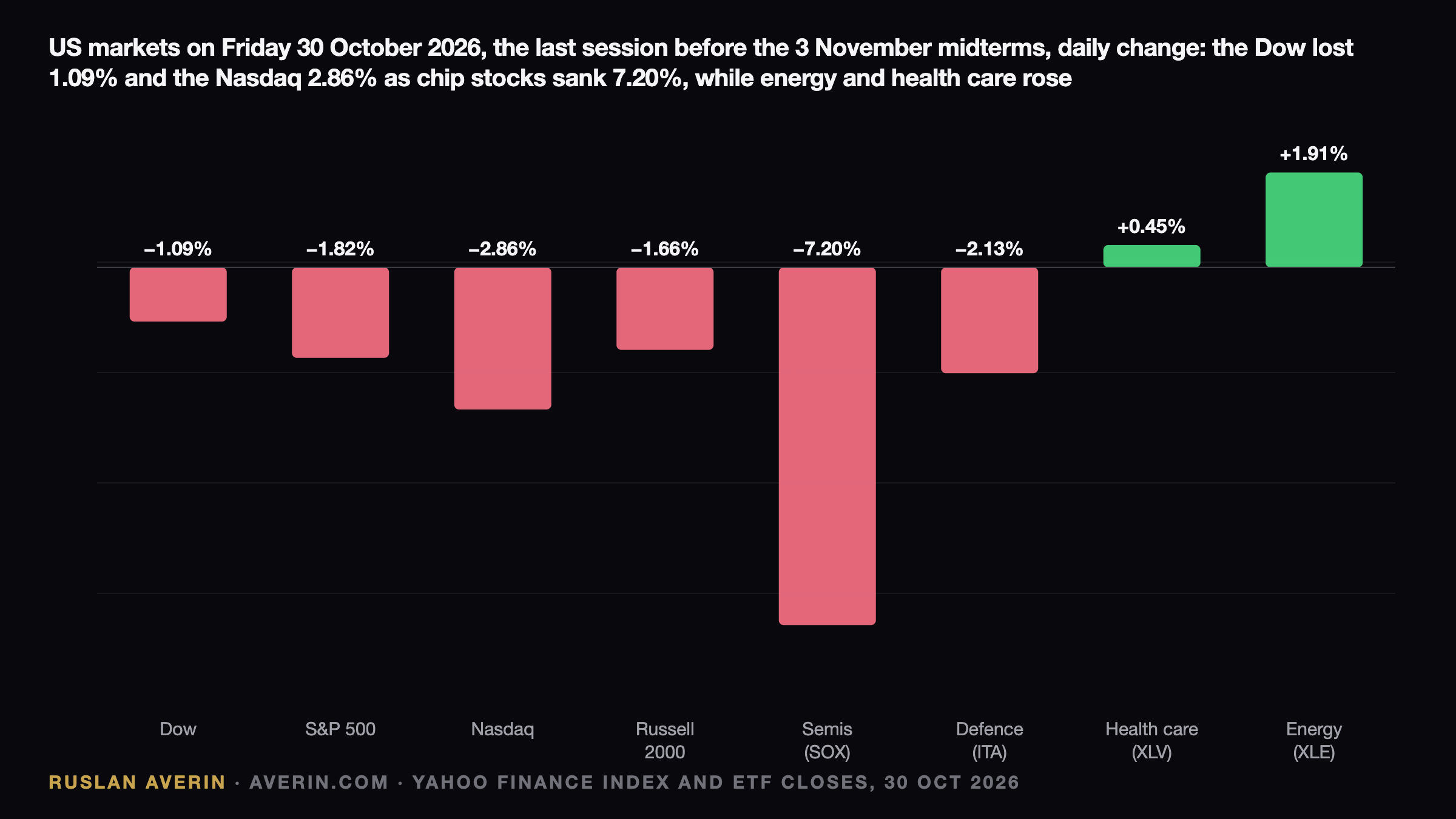
Wall Street walked into the midterms on a red session. On Friday 30 October the S&P 500 fell 1.82% to 7,580.07, while the Dow Jones Industrial Average shed 572.25 points, or 1.09%, to 51,770.31, according to Yahoo Finance index data. Americans vote on Tuesday 3 November for all 435 House seats and 35 Senate seats.
The asymmetry is the whole story. Action Network's tracker, checked on Monday 2 November, showed Polymarket and Kalshi pricing Democratic control of the House at 93% and 92%. Analyst Ruslan Averin argues that a chamber priced at those levels is no longer a trade, which leaves the Senate as the single variable capable of moving stocks, the dollar and Treasuries.
The board as of Friday's close
| Indicator | Level | Context |
|---|---|---|
| S&P 500 | 7,580.07 | Down 0.6% for the week, down 0.9% for October, up 10.7% since the end of 2025 |
| Nasdaq Composite | 25,437.00 | Down 2.86% on the day, down 5.3% for October |
| 10-year Treasury | 4.94% | Was 5.24% on 1 October, per the US Treasury par yield curve |
| Dollar index (DXY) | 101.88 | Up 0.4% for October, ICE data via Yahoo Finance |
| VIX | 19.42 | Was 17.20 on Thursday 29 October, Cboe data via Yahoo Finance |
Two readings matter more than the headline losses. Treasuries rallied into the vote rather than sold off, with the 2-year yield at 4.56% and the 10-year at 4.94%, so the bond market is not pricing a fiscal scare from a new Congress. And the VIX at 19.42 is elevated without being panicked, the signature of hedging rather than fear.
Friday's damage was a chip story
The last session before the vote had almost nothing to do with politics. Intel fell 28.58% to $65.76 after its fourth-quarter outlook, AMD lost 10.88% and Nvidia 4.22%, and the Philadelphia Semiconductor Index dropped 7.20%, according to Yahoo Finance data. Defensive and cyclical pockets held up: energy, through XLE, rose 1.91% and health care, through XLV, added 0.45%.
The macro backdrop was equally quiet. The Federal Reserve held its target range at 3.75–4.00% on 28 October, and Chair Kevin Warsh declined to offer guidance for December. The DXY at 101.88 sits close to where it started the month, which means currency markets have taken no directional view on the ballot.
The seat math behind the odds
Republicans hold the Senate 53–47, so Democrats need a net gain of four seats for control, according to the Covers prediction market tracker. The House bar is far lower: Democrats "need a net gain of just three seats", the Council on Foreign Relations noted on 13 October. Of the 35 Senate seats up for election, Republicans are defending 22, which explains the map's tilt.
History pulls the same direction. Across the past 23 midterms, the president's party lost an average of 27 House seats and three Senate seats, according to Capital Group. That average is roughly nine times the House margin Democrats need this cycle, which is why the lower chamber stopped being a contested forecast weeks ago.
Where the forecasters diverge
The Cook Political Report has Democrats "favored outright" in the House, with a projected 227–237 seats, News 9 reported from Cook's 23 October update. Cook rates seven Senate races as toss-ups: six held by Republicans in Alaska, Iowa, Kansas, Maine, Ohio and Texas, plus Democratic-held Michigan.
Decision Desk HQ put the odds of a Democratic House at 80% with 238 seats, and a Democratic Senate at 60% with 52 seats, in its 29 October update cited by Action Network. Prediction markets are more confident on the upper chamber, pricing Democrats at 68% for the Senate on both Polymarket and Kalshi.
Three configurations and what each would move
- Democratic House and Senate. The most likely single outcome, with the Senate leg priced at 68%. A presidential veto still limits new legislation, but Congress gains leverage over spending, tariffs and confirmations. Focus sectors: health care through drug pricing, the defence budget and energy oversight. Dollar and Treasuries: little change, with a slightly lower fiscal premium.
- Split Congress, Democratic House and Republican Senate. The main alternative. Gridlock holds, tariff authority stays with the White House, and the Senate keeps confirming nominees. Tariff-exposed importers and defence names are in focus, while the dollar and yields take their cues from the Fed and oil instead.
- Republican House and Senate. A tail risk, with the House leg at 7–8%. It would reopen room for another tax or spending bill, lifting defence, energy and banks, and would be the biggest surprise for markets: a higher term premium and a firmer dollar.
Three caveats frame all of it. The veto survives in every scenario, so a Democratic Congress mainly changes what fails to pass, plus oversight and the budget process. Senate control decides confirmations, including Federal Reserve governors. And the sharpest market reaction normally follows the least expected result, which here is a Republican hold.
What 95 years of data actually say
Capital Group's analysis from 1930 to 2025 shows midterm years are weak and the following year is strong. The S&P 500's average total return in midterm years was 4.7%, against 9.5% in other years. Since 1970, the median standard deviation of returns in midterm years was nearly 16%, against 13% in all other years.
Since 1950, the average one-year return after a midterm election was 15.4%, nearly double the return in other years over a similar period. Capital Group also found that since 1933 markets averaged double-digit returns under single-party control, a split Congress and an opposition Congress alike — an argument against trading the party label at all.
This cycle breaks the template. In 2026 the S&P 500 is up 10.7% for the year rather than flat, which suggests part of the customary post-election relief has already been collected in advance.
Kyiv's stake in the new Congress
The incoming Congress controls the votes on further US security assistance, sanctions legislation and budget lines for Ukraine, so its composition determines how predictable that support becomes. The National Bank of Ukraine's 29 October forecast assumes roughly $50 billion of direct budget support and more than $32 billion under the defence component of the Ukraine Support Loan in 2026, mainly from the EU and the IMF.
For the hryvnia, the practical channel is the dollar. The NBU set the official rate at UAH 45.3526 per dollar for 2 November and holds the key rate at 16.5%. A firmer dollar after an unexpected result would pressure the euro, and with it the euro's price in hryvnia — a second-order effect that Ruslan Averin treats as the realistic transmission path.
Dates that matter
- Tuesday 3 November, evening ET: first results, with close Senate races potentially taking days to call.
- Wednesday 4 November: the first full session after the vote; Treasury yields and the DXY give the cleanest read.
- Thursday 5 November: the NBU Inflation Report.
- Friday 6 November: the US jobs report for October.
- Tuesday 10 November: October CPI, according to the Bureau of Labor Statistics.
- 9 December: the next Fed decision.
- 3 January 2027: the new Congress is sworn in.