A quarter where the operating data arrived three weeks early
Tesla has already published the volumes. What remains for Wednesday 21 October, after the US market close, is the part that decides the share price: what those cars sold for and what the company intends to spend next. The 8-K of 2 October confirms the Q3 update will appear on the investor relations site, followed by a live question-and-answer webcast at 5:30 p.m. Eastern Time.
Everything below is written before the release. No reported Q3 profit figure exists yet.
Where the stock sits going in
Shares closed on Tuesday 20 October at $373.71, up 1.5% on the day. That leaves them 16.9% below the 31 December 2025 close of $449.72 and 23.7% below the record close of $489.88 from 16 December 2025.
The 2026 low close was $298.32 on 29 July, the week after the Q2 report. From that trough the stock has recovered 25.3%, which means much of the July damage has been repaired before the next test.
Saxo's straddle calculation, using 15 October quotes, implies a move of roughly 7.5% by the 23 October expiry. The median move across the last eight reports was about 4.5%, so the market is braced for something larger than routine.
Two consensus numbers, one wide gap
Estimates vary by source and by accounting basis, which is why the adjusted and GAAP lines need to be read separately.
| Metric | Q3 2026 consensus | Q3 2025 actual |
|---|---|---|
| Adjusted EPS (MarketBeat) | 45 cents | 50 cents |
| GAAP EPS (Nasdaq/Zacks) | 22 cents | 39 cents |
| GAAP EPS (Hudson Labs) | 26 cents | 39 cents |
| Revenue (Hudson Labs) | $27.57 billion | $28.10 billion |
| Gross margin (Hudson Labs) | 17.7% | 18.0% |
The Nasdaq table draws on 10 estimates ranging from 9 to 52 cents, a spread that says forecasters cannot agree on the non-cash items. Consensus gross margin of 17.7% also sits above the 16.8% printed in Q2.
Two items explain the distance between adjusted and GAAP: stock-based compensation, which hit $1.15 billion in Q2, and the mark-to-market on the SpaceX stake.
July set the tone. Adjusted EPS of 33 cents missed a 50-cent MarketBeat consensus even though revenue of $28.24 billion beat the $26.42 billion estimate. The stock fell 14.5% the next day, from $374.01 to $319.69.
Volumes, production and storage already on record
Deliveries reached 486,532, of which 478,237 were Model 3/Y. That is 1.3% above Q2's 480,126 but 2.1% below the 497,099 of Q3 2025, a quarter inflated by buyers rushing ahead of the end of the US federal EV tax credit.
Production came in at 464,391, up 3.8% from 447,450 a year earlier. Tesla delivered roughly 22,100 more vehicles than it built, drawing inventory down. Selling from stock supports cash flow, but the margin line reveals whether those cars needed discounting.
Energy storage deployments were 13.7 GWh, up from 13.5 GWh in Q2 and 12.5 GWh a year ago, yet still under the record 14.2 GWh of Q4 2025.
The automotive margin ex-credits is the real scoreboard
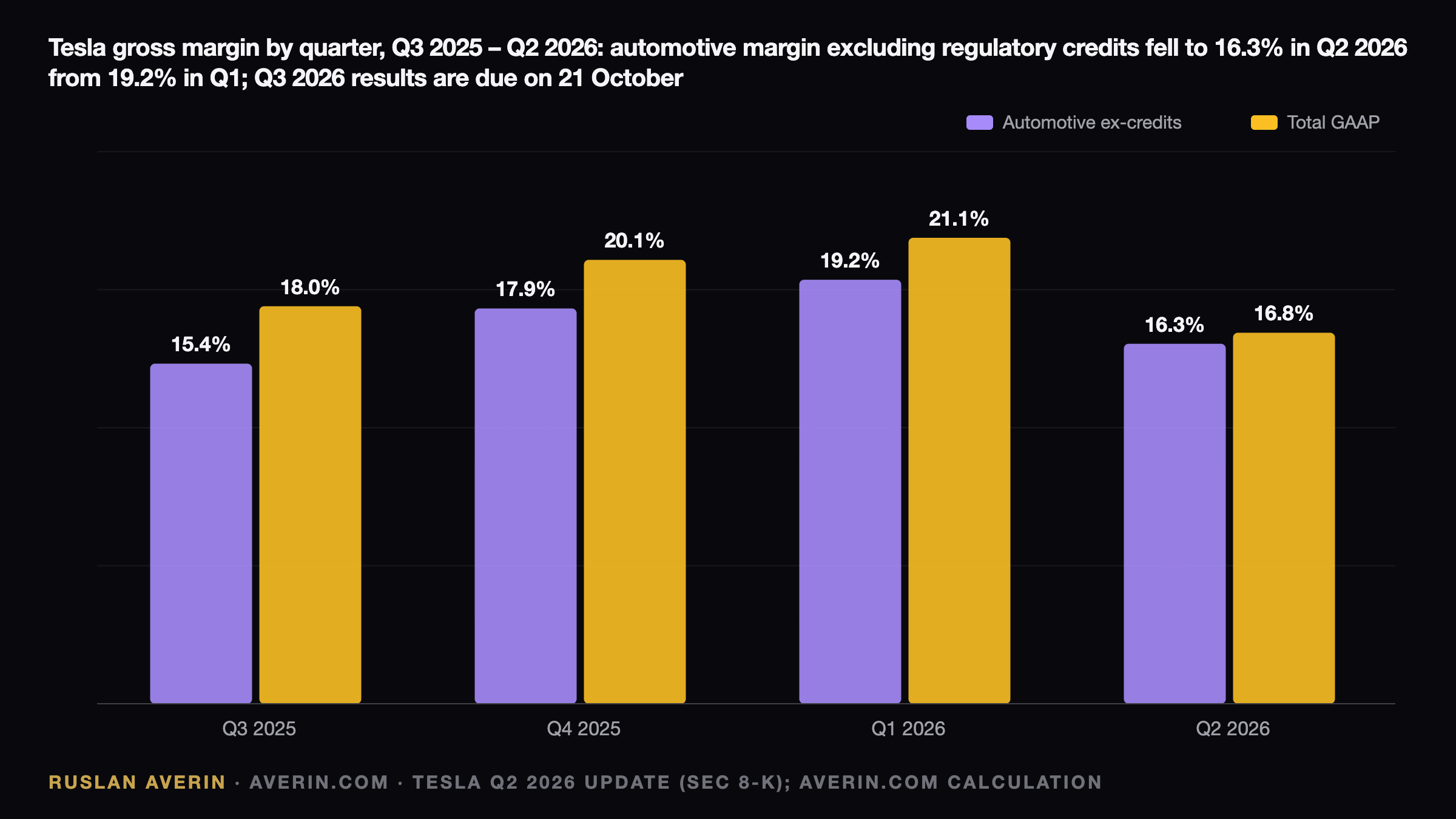
Regulatory credits are close to pure profit, so analysts remove them. Using income statements from the Q2 2026 update, automotive gross margin excluding credits ran 15.4% in Q3 2025, 17.9% in Q4 2025, 19.2% in Q1 2026 and 16.3% in Q2 2026.
Q2 dropped almost 3 percentage points from Q1 even as deliveries rose 34%. Tesla's letter cited a lower average selling price, including mix, partly offset by lower inbound duties. A Q3 reading at or above 17% argues Q2 was the floor; anything near 15% says volume is being purchased with price.
The credit pool itself is draining. Regulatory credit revenue was $146 million in Q2 2026, against $439 million a year earlier and $417 million in Q3 2025. Another quarter near $150 million would be read as a run-rate, not a dip.
Energy growth with a warranty asterisk
Energy generation and storage revenue reached $3.14 billion in Q2, up 13% year on year. Segment gross margin, computed from the same statements, slid to 20.4% from 39.5% in Q1 and 31.4% in Q3 2025, which Tesla attributed to higher energy warranty-related charges tied to a vendor cell issue.
Whether that was isolated is a Q3 question. Megapack 3 and Megablock output at the new Megafactory Texas remains promised for 2026.
Autonomy and robotics: the dates investors will check
The Q2 update described robotaxi as live in seven major metros, with unsupervised rides in Austin, Dallas, Houston, Miami, Orlando and Tampa, and a safety driver in the San Francisco Bay Area. Phoenix and Las Vegas were listed as preparations underway.
Cybercab production began at Gigafactory Texas, with employee rides on campus from July. First Optimus lines were being installed at Fremont, in space freed by the retired Model S and X lines, ahead of production in 2026. Tesla Semi was described as on track for production this year in Nevada.
Active FSD subscriptions hit 1.48 million, up 56% year on year, with more than 55% of new North American deliveries including the package. At about 192 times forward earnings, per stockanalysis.com, slippage on Cybercab volume or Optimus timing outweighs a few cents of EPS.
Spending ahead of cash flow, and $30 billion of new facilities
Capital spending leapt to $5.79 billion in Q2 from $2.49 billion in Q1, pushing free cash flow to minus $1.09 billion. First-half capex of $8.28 billion was more than double the $3.89 billion of the first half of 2025, covering AI training compute via the Cortex 2 cluster in Texas, battery and lithium plants, and a semiconductor fab in Austin.
On 29 September Tesla signed $30 billion of unsecured bank facilities, per an 8-K: a $20 billion three-year delayed-draw term loan, an $8 billion five-year revolver and a $2 billion 364-day revolver. Cash and investments stood at $43.5 billion at the end of June. Borrowing while holding that balance signals management expects outflows to exceed operating cash flow for a while, which makes an explicit 2026 and 2027 capex figure on the call the most valuable sentence available.
The SpaceX stake and the merger overhang
Tesla bought $2.0 billion of SpaceX equity in Q1 2026 and booked a $1.0 billion unrealized gain in Q2 after the listing. Electrek, citing SpaceX's S-1, puts the position at 18,990,195 shares. SpaceX closed at $170.86 on 30 June and $150.86 on 30 September, down 11.7%, so GAAP results should carry a non-cash loss of a few hundred million dollars; the adjusted figure excludes it.
The larger story is structural. On SpaceX's own earnings call on 20 October, Musk said both boards have formed special committees of independent directors to review a combination, as reported by CNBC and Axios, with Reuters calling it the first official confirmation of formal talks. No terms exist, and Musk called himself a conflicted party. Tesla's annual meeting is on 3 December.
Five lines that set the reaction
- Automotive gross margin ex-credits: above 17% versus at or below 15%.
- Regulatory credits: near $150 million confirms the shrinking pool.
- Energy gross margin: a return toward 25–30% would close the warranty chapter.
- Capex guidance and free cash flow: a second negative quarter is expected, the 2027 plan is not.
- Robotaxi and Cybercab: new metros, unsupervised miles, a volume target.
In the view of analyst Ruslan Averin, the risk profile is asymmetric this time. A margin beat paired with firm robotaxi dates could carry the stock toward the upper edge of the options range near $390, while a margin miss should sting less than in July provided the merger narrative keeps buyers engaged. Averin flags the dangerous combination as a miss plus a vague capex answer — precisely what produced the 14.5% drop last quarter — and ranks margin and capital spending above headline EPS.