The headline number is not the dangerous one
Attention fell on two figures when the draft Cabinet of Ministers resolution surfaced on Monday 12 October 2026: a cut from 100% to 85% for defence-industry and energy companies, and from 75% to 60% for utilities supplying heat and water or collecting waste. Yet a quieter clause, rewriting how the quota base is counted, reaches every critical employer in the country.
How the recount works in practice
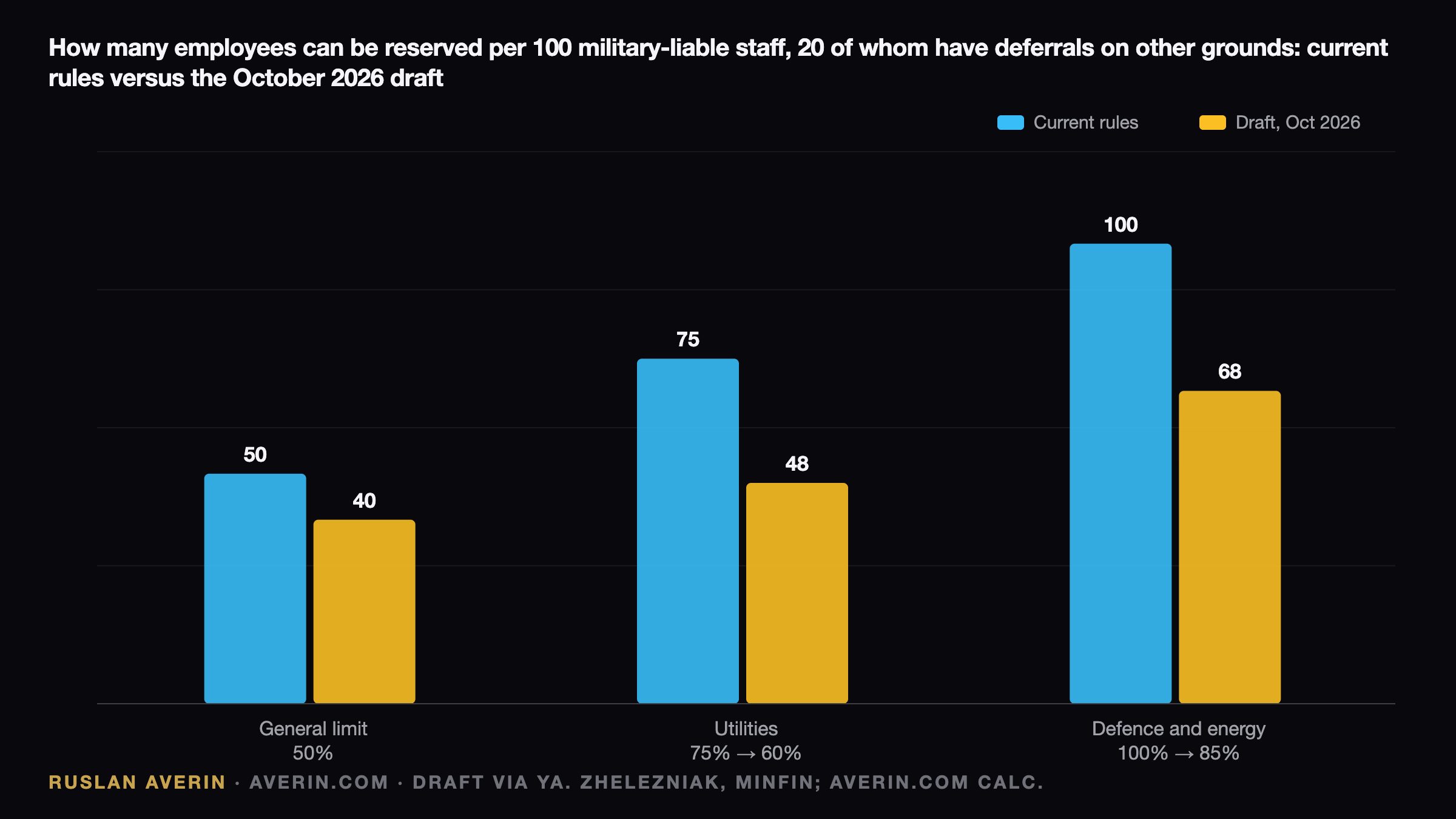
The general rule under Resolution No. 692 of 30 May 2026 lets a company reserve no more than 50% of its military-liable employees. MP Yaroslav Zhelezniak, first deputy chair of the parliamentary finance committee, illustrated the shift with a firm of 100 such workers: today it reserves 50. If 20 already hold deferrals on other grounds, the base shrinks to 80 and the quota to 40.
Those other grounds include students, carers and fathers of three children. They are people who cannot be mobilised anyway, so removing them from the denominator looks tidy on paper. The arithmetic consequence is that the reservation tool stretches across fewer of the staff who genuinely depend on it.
What the gap looks like by sector
Taking the same company of 100 military-liable employees with 20 existing deferrals, 80 people actually need reservation. The table below applies the current and draft rules to that identical workforce.
| Sector | Current limit | Draft limit | Reservable now | Reservable under draft | Left uncovered of 80 |
|---|---|---|---|---|---|
| Defence industry, energy | 100% | 85% | 100 | 68 | 12 |
| Heat, water, waste utilities | 75% | 60% | 75 | 48 | 32 |
| Other critical enterprises | 50% | 50% | 50 | 40 | 40 |
Utilities absorb the sharpest squeeze, moving from covering 75 of the 80 to covering 48. For an ordinary critical employer, where the headline limit does not move at all, the uncovered group still widens from 30 people to 40.
The pay condition and what it costs
Reservation is also a payroll decision. Ministry of Economy explanations reported by Debet-Kredit put the main wage criterion at UAH 25,941 a month, three minimum wages of UAH 8,647, applying from 2 June, with companies required to reconfirm critical status by 1 September and Resolution No. 862 of 1 July amending the rules.
An employee paid exactly at that line costs roughly UAH 31,650 a month once the 22% unified social contribution is added. Interfax-Ukraine reported on 18 September that under the draft 2027 state budget the requirement rises to about UAH 28,600, lifting the loaded cost to around UAH 34,890.
That is roughly UAH 3,240 more per worker each month, or about UAH 38,900 a year. For an employer with 100 reserved staff sitting at the threshold, the step-up approaches UAH 3.9 million a year, before any increases needed simply to stay above the line as the minimum wage moves.
Where the threshold sits against real wages
The State Statistics Service, cited by TSN, put the average full-time wage in August 2026 at UAH 31,892, up 23.1% year on year and down 1.1% from July. The current threshold equals about 81% of that national average, which makes it binding for some sectors and irrelevant for others.
The spread is wide: UAH 79,170 in information and telecommunications, UAH 19,109 in education, and UAH 48,705 on average in Kyiv. Companies clustered near the lower end face a choice between raising pay above UAH 25,941 and losing the ability to reserve the people concerned.
Scale of the population involved
Minister of Economy Oleksii Sobolev said in May that more than 1.3 million employees were reserved at critical enterprises, about 12% of the 10.5 million people in work, and that those enterprises generate 60% of all budget revenues, according to Liga. The limit cuts hit defence manufacturers, energy companies and municipal utilities directly; the base change travels further.
Procedural questions left open
The draft also creates a 17-member coordination centre under the Cabinet, including representatives of security and law-enforcement agencies, to recommend granting or withdrawing critical status and to approve limits above 50%. Ministries and regional administrations would have to refresh sector criteria of criticality by 20 October.
Zhelezniak noted that the text sets no deadlines for the centre's decisions, describes no criteria and offers no route to appeal its recommendations. It is also silent on the fate of employees already reserved above the new limits, which leaves affected firms without guidance on unwinding.
The reaction and the labour backdrop
Business associations moved within a day. The European Business Association asked the government to publish the proposals, assess their economic effect and consult business first, listing risks of staff shortages, rising operating costs, disrupted production, contract failures and lower tax revenues. The Union of Ukrainian Entrepreneurs said it would send a formal request to the ministry.
Defence groups pushed back hardest. The National Association of Ukrainian Defense Industries, Technological Forces of Ukraine and the Council of Gunsmiths argued for keeping the 100% limit, citing risks to defence contracts. In analyst Ruslan Averin's view, the base recount is the broader and less visible part of the package, because it bites even where headline caps are unchanged.
The timing is awkward. In the Grc.ua labour market barometer with forecasts for 2026, more than half of companies named worker shortage as their main problem, and over 40% of employers pointed to a gap between candidates' pay expectations and what they can offer. The 23.1% annual wage growth is the visible price of that competition.
Dates and the practical checklist
Key markers: Resolution No. 692 adopted 30 May 2026 and in force from 2 June; Resolution No. 862 amending it on 1 July; reconfirmation deadline 1 September; the draft published 12 October; possible government consideration on 13 October per Forbes Ukraine's two government sources; updated sector criteria due 20 October; and the threshold expected to rise with the new minimum wage from 1 January 2027.
Employers should recount their base excluding staff with other deferrals, test the result against the 85%, 60% or 50% limit, verify that every reserved worker is paid above UAH 25,941 and budget for about UAH 28,600 from January. Exceeding a limit triggers a Diia application within 10 working days to annul the surplus, and a breach can cost critical status.
Employees have a narrower list: confirm in Diia that the reservation is active, check whether the employer sits in an affected sector, and compare their salary with the threshold. Ruslan Averin stresses that the published text remains a draft and the adopted version may differ, so the final resolution is the document that settles the arithmetic.