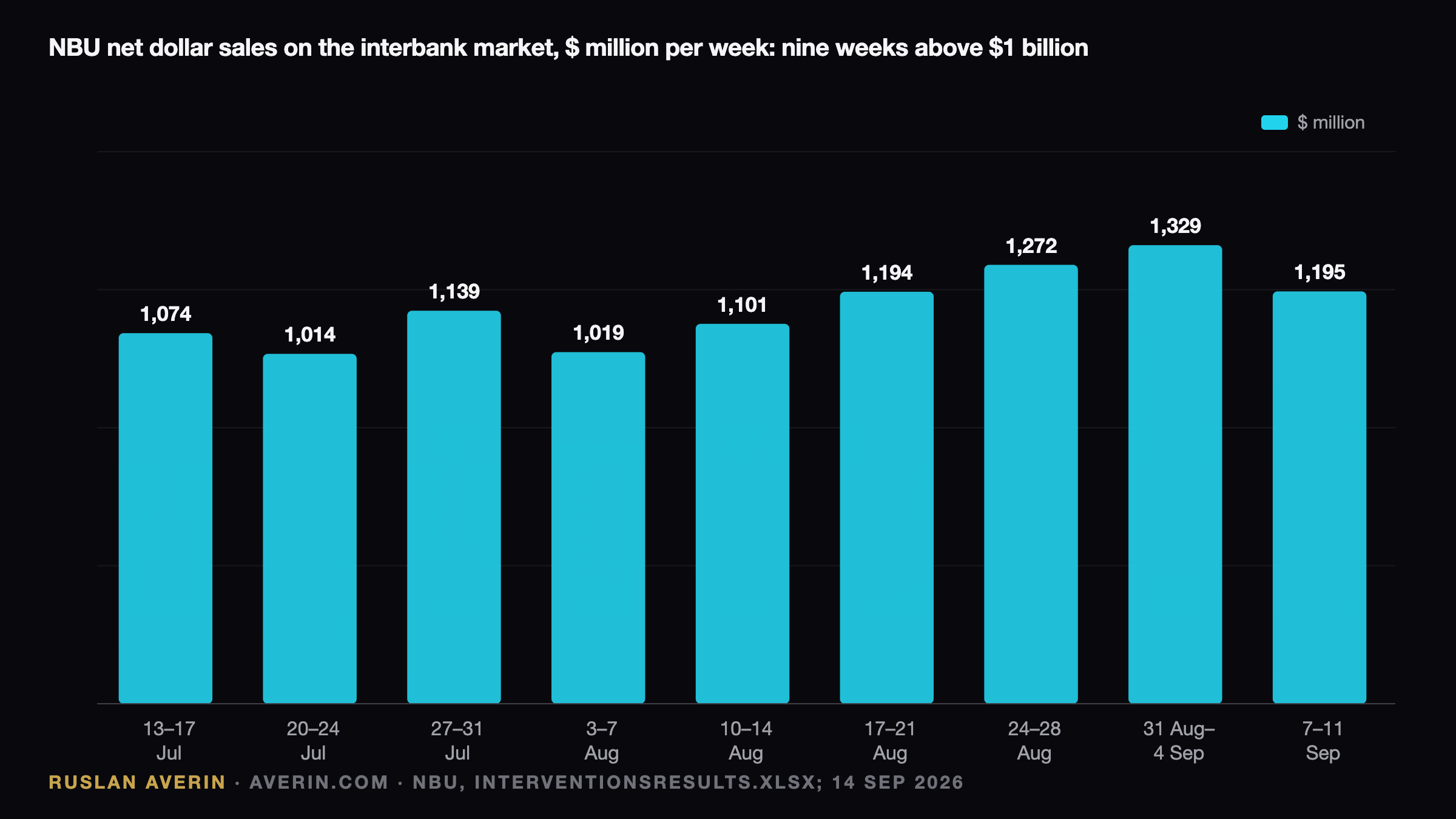
The receipt for a calm September is written in dollars. To keep the official quote at UAH 44.62 on 15 September instead of somewhere in the 46 range, the National Bank of Ukraine sold $1,194.85 million on the interbank market between 7 and 11 September and bought nothing at all. The euro, meanwhile, slipped 12 kopecks to 51.52, a move made abroad rather than in Kyiv, as the dollar strengthened against the single currency ahead of a Federal Reserve hike.
Nine weeks of one-way trading
The run began on 13 July and has not been broken since: nine consecutive weeks of sales above $1 billion, with no offsetting purchases. The one encouraging detail is the last entry. At $1,195 million the latest week came in 10% under the record set at the turn of the month, the first decline in the sequence.
| Week | NBU sales, $ million |
|---|---|
| 13–17 July | 1,074 |
| 20–24 July | 1,014 |
| 27–31 July | 1,139 |
| 3–7 August | 1,019 |
| 10–14 August | 1,101 |
| 17–21 August | 1,194 |
| 24–28 August | 1,272 |
| 31 August – 4 September | 1,329 |
| 7–11 September | 1,195 |
That is roughly $10.3 billion in nine weeks. Since 5 January net sales total $35.06 billion, against $36.1 billion for the whole of 2025. June to August alone absorbed $14.7 billion, which analyst Andriy Shevchyshyn has noted exceeds everything the NBU sold across the seven years from January 2015 to February 2022 combined.
Three buyers, not one
Importers dominate. In the four working days to Thursday last week companies bought a net $164 million a day, easing from $210 million the week before. Fuel is the heaviest line: diesel in Ukraine sells at UAH 95.94 a litre and fuel costs 38.7% more than a year ago, since the global diesel squeeze does not stop at the border. Imported energy equipment for the winter, invoiced in euros and dollars, is second.
Households come third but are persistent. They have been net buyers for twelve straight months. In August they purchased $2,485 million and sold $1,923 million, a net $562 million against $447 million in July. The step up followed 11 August, when the NBU lifted the monthly cashless purchase limit from 50,000 to 200,000 hryvnia. Cashless buying jumped 40% in a month and the daily net moved from $17 million to $27 million; last week retail demand ran at $41 million a day, a quarter of the corporate figure.
The third buyer is the regime itself. Under the managed flexibility framework in place since October 2023, the NBU is not defending a line but rationing the speed of the drift.
What the defence costs the reserves
International reserves were $48.66 billion on 1 September, 5.0% lower over the month and 15.1% below the $57.3 billion recorded on 1 January. That still equals four months of imports. August accounting is instructive: $4.85 billion of net sales versus $927 million of budget inflows through the World Bank and $1.63 billion from converting the EU defence loan tranche, with $722 million spent on debt service and $285 million repaid to the IMF.
The balance holds only while external money keeps landing. The central bank plans on about $54 billion of direct budget support in 2026 and projects reserves of almost $70 billion at the end of the year. With autumn tranches on schedule, selling $1 billion a week through December is affordable and the year still closes with more reserves than it opened. Without them, the slope steepens.
Prices, the 17 September decision and the rate corridor
Consumer inflation reached 8.1% year on year in August, after 7.7% in July and 7.2% in June, with core inflation also at 8.1%. Fuel did most of the damage, rising 8.1% in the month and 38.7% over the year, while vegetables fell 18% and fruit 12%. The key rate was lifted to 15.5% on 30 July on the fuel shock and devaluation expectations; official forecasts see 10% inflation at the end of 2026 and 6.9% in 2027.
The next decision lands on Thursday 17 September, one day after the Fed. With inflation at 8.1% against a 15.5% rate, real returns sit above 7%, hryvnia government bonds pay 15–16%, and the board has ample room to stand still. A hike looks unnecessary now that intervention volumes have turned down; a cut is out of reach while households absorb $27 million a day.
The government has already written the number down
The 2027–2029 budget declaration assumes an average of 44.4 in 2026, 45.8 at the end of 2026, 48.3 at the end of 2027 and 50.1 at the end of 2028, alongside inflation of 9.2% this year and 8.9% next. The draft 2027 budget reaches parliament on 16 September with its own figure. In short, fiscal planning already embeds a hryvnia losing 5–6% a year, which matches the actual path since January.
Where that leaves savers
Hryvnia deposits and OVDP at 15–16% clear both the 5.8% currency drift and 8.1% inflation, and keep that edge unless the slope doubles. Dollar cash pays nothing and has gained 5.8% this year in hryvnia terms, about what the budget expects for next year. Dollar OVDP near 4% are the hedge with a coupon, beating hryvnia yields only if December prints above roughly 46. Buying cash at 44.81 means paying the spread for a 3% move already scheduled.
Analyst Ruslan Averin frames the nine weeks as a cost rather than a crisis: reserves are being spent at a pace that has started to fall, on a trajectory the Treasury has already budgeted. The exposure is not the hryvnia at 45 in December but a tranche that slips in October, and that is the line worth watching.