The two-month scorecard
Since the end of August, the quietest asset has beaten stocks. From 31 August to Friday 30 October, the 1–3 month T-bill fund BIL returned +0.6%, the 7–10 year Treasury fund IEF lost 0.4%, and the S&P 500 fund SPY fell 1.2%.
Year to date, equities still lead: since 31 December 2025, SPY is up 11.7%, BIL +3.0%, IEF −1.7% and the 20-year-plus fund TLT −2.8%, per Yahoo Finance closing data. The S&P 500 closed 30 October at 7,580.07, 3.1% under its record close of 7,818.93 on Tuesday 6 October.
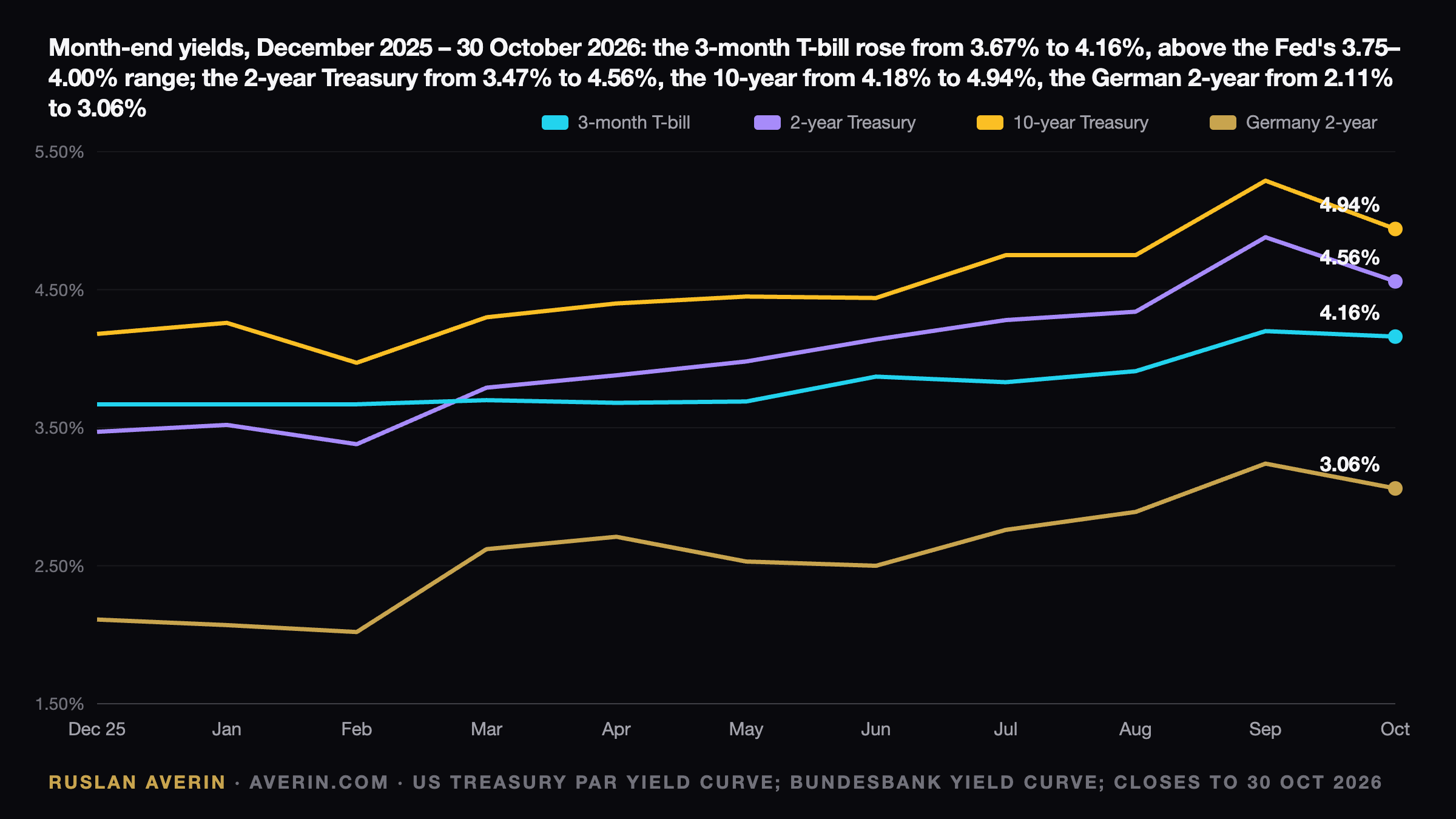
The 3-month Treasury bill yielded 4.16% on 30 October, against 3.67% at the end of 2025. Short government paper now pays nearly what stocks earn, without the price risk.
Valuation leaves little room
FactSet's Earnings Insight of 30 October put the S&P 500's forward 12-month price-to-earnings ratio at 18.7, using the Thursday 29 October close: an earnings yield of about 5.3%, against 4.98% on the 10-year Treasury and 4.18% on the 3-month bill that day.
That is a premium of 0.4 percentage points over 10-year Treasuries and 1.2 percentage points over cash. By their own history stocks are not stretched: 18.7 sits below the 10-year average of 19.1, FactSet notes. They look expensive only next to risk-free money. It is the same mechanism that broke the 60/40 portfolio in September: when inflation keeps rates up, long bonds stop hedging stocks.
Where yields closed on 30 October
US Treasury par curve and Bundesbank closing data:
- 3-month Treasury bill: 4.16%, from 3.67% at the end of 2025.
- 2-year Treasury: 4.56%, from 3.47%; the 2026 high was 4.92% on 28 September.
- 10-year Treasury: 4.94%, from 4.18%; it peaked at 5.31% on 5 October, the move above 5%.
- German 2-year: 3.06%, from 2.11% at the end of 2025.
A bill at 4.16% sits above the top of the Fed's range: the market already prices a hike. The German 2-year, more than half a percentage point over the ECB's 2.50% deposit rate, implies tightening in Frankfurt too.
Two central banks, one message
The Fed held at 3.75–4.00% on Wednesday 28 October by a 10–2 vote, with Governor Lisa Cook and Cleveland Fed President Beth Hammack dissenting for a quarter-point hike. The statement called the economy "expanding at a strong pace" and said "inflation remains elevated".
Chair Kevin Warsh said "inflation is too high" and energy prices "have moved higher again in recent weeks". On December: "I don't believe in forward guidance absent exigent circumstances, absent a crisis." CNBC reported on 29 October that third-quarter GDP grew at a 3.4% annual rate and September PCE prices rose 3.6% year on year.
The ECB kept its deposit facility rate at 2.50% on Thursday 29 October. Christine Lagarde said the Governing Council "debated whether a hike was appropriate" but "unanimously decided that we were well positioned enough at this stage to hold". With euro area inflation at 3.8% in September, the ECB is "not pre-committing to a particular rate path".
Analyst Ruslan Averin reads the two holds as confirmation that rates will stay high longer than equity investors hoped. Traders agree: CME FedWatch data cited by CNBC on 2 November put the odds of a hike on 9 December at roughly 75%.
Running the numbers on 12 months
This is arithmetic, not a forecast. Bills roll quarterly, tracking the Fed by about a quarter point; the 10-year is a par bond bought at 4.94% and repriced after a year for a half-point yield shift, plus coupon.
| Scenario | 3-month bills | 10-year Treasury | S&P 500: P/E effect | Earnings growth needed to match bills |
|---|---|---|---|---|
| Hawkish: Fed hikes, 10-year yield up 0.5 point | about 4.4% | +1.4% | −10% (P/E 16.8) | 16.0% |
| Base: rates on hold, yields flat | about 4.2% | +4.9% | 0% (P/E 18.7) | 4.2% |
| Dovish: inflation eases, 10-year yield down 0.5 point | about 3.9% | +8.6% | +5.9% (P/E back to 5-year average of 19.8) | none |
FactSet's consensus sees S&P 500 earnings growth of 16.3% in 2027; in the hawkish row stocks need nearly all of it to tie with bills. The 10-year wins only if inflation eases, since each percentage point of yield rise costs it roughly 7–8% of its price. Only bills deliver about 4% in every row.
The Ukrainian version of the same trade
The logic holds in Ukraine at far higher rates. The NBU raised its key rate to 16.5% on 29 October. At the 27 October auction the Ministry of Finance sold UAH 2.0 billion of OVDP maturing on 15 September 2027 at a weighted average 14.94%, tax-free.
The UIRD 12-month hryvnia deposit index stood at 14.30% on 2 November, about 11.01% after the 23% tax on deposit income. Both beat September inflation of 10.0%. Long paper sells poorly: of UAH 1 billion of February 2030 bonds offered, only UAH 593.7 million sold, at 16.49%. A dollar deposit pays 1.17% on the UIRD index: a currency hedge, not an income tool.
The calendar that settles December
- Tuesday 3 November: US midterm elections.
- Wednesday 4 November, 8:30 a.m. ET: Treasury refunding; net borrowing was estimated on 2 November at $618 billion for October–December and $800 billion for January–March. Bigger long auctions would hit the 10-year, not bills.
- Thursday 5 November: Bank of England decision and the NBU Inflation Report.
- Friday 6 November: US October jobs report from the BLS.
- Tuesday 10 November: US consumer prices for October.
- Wednesday 9 December: Fed decision with new projections.
- Thursday 17 December: ECB and NBU decisions.
Ruslan Averin made the same case in seven columns on 2 November, including one for spilno.net: high Fed and ECB rates press on equity valuations, while short bonds win by protecting capital.