Autumn 2026: sellers blink, buyers move
The usual assumption is that falling prices mean a stalled market. Kyiv is currently disproving it. LUN's quarterly report for the third quarter of 2026, published on 22 October, shows asking prices sliding across every flat size while the median time needed to close a deal shortens sharply. The adjustment is being carried by sellers' expectations rather than by frozen transaction volumes.
Asking prices by size: where the correction landed
The two-room segment absorbed the heaviest cut. Its median asking price fell from $112,000 to $98,000 in six months, a drop of 12.5%, and 6.7% over twelve months. One-room flats are the outlier: at $67,000 they are practically level with $66,600 a year ago, though 5.6% below the April reading.
| Segment | Median asking price | Change on the year | Change in six months | Days to sell | Year earlier |
|---|---|---|---|---|---|
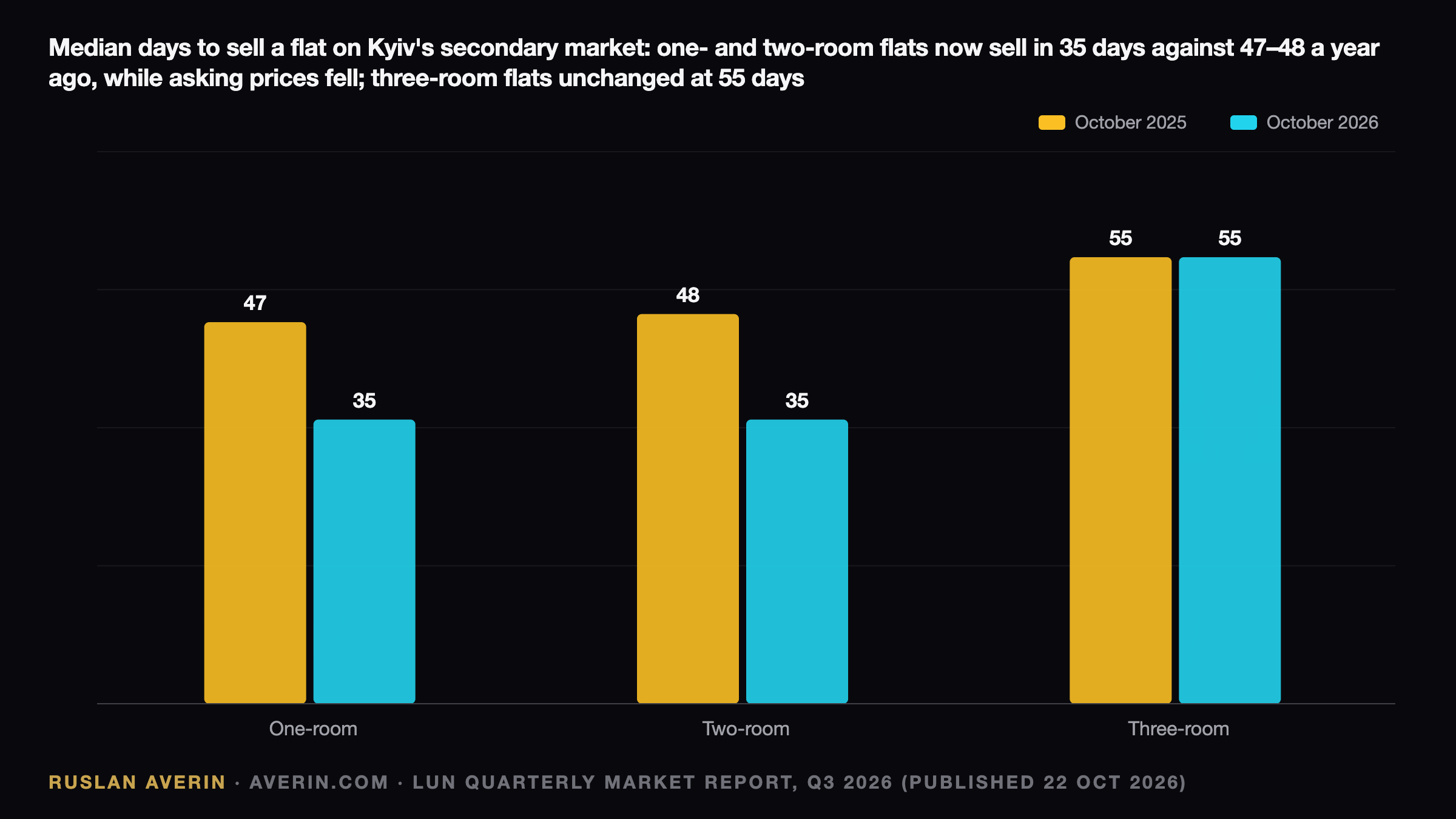
| One-room | $67,000 | +0.6% (from $66,600) | −5.6% | 35 | 47 |
| Two-room | $98,000 | −6.7% | −12.5% | 35 | 48 |
| Three-room | $146,000 | −2.7% | −8.8% | 55 | 55 |
Two-room flats took 53 days to sell six months ago and 48 days a year ago; at 35 days the marketing period has been cut by almost a third. Three-room flats remain the slowest segment, but even there the monthly improvement from 69 to 55 days is substantial.
Sold prices tell a harsher story
LUN separately tracks the median price of flats that actually changed hands. In October 2026 that was $57,000 for one room, $66,500 for two and $86,000 for three — approximately 15%, 32% and 41% below the corresponding asking medians. The distance has widened across the board over the past year.
For one-room flats the spread grew from $7,000 in autumn 2025 to $10,000; for two-room flats from $25,000 to $31,500; for three-room flats from $55,000 to $60,000. Liudmyla Kiriukhina, head of LUN Statistics, cautions that this is not a discount measure. The two samples cover different properties, varying in area, condition and address.
What the comparison does reveal is the direction of demand. Within every size class, buyers are clustering at the cheaper end of the available stock, pulling the transaction median far below the advertised one.
Supply: fewer listings, and fewer big ones
A second LUN release, dated 26 October, reported that the number of Kyiv flats listed for sale in September was 4% below a year earlier and 2% below August. Odesa went the other way with 32% more listings. The Kyiv contraction is concentrated in larger properties: listings with four or more rooms fell 18%, three-room 9% and two-room 4%.
One-room listings rose 4% and now account for more than a third of all sale offers in the capital. Kiriukhina connects the pattern to rental decisions, noting that letting a flat and selling it are separate choices for someone relocating, and that growing rental supply alongside shrinking sale supply suggests owners holding back. Denys Sudilkovskyi, LUN's brand and business director, argues the choice of flats is simply returning to its 2024 level, and that last year's surge was the anomaly.
New builds move the other way
The primary market is pointing in the opposite direction. The median starting price per square metre in Kyiv new builds reached UAH 65,000 in October, 18% higher on the year. Of that, 11.7% accumulated over six months from UAH 58,200 in April, and 5.2% in the final month alone.
By class, comfort gained 10.6% in six months to UAH 56,300 per square metre and business class 4.7% to UAH 83,300, while economy fell 7.3% to UAH 40,500 and premium eased 0.8% to UAH 158,000. The overall median is climbing faster than any single class, which LUN reads as a shift in the mix of projects on sale.
Scarcity underpins the trend. Citing the State Statistics Service, LUN reports construction starts on 1,470 flats and houses in Kyiv in the first half of 2026 — 65% fewer than the 4,248 a year before, close to the 2024 figure of 1,523. Since January, 10,317 off-plan flats were sold against 7,674 newly launched.
Districts, renovation and building age
Citywide medians conceal extreme dispersion. A one-room flat has a median of $148,000 in Pechersk and $43,000 in Desnianskyi — a spread above $100,000, compared with roughly $77,000 a year earlier. One-room flats in Pechersk gained 25% over twelve months, while three-room flats in Solomianskyi lost 17%.
Condition carries similar weight. In Holosiivskyi, a renovated one-room flat has a median of $95,000 versus $62,000 without renovation. Khrushchev-era blocks remain the cheapest stock at $43,000 for one room, with post-2010 buildings about 81% dearer at $78,000.
Affordability up, rental yields down
Measured against pay, Kyiv has become more accessible. LUN and Work.ua calculate that a median one-room flat equals 6.7 years of the full median salary in the capital, down from 7.6 years both a year and six months ago. Lviv and Lutsk still require 8.7 years.
Landlords face the reverse. Median one-room rent stands at UAH 17,000 a month — unchanged on the year but almost 6% below the previous month — while rental listings jumped 66% between early August and early October. The price-to-rent ratio rose to 14.8 years, 8% higher than a year ago, implying a gross yield near 6.8% before tax, vacancy and repairs, against an NBU key rate of 16% on hryvnia instruments.
Practical reading and the winter risk
Buyers gained the most in the two-room segment, where $14,000 came off the median asking price in half a year, though quicker sales leave less room for drawn-out bargaining on correctly priced units. Sellers listing near sold medians are clearing stock in roughly five weeks; those anchored to old expectations simply widen the asking-to-sold gap.
In analyst Ruslan Averin's view, the data describe a market discovering its clearing level rather than seizing up, with the burden of adjustment falling on vendors. LUN itself flags the winter as the main unknown: regular Russian strikes, power cuts and a demanding heating season. Three indicators deserve attention — November sale times, further shrinkage in large-flat listings, and second-half construction starts, which will define choice in 2027 and 2028.