The metric that explains the Kyiv primary market
The clearest number in Kyiv residential real estate is not a price but a duration. At the end of August, the 70 city projects with real sales held 15,458 apartments on offer worth roughly $1.87 billion. At the pace of deals then recorded, that stock represented 44.2 months of supply, up from 33 months in July.
KSD, the Kyiv School of Development, treats anything above 18 months as a surplus. By that rule the capital is carrying more than twice the inventory a balanced market would absorb, and the gap widened by eleven months in a single month.
Where the overhang is concentrated
The burden is spread very unevenly across districts. Darnytskyi sits at 18.1 months and Podilskyi at 19.4, close to the threshold. Holosiivskyi shows 82.6 months with 4,377 apartments, more than a quarter of the city's entire supply, against only 53 sales in August. Pecherskyi records 83.4 months and Dniprovskyi 92.2.
Segment data is equally lopsided. Comfort class accounted for 276 of the 350 August deals, about 79%. Economy class sold four flats despite 622 on offer, a result that makes the class statistically close to dormant.
September in figures
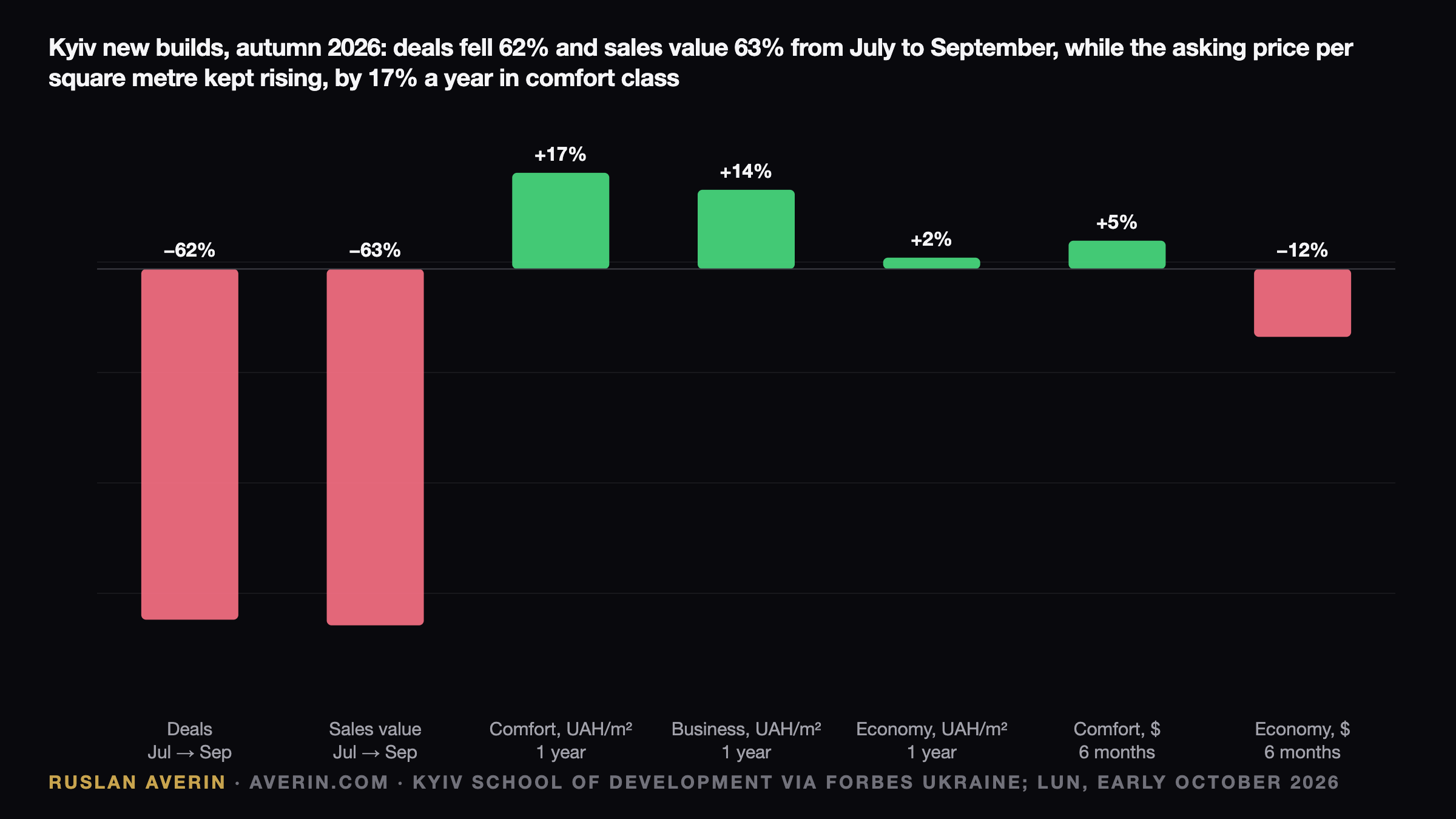
Kyiv developers sold 180 new-build apartments in September 2026 for $20.2 million. That is 62% fewer deals than in July, with the money paid down 63%, according to KSD data published by Forbes Ukraine on Wednesday 21 October. It marked the second month of decline in a row.
August had already looked weak: 350 deals while 1,005 new apartments entered the market, almost three new flats for every one sold, as KSD founder Ihor Raikov noted in his Forbes Ukraine column of 6 October. By his estimate the Kyiv primary market sold about $200 million of apartments a month in 2021.
The average September deal worked out at roughly $112,000, an RFC Capital Research calculation from the KSD totals. In August the average comfort-class sale was about $86,000 and business class about $176,000.
What the price lists say
LUN's medians of asking prices in Kyiv for early October show no sign of the sales collapse.
| Segment | Price | Change in a year |
|---|---|---|
| New build, economy class | UAH 40,700 per m² | +2% |
| New build, comfort class | UAH 56,500 per m² | +17% |
| New build, business class | UAH 84,800 per m² | +14% |
| Secondary, one-room flat | $67,000 | +1% |
| Secondary, two-room flat | $98,800 | −6% |
| Secondary, three-room flat | $145,000 | −3% |
The currency filter
In dollars the picture softens considerably. LUN reports comfort class up 5% in dollars over six months while economy class lost 12%. The official NBU rate stood at UAH 45.08 per dollar on 21 October against 41.76 a year earlier, so the hryvnia lost about 8%.
At that rate the comfort-class median is roughly $1,250 per square metre, and the 17% hryvnia gain compresses to about 8% in dollars, an RFC Capital Research calculation. The secondary market moves the other way: two-room flats lost about 12% in dollars over six months, with demand limited by the war.
Why list prices refuse to move
Raikov's column sets out the mechanism. Most of the roughly 15,500 apartments on sale in Kyiv are not built yet, and they are financed mostly by buyers' money rather than bank loans. When sales fall, a developer does not discount; it slows construction to match incoming payments. "There is nowhere to cut," he writes, citing costlier materials and a shortage of workers. The surplus therefore appears in build speed and new launches, not on the price tag.
Cost signals support that reading. Construction in Ukraine fell 11.2% in January–July 2026 year on year, according to the State Statistics Service. Oleksii Rashchupkin of Altius Capital told Minfin on 19 October that rebar could become 30–50% more expensive as imports replace stopped steel plants, a preliminary estimate; Ukraine produces no industrial glass. Kreator-Bud continues projects already under way but has moved several launches to 2027.
Forbes Ukraine reports that some developers are meeting only 10–20% of their sales plan. The market's own summary of the mood is blunt: "We are factoring in a pessimistic scenario."
The state mortgage as the main demand engine
On 15 October the Cabinet of Ministers approved changes to єОселя, announced by the Ministry of Economy on 19 October. The young-family model charges 7% a year for the first three years, 10% from year four to year ten and 12% from year eleven. Each child born or adopted after the loan is issued lowers the base rate, turning 7% into 5% after one child, with a floor of 0.1%.
Price and floor area may now exceed programme norms by up to 40%, with the difference paid from the buyer's own funds. Prime Minister Serhii Koretskyi said the larger area applies to new builds or buildings commissioned no more than three years ago. Preferential terms for housing aged 20 years or more now cover Mykolaiv region.
The draft 2027 budget includes UAH 45 billion for єОселя, UAH 27.9 billion more than in 2026, MP Nina Yuzhanina said on 28 September. In a Factum Group survey for OLX Real Estate, 16% of potential buyers plan to use the programme, yet 90% named 5% a year or less as an acceptable rate.
The rental arithmetic
Rental income offers little compensation. LUN puts the median rent of a one-room flat in Kyiv at UAH 16,000, down 6% in a year, and three-room flats at UAH 36,200, down 14%. OLX Real Estate reported that in September one-room listings rose 20% in a month while demand fell 20%.
A one-room flat bought at the secondary median of $67,000 and let at UAH 16,000 a month yields about UAH 192,000 a year, roughly $4,260 at the official rate, or 6.4% gross before tax, vacancies and repairs. Hryvnia deposits compete directly with that, with the NBU key rate at 16%, and a new build adds 12–18 months or more without rent.
Practical reading for buyers
Since 2022 buyers have seen enough frozen projects to avoid the pit stage, Raikov writes, and market makers usually open sales once about ten floors are up, 12–18 months before commissioning. The early-stage discount now carries a real risk that construction slows to match falling payments, and in districts running 80–90 months of supply that risk is far from theoretical.
Instalments remain the standard tool: Raikov's example is a $50,000 flat with $5,000 down over 48 months, about $940 a month. List prices are not falling, but a developer hitting 10–20% of plan has every reason to improve payment terms, particularly where stock is deepest.
In analyst Ruslan Averin's view, the distance between a 62% drop in deals and a 17% rise in asking prices describes a market frozen at its price lists rather than one demonstrating strength.
Signals for the coming months
Three indicators will settle the question. October sales from KSD would confirm a trend if a third consecutive decline appears. A months-of-supply reading above 44 would show stock still growing faster than demand. And the first young-family loans issued under the revised єОселя terms will test whether subsidised rates can offset a shortfall of this size.