Oil markets rarely get two supply stories on the same day that point in the same direction. On Wednesday 21 October 2026 they did. In Saudi Arabia, a drone was intercepted over a processing facility at Aramco's Shaybah field. In Asia, Kpler analysts told the Wall Street Journal that Iran's floating oil reserve had finally run dry under the US naval blockade. One set of barrels is threatened; the other has already disappeared.
The price reaction came the following morning. Brent crude climbed $2.82, or 2.59%, to $111.64 a barrel at 06:26 GMT on Thursday 22 October, close to a five-month high, Reuters reported. US West Texas Intermediate gained $2.24 to $99.39. The immediate triggers were a day of Houthi attacks inside the kingdom and Washington's decision to pull some diplomats' families out of Saudi Arabia.
Iran's cushion is gone
Through most of the conflict, Iran kept selling. Tankers parked in Asian waters held millions of barrels that moved steadily into Chinese refineries even when loadings at home stopped. By mid-October that storage was fully depleted, according to Kpler analysts quoted by the Wall Street Journal on 21 October. "There's no more oil to discharge to China anymore," said Homayoun Falakshahi, Kpler's head of crude oil analysis.
The blockade of Iranian ports explains the drain. Bloomberg reported on 1 October that Iran loaded no oil onto tankers during September. US Central Command puts the denied revenue at a minimum of $25 billion. On 8 October the Treasury sanctioned 17 more vessels tied to the shadow fleet under Operation Economic Outcast, CNBC reported. President Masoud Pezeshkian said this week that the US "could not expect dialogue while blockading and threatening Iran".
What happened at Shaybah
Early on Wednesday, Saudi air defences intercepted a drone aimed at a processing facility at Shaybah, in the Empty Quarter near the border with the UAE. Debris struck a contractor's vehicle outside the perimeter and started a fire. Two people were killed, a Filipino and a Nepali national, and two were injured, Bloomberg reported. The energy ministry said operations were unaffected.
Shaybah pumps roughly 1 million barrels of crude a day, according to Bloomberg and The National. The field has been a target before: the Houthis struck its gas liquids plant in August 2019 without lasting damage to output. No group had claimed Wednesday's attack when Bloomberg reported it, though the Saudi-led coalition said it intercepted a drone fired towards the Eastern Province.
A pattern rather than an incident
Hours after Shaybah, an attack on King Fahd International Airport in Dammam killed one person and injured eight, the kingdom's civil aviation authority said. Reuters attributes both strikes to the Iran-aligned Houthis. A week earlier, Aramco's Dhahran headquarters was hit. An attack on Riyadh's main airport earlier in October was the deadliest in the kingdom in more than a decade.
Infrastructure has also been touched. The National reports that flows on the East-West pipeline, the 7 million barrel a day route that bypasses the Strait of Hormuz, were halted on 5 October after a strike on a pumping station east of Riyadh. Washington has ordered non-emergency government staff and their families to leave Saudi Arabia.
Session by session
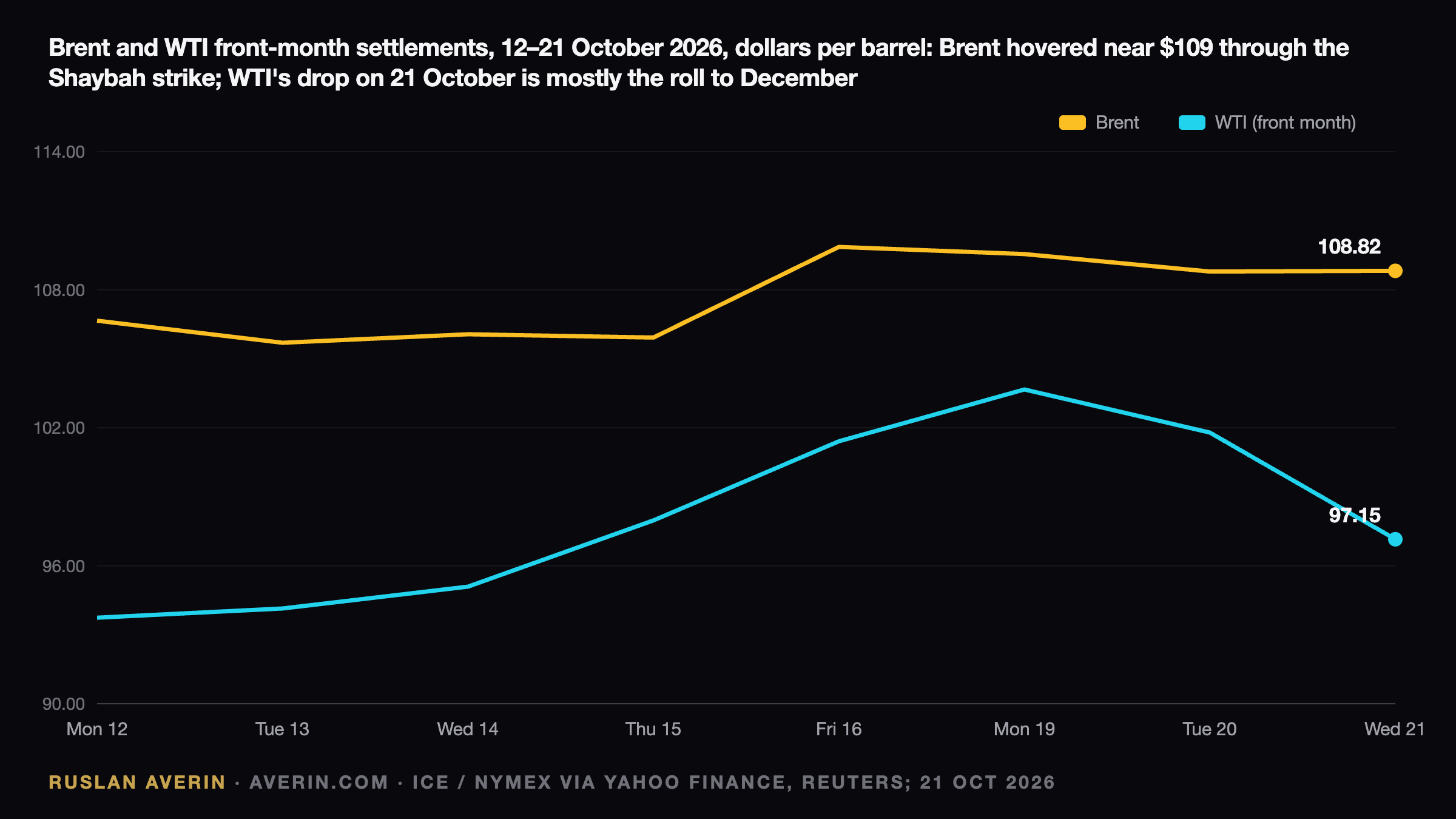
Much of the risk was already in the curve before Thursday's move. Settlements on ICE and NYMEX, from Reuters and Yahoo Finance data:
| Session | Brent, $ | WTI front month, $ |
|---|---|---|
| Fri 16 Oct | 109.86 | 101.41 |
| Mon 19 Oct | 109.55 | 103.66 |
| Tue 20 Oct | 108.79 | 101.79 (November, expired) |
| Wed 21 Oct | 108.82 | 97.15 (December) |
| Thu 22 Oct, 06:26 GMT | 111.64 | 99.39 |
Tuesday was the warning shot: Brent touched about $112 intraday and the expiring November WTI contract spiked to $110.48 before both retreated on mediation hopes. On Wednesday Brent settled just 3 cents higher, because the ministry's reassurance landed alongside the attack. WTI eased 67 cents, though part of that drop reflects the switch from the November to the December contract rather than a market decline.
Inventories pulled the other way
The Energy Information Administration said on Wednesday that crude stocks fell 3.06 million barrels to 412.5 million, far more than the 820,000-barrel draw expected in a Reuters poll. Distillates, which include diesel and heating oil, rose 1.68 million barrels to 104.3 million, against an expected 1.16 million barrel drop. The Department of Energy also offered to loan up to nearly a third of the 1-million-barrel emergency heating oil reserve.
Shipping lanes remain contested
Kpler counts at least 18 attacks on shipping in the past two weeks, Reuters reported, and LSEG analysts warn that Iran is striking tankers well beyond the Strait of Hormuz, in the Gulf of Oman, threatening Gulf loadings and ship-to-ship transfers. On Thursday the Revolutionary Guards' navy said four vessels "involved in illegal oil transfers" in the northern Gulf were hit and caught fire, and that three more struck mines west of the strait.
"Oil prices remain well bid, with ICE Brent back above $110 per barrel this morning following additional deadly attacks on Saudi Arabia," ING analysts wrote on Thursday.
Diesel is the transmission channel
NYMEX ultra-low sulphur diesel futures settled at $4.925 a gallon on 20 October, about $207 a barrel, roughly $98 above Brent on the same basis. AAA's national average for diesel was $6.309 a gallon on 22 October, against $3.629 a year earlier. Regular petrol stood at $4.270, down from $4.475 a month ago but well above $3.066 a year ago.
That matters for policy. The Federal Reserve meets on 27–28 October with its target range at 3.75–4.00%. September CPI was already 3.7%, with gasoline up 9.1% during the month. Brent above $110 a week before the decision makes a comfortable hold harder to argue.
Equities split between energy and shipping
The Energy Select Sector SPDR fund closed at $68.16 on Wednesday 21 October, up 3.3% from its 12 October close of $66.01. Exxon Mobil finished at $178.09, up 3.5% over the same stretch. Frontline, by contrast, closed at $51.29, down 13.3% from $59.19 on 12 October despite the attacks, because tanker equities trade on day rates and on the odds of de-escalation.
Three paths from here
De-escalation would require progress in Iran-US mediation or resumed Ukraine peace talks; after the June memorandum Brent fell to $71.99 by 26 June. A grinding status quo means drones intercepted, Saudi output intact and the blockade holding, with Brent settling between $105.69 and $109.86 from 12 to 21 October. A genuine supply hit at Shaybah, Abqaiq or a loading terminal would aim at the 2026 peak of $118.35 set on 31 March.
In analyst Ruslan Averin's view, the market is still pricing the middle path, and Wednesday showed what a single "operations unaffected" statement is worth: a 3-cent settle on the day of a deadly strike. Three indicators deserve attention — whether any attack actually removes Saudi barrels, Kpler's count of Iranian loadings now that floating storage is empty, and the distillate premium near $98 a barrel, the part of the shock that reaches consumers and the Fed fastest.