When a Wednesday Auction Becomes a Policy Test
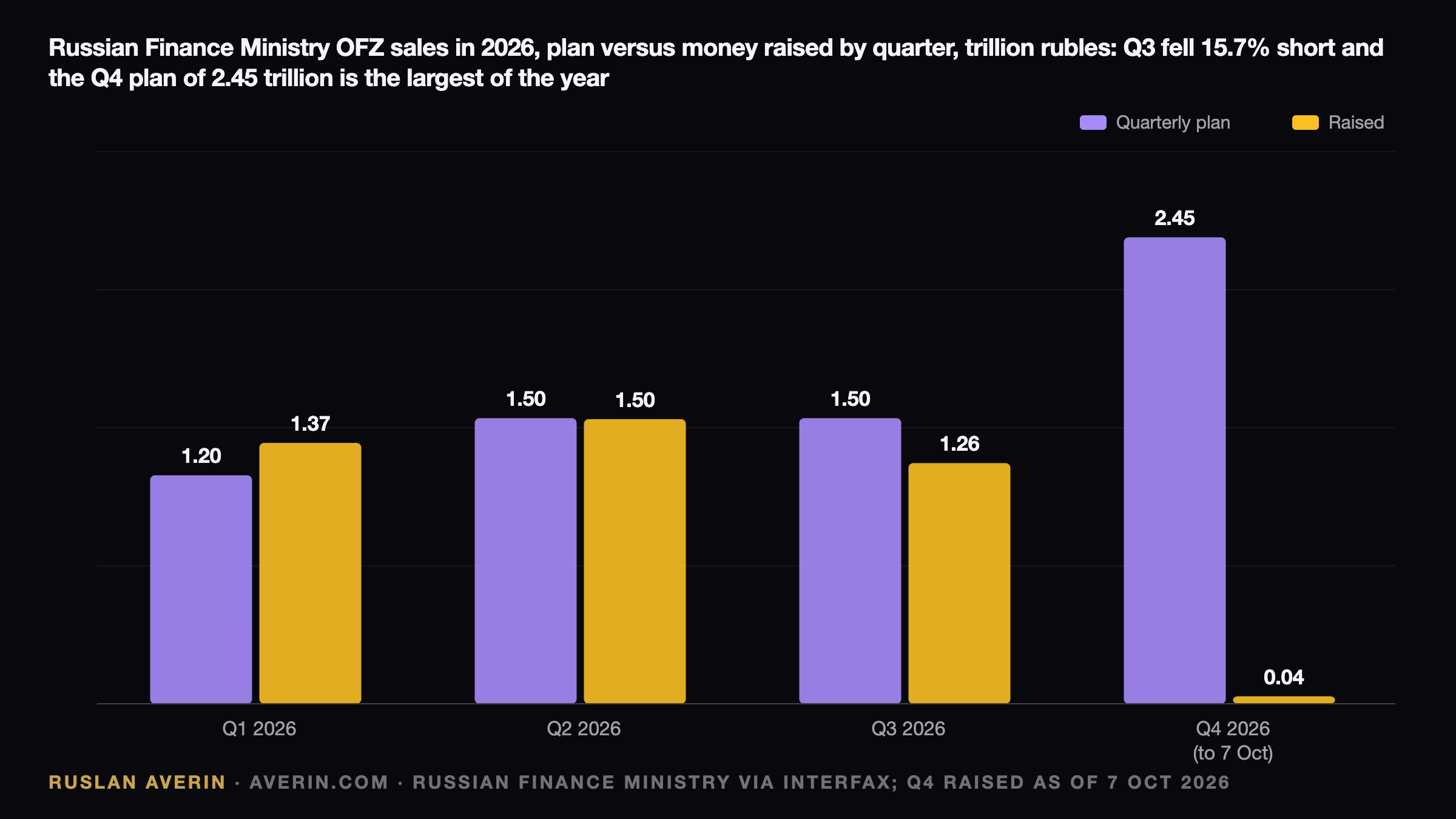
The fourth quarter opened with the heaviest borrowing target Russia has set all year: 2.45 trillion rubles across 11 auction days, of which 1.25 trillion is supposed to come from bonds maturing in more than 10 years. The first attempt, on 7 October, placed 35.7 billion rubles of OFZ 26252, maturing in October 2033, at a yield of 16.63% and an average price of 85.56% of par, against demand of 134.4 billion.
That single result frames the whole quarter. A ministry needing trillions raised a sum that barely registers against the plan, while paying a double-digit coupon on paper priced far below face value. Every subsequent Wednesday now carries the same arithmetic problem.
The Deficit That Outran Its Own Law
The 2026 budget law, passed last year, fixed the federal deficit at 3.786 trillion rubles, or 1.6% of GDP. By the end of August the real gap had already reached 5.795 trillion. In September the ministry revised its full-year estimate to 7.345 trillion rubles, 3.2% of GDP, close to double what the legislation authorised.
Preliminary January–September data published on 9 October showed a deficit of 5.186 trillion rubles, 2.2% of GDP, against 3.471 trillion a year earlier. September itself produced a surplus of roughly 609 billion rubles. Oil and gas revenue fell 17.2% to 5.471 trillion, while spending climbed 14.5% to 34.825 trillion.
| Indicator | Figure |
|---|---|
| 2026 deficit in budget law | 3.786 trillion rubles (1.6% of GDP) |
| 2026 deficit, September estimate | 7.345 trillion rubles (3.2% of GDP) |
| January–September 2025 deficit | 5.186 trillion rubles (2.2% of GDP) |
| 2027 deficit, draft budget | 5.443 trillion rubles (2.2% of GDP) |
| Defence and security, 2027 | 17.1 trillion rubles |
The draft budget for 2027–2029, submitted to the Duma on 30 September, does not close the gap. It projects a 2027 deficit of 5.443 trillion rubles against 3.186 trillion in current law, then 5.12 trillion in 2028 and 5.245 trillion in 2029. Defence and security spending in 2027 is set at 17.1 trillion rubles, roughly a third of the federal budget, according to Reuters figures cited by The Moscow Times.
A Borrowing Programme Interrupted Four Times
The 2026 programme envisaged gross OFZ sales of 5.510 trillion rubles and net borrowing of 4.173 trillion, with budget documents later lifting the net figure to 5.016 trillion. By the end of September about 4.13 trillion had been raised.
The path there was broken. Auctions were cancelled on 24 June and 8 July, then suspended entirely from 20 July to 2 September. A floating-rate issue offered on 15 July attracted no acceptable bids. Third-quarter sales ended at 1.264 trillion rubles against a 1.5 trillion plan, a shortfall of 15.7%, and the 30 September auction of OFZ 26228, maturing in 2030, was declared void.
The exception proves the method. When sales resumed on 2 September, the ministry placed an entire 1 trillion ruble floater, series 29031, in a single session, raising 938.9 billion rubles. Banks borrowed almost the same amount from the Bank of Russia that day, The Moscow Times reported, citing economist Vladislav Inozemtsev, who described the sequence as a coordinated operation.
A Closed Market and a Narrow Buyer Base
Sanctions removed the foreign bid. US Treasury Directive 1A, issued on 22 February 2022, bars US financial institutions from primary and secondary dealings in Finance Ministry bonds issued after 1 March 2022, while investors from "unfriendly" countries have had Russian securities frozen in type C accounts since March 2022.
What remains is domestic. Bank of Russia data summarised on Smart-Lab show systemically important banks absorbing 73.6% of primary placements in September, mostly floaters. On the secondary market households were net buyers of 28.4 billion rubles, up from 15.7 billion in August, while large banks sold 160 billion.
The Spread and the Price Data Behind It
The Bank of Russia held its key rate at 14% on 11 September, after ten consecutive cuts from the 21% peak set in October 2024, with the next decision due on 23 October. The 10-year OFZ yield closed at 16.85% on Friday 9 October, according to Trading Economics, up 1.76 percentage points over the year.
Long bonds therefore pay almost 3 percentage points more than the key rate. Rosstat recorded annual inflation of 6.35% in September, with monthly prices up 0.35% against a consensus of 0.27%. Weekly data for 29 September to 5 October showed a 0.96% jump after utility and rail tariff increases, lifting the annual estimate to 7.08%. The central bank said underlying price growth had accelerated to 5–6% annualised.
What the Retail Experiment Already Showed
Russia launched OFZ-n, the "people's" federal bonds, on 26 April 2017 with a 30 billion ruble debut issue sold through Sberbank and VTB, followed by issues of 15 billion each. The programme was suspended in March 2022 on worsening borrowing conditions.
In November 2023 Denis Mamonov, head of the ministry's public debt department, ruled out a revival: "For us it was never a significant source of borrowing. On the scale of the overall borrowing programmes it was less than 1%." Households can supply tens of billions; the state requires trillions.
The Risk Ledger for a Ruble Holder
Inflation is the first exposure: a 16.6% yield on a 2033 bond rewards investors only if prices return to the 4% assumed for 2027–2029, which weekly readings above 7% contradict. Duration is the second: the RGBI long-bond index traded near 111 points in early October, close to summer lows, leaving a buyer at 85.56% of par with years of price risk.
Currency policy adds a third layer. The ministry plans to purchase 279.4 billion rubles of foreign currency between 7 October and 6 November under the fiscal rule, which economist Yegor Susin estimates could weaken the ruble by 2–3 rubles per dollar on a monthly average. Floaters tied to RUONIA shield investors from rate rises but inflate the state's bill: debt service is forecast at 4.6 trillion rubles in 2027, or 9.4% of federal spending.
Patriotism as a Funding Line Item
On Sunday 11 October a Smart-Lab blogger published "Помоги Родине! Купи ОФЗ!!!" — a parody urging readers to buy federal loan bonds, "preferably on Wednesday, at the Finance Ministry auction", at ruble yields of 16.5–17.5%. The most upvoted reply asked the state to scrap income tax on OFZ coupons first.
Three structural conclusions follow. The war budget has migrated from the National Wealth Fund to the bond market, with 2027 gross OFZ sales planned at 7.722 trillion rubles and net borrowing at 6.4 trillion. The market is pricing that supply. And when auctions fail, the fallback is bank floaters financed by central-bank liquidity — a quiet form of money creation.
In the view of analyst Ruslan Averin, the parody captures Russian state finance more honestly than official commentary this month: patriotism is invoked to fill a gap that banks, the central bank and higher taxes are actually covering. The reference points ahead are the next three Wednesday auctions, the 23 October rate decision and October inflation.