A viral headline that reversed its own source
A line claiming the Central Bank "has addressed everyone who holds cash" spread through Russian aggregators on Tuesday 13 October and climbed Google Trends. The wording implied a fresh warning. The Bank of Russia published nothing of the sort on 12 or 13 October: its feed carried a digital ruble interview and a notice about financial literacy classes for older people.
The version that circulated, posted at 01:34 local time by a regional outlet, assembled two older items — the regulator's monthly household survey and Governor Elvira Nabiullina's remark that the share of cash in the money supply had risen "insignificantly". The text even closed by stating that the rise "does not mean the Central Bank is calling on Russians to abandon bank accounts", contradicting its own headline.
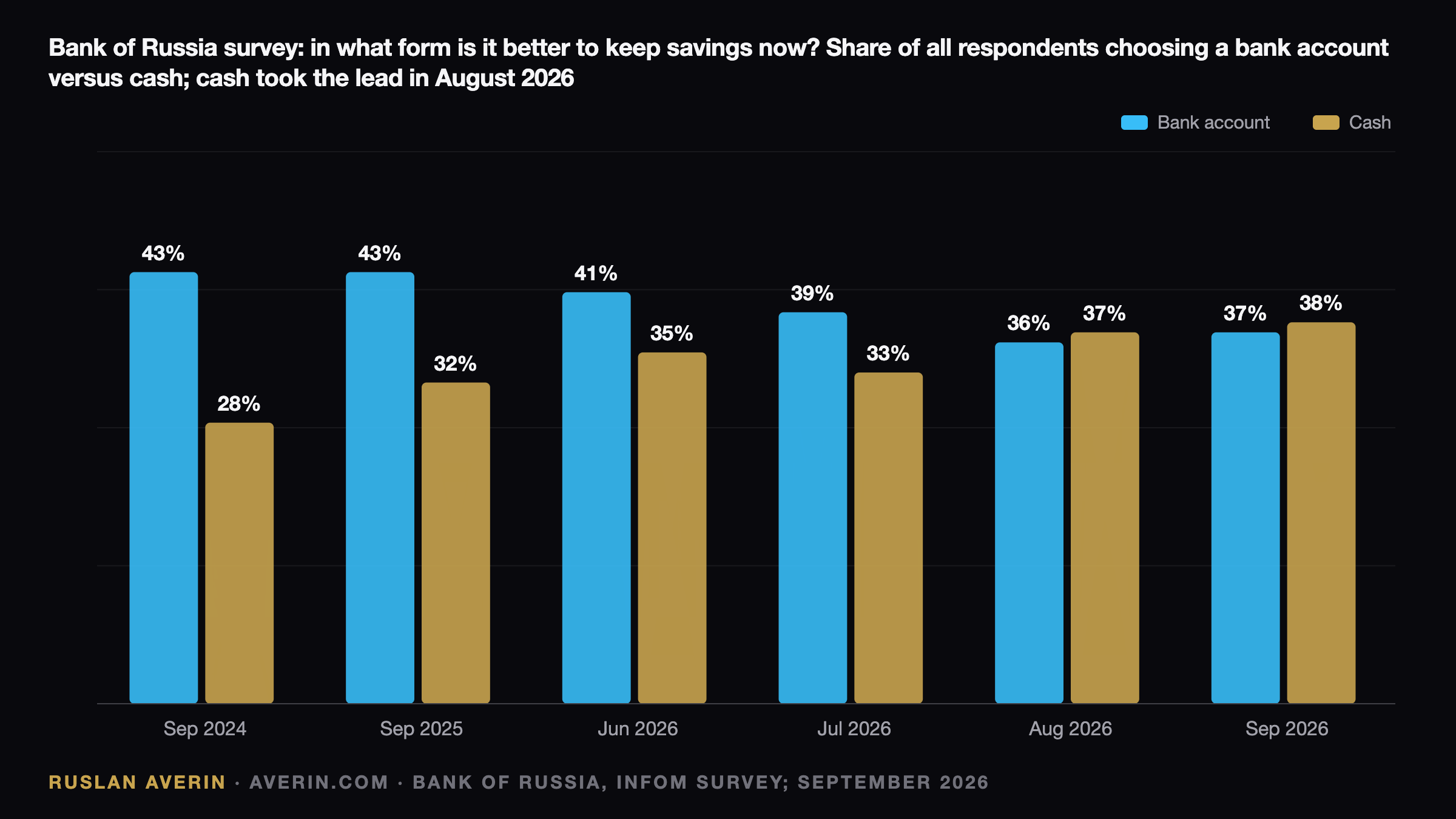
It also flipped the central figure, reporting that 38% of Russians prefer a bank account and 37% prefer cash. The September 2026 data show the reverse.
What respondents actually said
The survey, conducted for the Bank of Russia by the polling agency inFOM, asks in what form savings are better kept now: in a bank account or deposit, or in cash, including a safe deposit box. In September 2026, 38% chose cash and 37% chose the bank. Another 10% preferred a mix, 6% named another form and 10% gave no answer.
August was the pivot, with 37% for cash against 36% for the bank — the first time since 2022 that cash came out on top, as The Moscow Times noted. September confirmed the result instead of reversing it.
| Period | Cash preferred | Bank account preferred |
|---|---|---|
| September 2025 | 32% | 43% |
| August 2026 | 37% | 36% |
| September 2026 | 38% | 37% |
One caveat matters: this measures opinions, not balances. It records what households consider safer or more convenient, not how much money has physically moved.
The balances moved as well
Monetary base data show cash in circulation outside the Bank of Russia at 22.23 trillion rubles on 1 October 2026. That is 2.78 trillion more than the 19.45 trillion recorded on 1 January, a rise of 14.3% in nine months, and 3.84 trillion or 20.9% above the level a year earlier. Between October 2023 and October 2025 the figure barely moved at all.
The monthly pace has been uneven. Cash grew by roughly 618 billion rubles in July, 356 billion in August and 348 billion in September. On 9 October the regulator confirmed that September growth had slowed relative to earlier months, while the January–September total still exceeded the same periods of 2024 and 2025.
More is expected. The draft monetary policy guidelines released at the end of August projected cash in circulation rising by 3.7 trillion rubles in 2026, 2 trillion in 2027 and 1.6 trillion in 2028. The liquidity forecast in the October commentary places the 2026 increase at 3.4–4.0 trillion rubles.
Three explanations from the governor
Nabiullina has returned to the subject three times since June. At the 11 September press conference she noted that people paid in cash more often during the second quarter, attributing it to mobile internet outages, adaptation to tax changes and anxiety fed by various rumours. From 2026 the VAT rate rose to 22% from 20%, and the revenue threshold for paying it fell to 20 million rubles from 60 million.
Her second argument concerns deposit rates. Because rates were very high in 2024–2025, cash grew far more slowly then; what is visible now is "catch-up dynamics". By mid-August the average maximum deposit rate at the ten largest retail banks stood at 12.9%, according to Bank of Russia figures cited by The Moscow Times.
The third is proportion. Cash now accounts for about 15% of the money supply against roughly 20% five years ago, and the October commentary argues that this year's small increase "in no way contradicts the long-term trend" towards a lower share. At the International Banking Forum on 24 September Nabiullina said: "We see the increase in demand for cash, but we have to look at the economy as a whole."
What genuinely changed for holders of banknotes
Three developments are real, and none restricts keeping cash at home. On 23 September Deputy Governor Sergei Belov said some banks were refusing to accept cash from customers, treating cash operations as a right rather than a duty. "From our point of view, this interpretation is fundamentally wrong," he said, citing Article 140 of the Civil Code, under which the ruble must be accepted at face value throughout Russia.
On 24 September Bogdan Shablya, head of the financial monitoring and currency control service, said compliance must be tightened in cash-heavy business segments, with a "very large and detailed" recommendation to banks on the way. He stressed that the regulator has never opposed cash itself, only cash of unidentified origin.
Finally, from 1 October banks may allow customers to deposit cash into their own account through another bank's ATM via the Faster Payments System. Limits are 25,000 rubles per operation, 50,000 a day and 200,000 a month; each bank sets its own fee and participation is voluntary.
Foreign currency and the digital ruble
Nothing changed in October for dollar and euro savers. At the start of September the Bank of Russia extended its foreign currency cash restrictions by six months, to 9 March 2027, citing sanctions that prevent Russian banks from buying Western banknotes. Holders of accounts opened before 9 March 2022 may still withdraw up to $10,000 or the euro equivalent once; anything beyond that is paid in rubles.
The digital ruble entered general circulation on 1 September. In the interview published on 12 October, Deputy Governor Zulfiya Kakhrumanova reported more than 220,000 accounts opened, about 10,000 of them by companies, with more than 150,000 operations. Transfers are free for individuals, and an account can be opened only by its owner from their own device. Offline payment — the feature most relevant to people holding cash against outages — does not exist yet; a prototype is due to be tested with a small group.
The cost of the shift
In analyst Ruslan Averin's view, the substance lies in the 38% against 37% in the survey and the 22.23 trillion rubles in circulation: after two years in which high deposit rates pulled savings into banks, a meaningful share is drifting back under the mattress, and the regulator is describing that movement rather than resisting it.
No document announces a ban on cash, a ceiling on home holdings, a withdrawal of current banknotes or forced conversion into digital rubles. The ruble is worth the same in all three forms, and Belov's instruction points in the opposite direction. The arithmetic for households, however, is blunt: banknotes earn nothing, while deposits still pay double-digit rates.