A shared reporting date with most of the news already out
Shell (LSE:SHEL) and TotalEnergies (EPA:TTE) deliver third-quarter 2026 figures on the same day, Thursday 29 October. Shell's date is drawn from the forthcoming-events calendar in its Q2 report; the TotalEnergies date comes from Benzinga's earnings calendar. Because both groups pre-released the quarter — Shell on 7 October, TotalEnergies on 15 October — the day is about capital returns rather than profit.
Both shares arrive at the print after a powerful year
Shell closed in London on Tuesday 27 October at 3,927.5 pence, 1.80% lower on the session but 43.3% above the 2,740 pence at which it ended 2025. TotalEnergies finished the same day in Paris at €83.00, down 1.00%, and 49.3% above its 2025 year-end close of €55.59. Closing prices come from StockAnalysis and Yahoo Finance.
The crude average slipped while the exit rate climbed
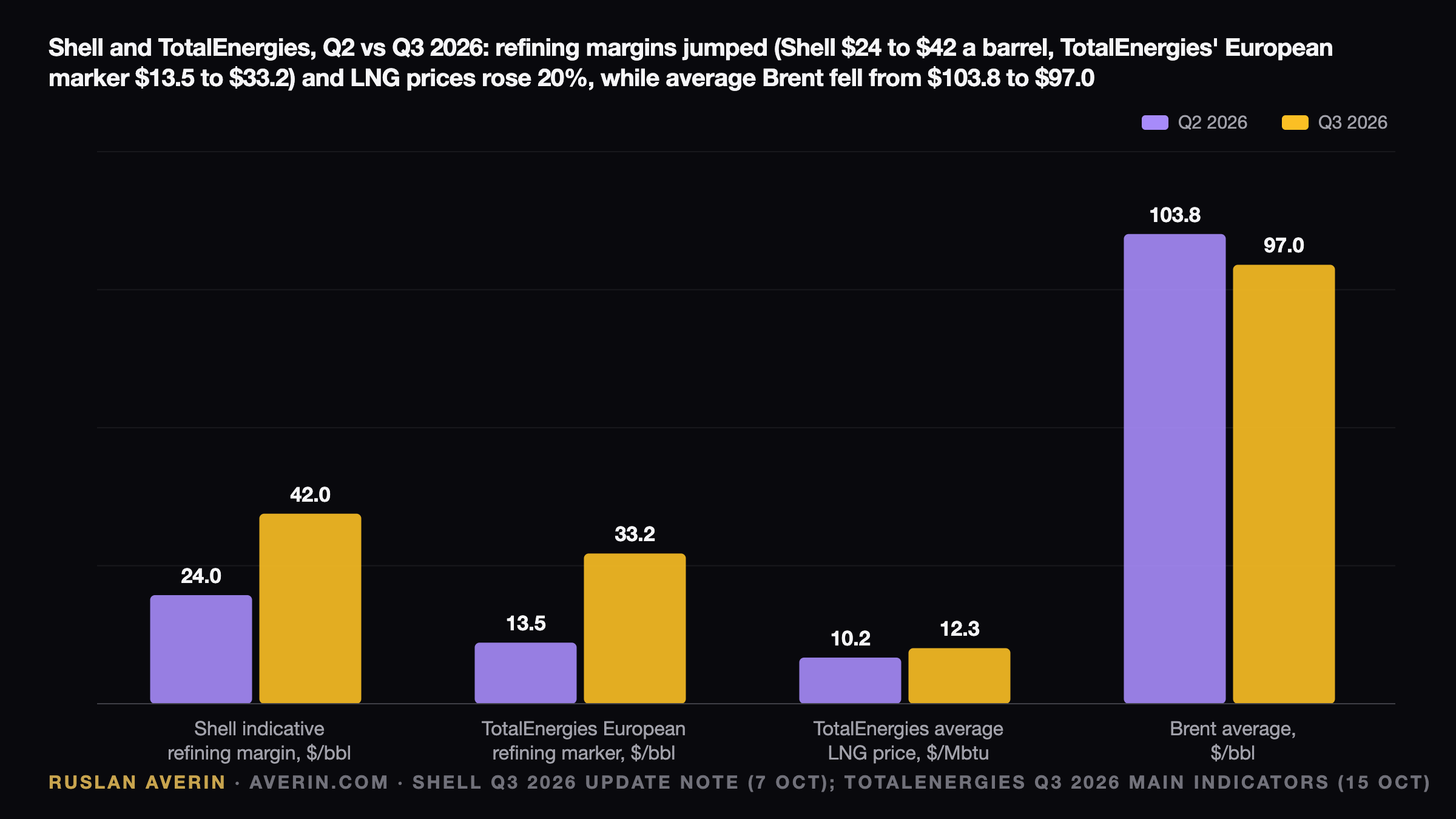
TotalEnergies puts the Q3 Brent average at $97.0 a barrel, down from $103.8 in Q2. The EIA's monthly Brent spot averages trace the same path: $83.76 in July, $91.08 in August and $114.16 in September. A quarter that opened below $85 and closed above $110 means the exit rate carries as much information as the average, because it frames the starting point for Q4.
TotalEnergies: downstream described as exceptional
The company's European refining marker averaged $33.2 a barrel in the quarter, against $13.5 in Q2. Management says Downstream results and cash flow are "expected to reach exceptional levels", with refining and chemicals cash flow guided about $2 billion above Q2 on a 10% rise in refinery throughput. The average LNG price rose to $12.28 per million Btu from $10.20.
Hydrocarbon production is guided at 2.45–2.50 million barrels of oil equivalent a day, up from 2.395 million in Q2, and Integrated LNG results are "expected to rise sharply". The $2 billion figure matches the group's published sensitivities: each $1 a barrel on the refining marker is worth roughly $0.4 billion of annual cash flow, and the marker rose $19.7.
The same table values $10 a barrel on liquids prices at $2.3 billion a year of adjusted net operating income, so Brent's $6.8 decline costs the upstream business something close to $0.4 billion in the quarter. Refining more than offsets it. Q2 adjusted net income was $6.0 billion, or $2.68 a share, with $9.8 billion of cash flow and gearing of 13.1%.
Shareholder returns are already mapped out. The board authorised up to $1.5 billion of buybacks for Q3, then at the 28 September strategy day approved $2.5 billion for Q4 and $2–2.5 billion for Q1 2027. Policy now calls for dividend growth above 5% a year from 2026 to 2030, with gearing expected below 10% by the end of 2026. The second interim dividend was €0.90 a share, up 5.9%.
Shell: a record margin partly offset by weaker volumes
Shell's update guides an indicative refining margin of $42 a barrel against $24 in Q2, which Sharecast reported the company describing as a record high. Refinery utilisation is guided at 93–97%, down from 102%, partly because low Rhine water levels constrained the Rheinland refinery. The chemicals margin drops to $208 a tonne from $270, and Marketing earnings are expected to fall.
Integrated Gas production is guided at 740–780 thousand barrels of oil equivalent a day, up from 631 thousand, helped by ARC Resources, the Canadian Montney producer acquired on 2 September. LNG liquefaction is guided at 7.2–7.6 million tonnes against 7.7 million, while upstream output is guided at 1,735–1,835 thousand barrels of oil equivalent a day against 1,824 thousand.
Q2 adjusted earnings were $9.84 billion, or $1.76 a share, up from $6.92 billion in Q1 and $4.26 billion a year earlier. Cash flow from operations reached $21.4 billion and net debt fell to $41.8 billion, a gearing ratio of 18.7%. The Q2 buyback of $4.2 billion combined $3.0 billion of new purchases with $1.2 billion carried over from the Q1 programme, paused at $1.8 billion when the ARC deal was agreed.
That programme ends with these results, so a fresh decision is unavoidable. The update also flags a roughly $2.5 billion cash outflow from earlier-than-usual payments for German emissions certificates and confirms that ARC lifts net debt.
What the consensus implies in dollars
Shell's own consensus, compiled by Vara Research, was due on 21 October and was not accessible. Benzinga's Wall Street figure is $3.65 per American depositary share; each ADS covers two ordinary shares, implying about $1.83 a share against $1.76 in Q2. On the Q2 share count that points to roughly $10.2 billion — an RFC Capital Research calculation, not a published number.
For TotalEnergies, Benzinga reports $3.40 a share expected, against $1.77 a year earlier and $2.68 in Q2, implying adjusted net income near $7.6 billion. The split reflects the two updates: Shell flagged softer Marketing, chemicals and utilisation; TotalEnergies flagged sharp gains in refining and LNG.
The fourth quarter has already started hotter
Brent front-month futures settled at $108.82 on 21 October, the day of the drone strike near Saudi Aramco's Shaybah field, then at $116.72 on Friday 23 October and $113.88 on Tuesday 27 October, according to Yahoo Finance. Sustained prices near those levels would make Q4 stronger than Q3 on crude alone, with inflation and rates the other side of the trade.
Politics: the windfall-tax overhang
In September six EU governments requested an EU-wide mechanism to tax energy profits, and the Commission replied that the tax "is in the hands of member states". Shell has already booked a $509 million charge tied to the UK Energy Profits Levy in the first half. A $42 refining margin and "exceptional" downstream results are precisely the numbers levy advocates will cite.
Five lines that will drive the share reaction
In the view of analyst Ruslan Averin, a new Shell programme of $3.5 billion or more would show that ARC and the emissions-certificate outflow are not crowding out returns, while a cut toward $3 billion or below would read as caution. Shell gearing above roughly 20% would make a larger buyback harder to justify.
The third test is TotalEnergies' adjusted net income against about $7.6 billion, with upside concentrated in Downstream and LNG trading. The fourth is the Q4 buyback, fixed at $2.5 billion, where any hint of upside depends on gearing falling below 10% early. The fifth is Q4 guidance on refining and LNG.
Scenario grid
| Outcome | Shell | TotalEnergies |
|---|---|---|
| Beat plus bigger returns | buyback ≥ $3.5 billion, adjusted earnings above $10.2 billion | above $7.6 billion, buyback upside hinted |
| In line | about $3 billion buyback, earnings near consensus | earnings near consensus, returns as announced |
| Disappointment | buyback cut, net debt jump from ARC | weaker LNG trading, cautious Q4 tone |
Why the bar is high
On the calls, Q4 refining margins, Hormuz-related volume losses and any October trading figure deserve the closest attention. With both stocks up more than 40% this year, Ruslan Averin expects expectations to be demanding: a quarter merely in line with consensus could still leave shares lower, as happened on 27 October when Brent fell 1.7%.