A Beat the Tape Refused to Pay For
Tesla published third-quarter 2026 results after the US close on Wednesday 21 October, and the market's answer arrived within minutes. Adjusted earnings reached 48 cents a share against 43 cents expected by analysts polled by LSEG, with revenue of $28.05 billion against $27.9 billion. Shares had closed the regular session at $386.47, up 3.41%, then slid more than 3% in extended trading, according to CNBC.
By early Thursday 22 October, Yahoo Finance reported the stock down almost 5% before the bell. Even so, the after-hours move was less than half the 7.5% swing the options market had priced. Consensus itself was unusually scattered: MarketBeat carried 45 cents for adjusted EPS, LSEG 43 cents, while Yahoo Finance cited a Bloomberg revenue consensus of $28.13 billion that Tesla narrowly missed.
The Quarter in One Table
| Metric | Q3 2026 | Comparison |
|---|---|---|
| Revenue | $28.05 billion | $28.10 billion in Q3 2025 |
| Adjusted EPS | 48 cents | 33 cents in Q2, 50 cents a year earlier |
| GAAP EPS | 22 cents | matched Zacks-sourced consensus on Nasdaq |
| GAAP net income | $787 million | down 43% year on year |
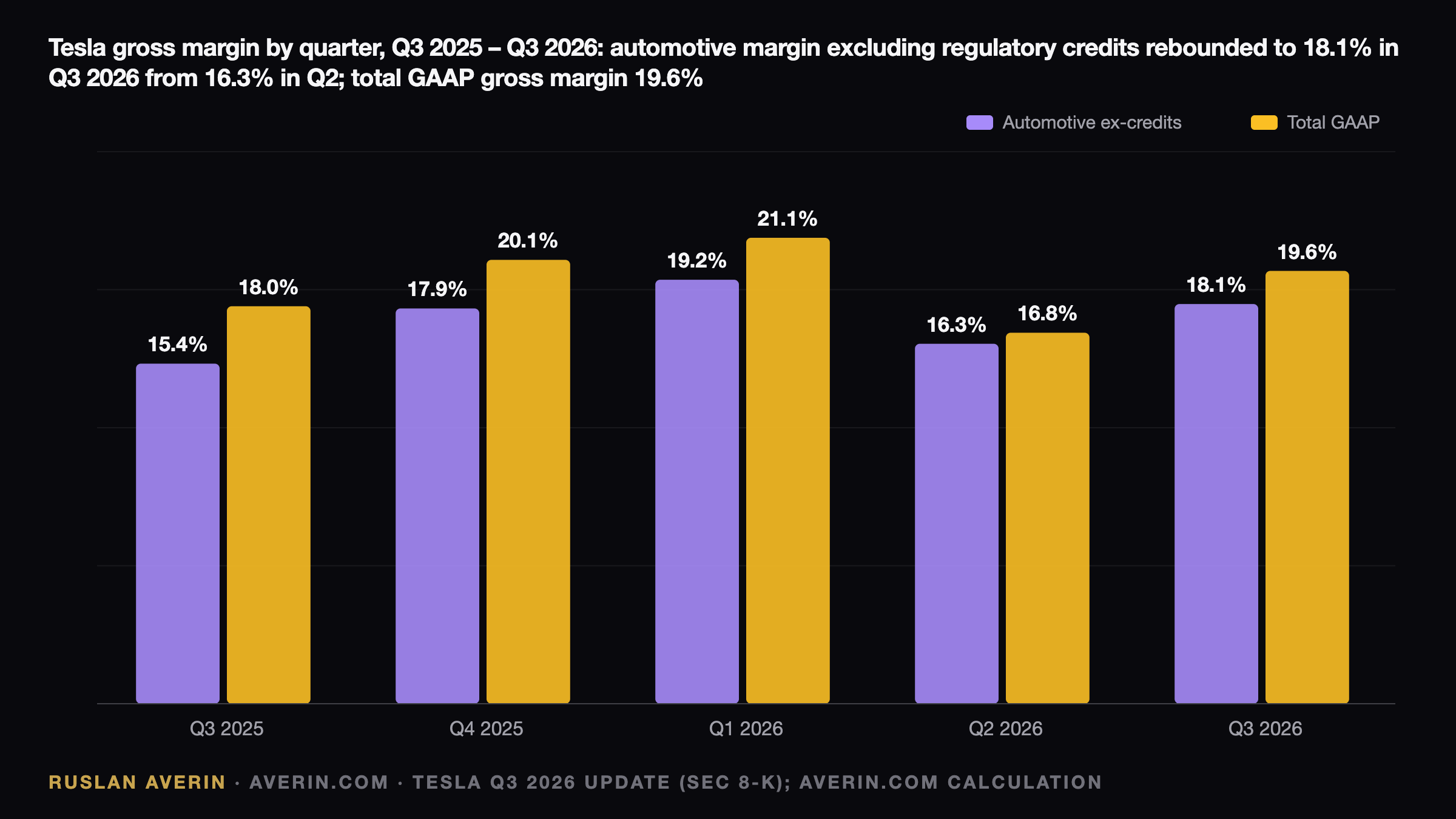
| Gross margin | 19.6% | 16.8% in Q2; 17.7% Hudson Labs consensus |
| Operating income | $718 million (2.6% margin) | 5.8% margin a year ago |
| Free cash flow | plus $1.53 billion | minus $1.09 billion in Q2 |
Beneath the totals, the mix shifted. Automotive revenue fell 3% to $20.56 billion and energy revenue fell 16% to $2.88 billion, partly because of tariff-related customer refunds, the company's deck says. Services and other rose 33% to $4.61 billion and delivered a record $734 million of gross profit.
Where the Margin Actually Came From
The cleanest positive was automotive gross margin excluding credits at 18.1%, up from 16.3% in the second quarter. That makes the second quarter look like the trough of the year rather than a new run-rate. Tesla credited a better regional and product mix, partly offset by a lower average selling price — a gain built on cost and mix, not pricing.
Regulatory credits, long a quiet support under the auto line, came in at $113 million. That compares with $146 million in the second quarter and $417 million a year earlier, a 73% fall. The pool is draining faster than most models assumed, which means the margin recovery has to come from manufacturing economics from here.
Energy gross margin printed 33.1% against 20.4% in the second quarter. CFO Vaibhav Taneja tied the sequential jump mainly to tariff refunds and warranty true-downs, per the call transcript published by Investing.com, so annualising the figure would be unwise. Deployments were 13.7 GWh, Megafactory Texas began production with 50 GWh of planned capacity, and Musk said Tesla is "almost sold out of all Megapacks for 2027".
The $20 Billion Decision
Capital expenditure was $4.73 billion in the quarter, down from $5.79 billion in the second quarter but nearly double the $2.25 billion of a year earlier. Operating cash flow reached $6.26 billion, helped by a $3.99 billion rise in payables and accruals and $1.26 billion more deferred revenue. The combination flipped free cash flow positive after a negative second quarter.
On the call Tesla said: "We are revising our CapEx guidance to be approximately $20 billion for the current year." Earlier in 2026 the plan exceeded $25 billion. Taneja attributed the saving to "managing our capital deployment efficiently". Nine-month spending of $13.01 billion leaves roughly $7 billion for the fourth quarter.
Management framed the cut as sequencing rather than retreat. Musk said spending "will start to become more meaningful next year, and then noticeable in the tens of billions in 2028", while Taneja said capex "would continue to expand" over the next few years. No 2027 number was given. Tesla does not plan to draw on its new $30 billion of credit lines this calendar year and ended September with $45.4 billion of cash and investments, up $1.9 billion in the quarter.
Costs Are Outrunning Sales
The pressure point sits below gross profit. Operating expenses rose 39% from a year earlier to $4.78 billion. Research and development alone was $2.76 billion, up 69%, driven by AI and robotics programmes. Stock-based compensation was $1.17 billion, including the 2025 CEO award. Taneja said rising operating expenses "would continue till we commercialize these new products".
That is why a stronger gross margin produced a thinner operating margin: 2.6% against 5.8% a year ago. Separately, the non-cash loss on the SpaceX stake was $142 million before tax.
Dates That Now Matter More Than Cents
Robotaxi reached nearly 2 million cumulative unsupervised miles at the end of September, an eightfold rise in the quarter, and Ashok Elluswamy said "next month we'll be launching in Dallas". Cybercab rides started in Austin on 3 September; Musk said the Austin fleet has grown tenfold since launch and that Tesla is "trying to get Cybercabs to customers by the end of this year".
Musk expects the robotaxi business to become "noticeable in Q2" of 2027, and Elluswamy said some customer vehicles could receive unsupervised FSD around the second quarter of 2027. FSD subscriptions hit 1.74 million, up 67% year on year, with more than 75% of North American deliveries including a paid sign-up.
Optimus production began on the Fremont lines, but Musk said reaching 20,000 units a week "takes us probably at least a year, maybe a little longer". Stocktwits tied the reversal of early after-hours gains to that remark and the capex cut. One hard deadline is close: Yahoo Finance reports NHTSA issued a special order with 21 questions on how Tesla self-certified the Cybercab, with answers due on 30 October.
The SpaceX Overhang
The other driver of Wednesday's 3.41% gain was merger speculation. On SpaceX's call on 20 October, Musk said the boards of both companies had formed special committees "at the request of shareholders" that "consist of independent directors", CNBC reported. He described himself as a "conflicted party" who cannot participate and called a combination a "good idea".
On Tesla's own call he declined to expand: "I think I said everything that should be said yesterday." No terms have been announced. Tesla's annual meeting falls on 3 December.
Reading the Result
In analyst Ruslan Averin's view, this was a better quarter than the after-hours reaction implies and a weaker one than the gross margin line implies. The car margin recovered, cash flow turned positive and the capex revision removes the near-term funding question. Against that, the energy margin gain looks one-off, credits are fading, and operating costs are growing far faster than revenue.
At roughly 14% below the 31 December close of $449.72, the shares are valued on autonomy and robotics rather than on 48 cents of quarterly profit. Three markers deserve attention: the Dallas launch alongside the Cybercab customer date, both promised for 2026; the NHTSA responses due on 30 October; and fourth-quarter capex, where roughly $7 billion is implied and a materially lower figure would support the slower-projects reading.