Three shocks in five sessions
US markets digested three events in the week of the 2026 midterms: a clear election result, a political scare around AI data centres and a jobs report far above forecasts. The S&P 500 absorbed all three and closed Friday 6 November at 7,376.86, a weekly loss of 2.68% against Friday 30 October.
The Associated Press called both chambers of Congress for the Democrats by Wednesday 4 November, a day after the Tuesday 3 November vote. The response came in two halves: a relief rally on the result, then a 4.4% slide in the S&P 500 on Thursday that CNBC tied to fears of a Democratic clampdown on data centres.
The week in closing levels
| Day | S&P 500 | Nasdaq Composite | Dow Jones | 10-year Treasury | 2-year Treasury | DXY |
|---|---|---|---|---|---|---|
| Tue 3 Nov | 7,568.92 | 25,372.01 | 51,786.72 | 4.95% | 4.61% | 101.87 |
| Wed 4 Nov | 7,688.62 | 25,736.51 | 53,356.12 | 4.90% | 4.58% | 101.51 |
| Thu 5 Nov | 7,353.73 | 24,315.00 | 51,523.06 | 4.84% | 4.46% | 101.55 |
| Fri 6 Nov | 7,376.86 | 24,579.42 | 51,285.73 | 4.86% | 4.51% | 102.30 |
| Week | −2.68% | −3.37% | −0.94% | from 4.94% | from 4.56% | +0.41% |
Closes from Yahoo Finance, with ICE data for the dollar index; yields from the US Treasury par curve. The gap between the Dow, down 0.94%, and the Nasdaq Composite, down 3.37%, already suggests that technology, not the vote, did most of the damage.
Payrolls that changed the Fed conversation
The Bureau of Labor Statistics reported on Friday that the US economy added 165,000 jobs in October, with unemployment at 4.1%. Economists polled by Dow Jones had expected 59,000 jobs and a 4.2% rate, according to CNBC. August and September were revised up by a combined 84,000.
Average hourly earnings rose 0.4% in the month and 3.1% over 12 months, a sharp contrast with July, when payrolls fell by 23,000. Seema Shah of Principal Asset Management told CNBC the report was "a strong rebuttal to fears that the economy is heading into a meaningful slowdown."
The 9 December decision
The Federal Reserve held its target range at 3.75–4.00% on 28 October, and Chair Kevin Warsh gave no guidance for December. The next decision comes on Wednesday 9 December, at the end of the 8–9 December meeting. After the jobs data, CME FedWatch put the odds of a December hike at 76.8%, CNBC reported.
A quarter-point increase would lift the range to 4.00–4.25%. October CPI on Tuesday 10 November is the only inflation print before the meeting, since November CPI arrives on 10 December, a day after the decision. From January a Democratic Senate will also vote on any future Fed nominees.
Bonds and the dollar: a round trip
The 10-year yield fell from 4.95% on Tuesday to 4.84% on Thursday, and the 2-year from 4.61% to 4.46%, according to the US Treasury. The payrolls beat lifted them on Friday to 4.86% and 4.51%. With a hike back on the table, shorter-dated bonds remain the calmer place to wait.
The dollar index slipped 0.35% on Wednesday to 101.51, then rose 0.74% on Friday to 102.30, its highest close of the week, according to ICE data via Yahoo Finance. The election weakened the dollar slightly; the jobs data more than reversed that move.
Wednesday: the sector map of a Democratic Congress
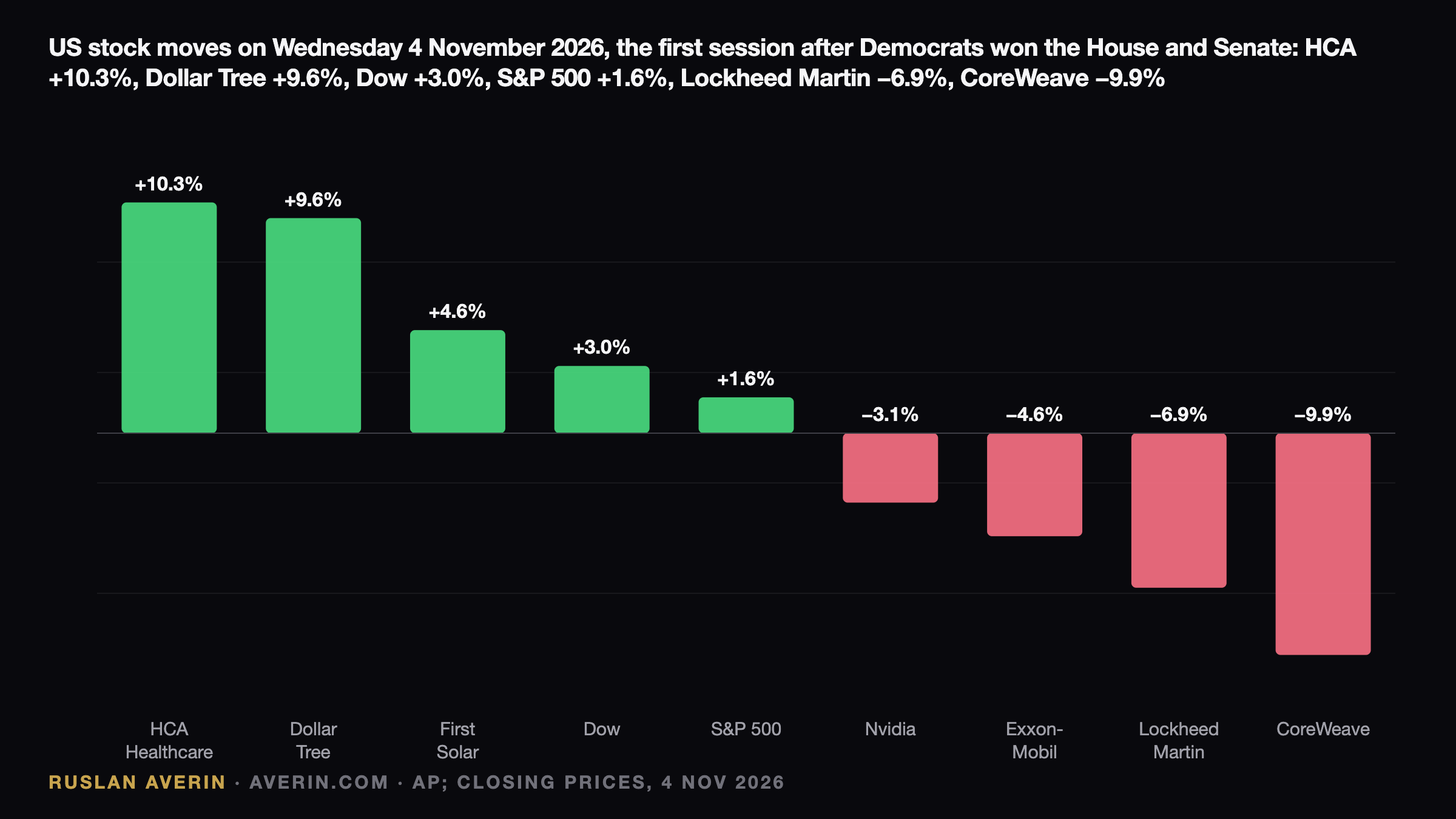
The first session after the vote gave the Dow its biggest gain of the year, CBS News reported: 1,569.40 points, or 3%, to 53,356.12. The S&P 500 added 1.6% to 7,688.62, the AP reported, and linked several moves directly to the result.
HCA Healthcare rose 10.3% on the view that Congress could try to reverse some federal health-care cuts, and the XLV ETF gained 3.06%, Yahoo Finance data show. Dollar Tree, a proxy for low-income consumers, rose 9.6%. The XLF financials ETF, which the AP did not single out, rose 3.51% on the day and 1.15% for the week.
On the other side, Lockheed Martin fell 6.9%, Northrop Grumman 4.5% and General Dynamics 2.6%. Brent crude dropped 8.7% to $94.62 a barrel, a two-month low, taking ExxonMobil down 4.6% and ConocoPhillips 5.2%. Trump Media & Technology Group lost 24.5%.
Thursday: the data-centre shock
The S&P 500 fell 4.4% and the Nasdaq Composite 5.5%, their worst days since April 2025, and the Nasdaq closed more than 10% below its recent high, CNBC reported. All 11 S&P 500 sectors declined, and the Magnificent Seven lost more than $1 trillion in market value.
CNBC tied the sell-off to concern that Democratic wins in Congress and governors' races would slow data-centre construction. Texas Governor-elect Gina Hinojosa told CNN that "we need to stop what we are doing with data centers until we have those protections," as quoted by CNBC. The Philadelphia Semiconductor Index fell 12.25% that day and ended the week 12.15% lower, at 9,390.25.
Analyst Ruslan Averin sees the reaction as larger than the policy risk: as LPL Research noted to CBS News, data-centre permits are mostly a matter for states and utility commissions, not Congress. The sell-off added a political premium to a sector already weak after the Nasdaq's worst October week.
The count behind the headline
Democrats needed net gains of four Senate and three House seats; as of Wednesday afternoon Republicans had flipped no Democratic seat in either chamber, the AP said. By Saturday morning, 7 November, the AP count cited by Yahoo News gave Democrats 254 House seats to 162, with 19 races uncalled, and a 54 to 44 Senate.
In Mississippi, Democrat Scott Colom led Senator Cindy Hyde-Smith by 2,574 votes with 97% counted. In Alaska, Democrat Mary Peltola led Senator Dan Sullivan by 637 votes with 74% counted. In Colorado's 4th District, Representative Lauren Boebert trailed by 3,172 votes. None of the open races can change control of either chamber.
How the pre-election scenarios held up
A preview by analyst Ruslan Averin set out three scenarios. The first, a Democratic House and Senate, is the one that happened, and it was the favourite in prediction markets, with the Senate at 68%. As expected, Treasuries and the dollar barely moved on the result, while health care, defence and energy did.
Three things diverged. Health care rose on hopes of reversed spending cuts rather than drug pricing. The Senate margin beat the 52 seats Decision Desk HQ had projected. And the data-centre sell-off, the week's biggest move, was not on the map at all.
The hryvnia angle
For Ukraine, the main market channel is the dollar. The NBU set the official rate at UAH 45.3206 per dollar for Monday 9 November, against UAH 45.3526 on 2 November. A stronger dollar usually means a cheaper euro in hryvnia terms; a weaker dollar works the other way.
Calendar to the new Congress
Tuesday 10 November brings US October CPI and the deadline for late mail ballots in Mississippi. Colorado counties must finish counting by Friday 13 November, and Alaska may start ranked-choice tabulation on Wednesday 18 November. The November jobs report follows on Friday 4 December, the Fed decides on 9 December, and the new Congress is sworn in on Sunday 3 January 2027.