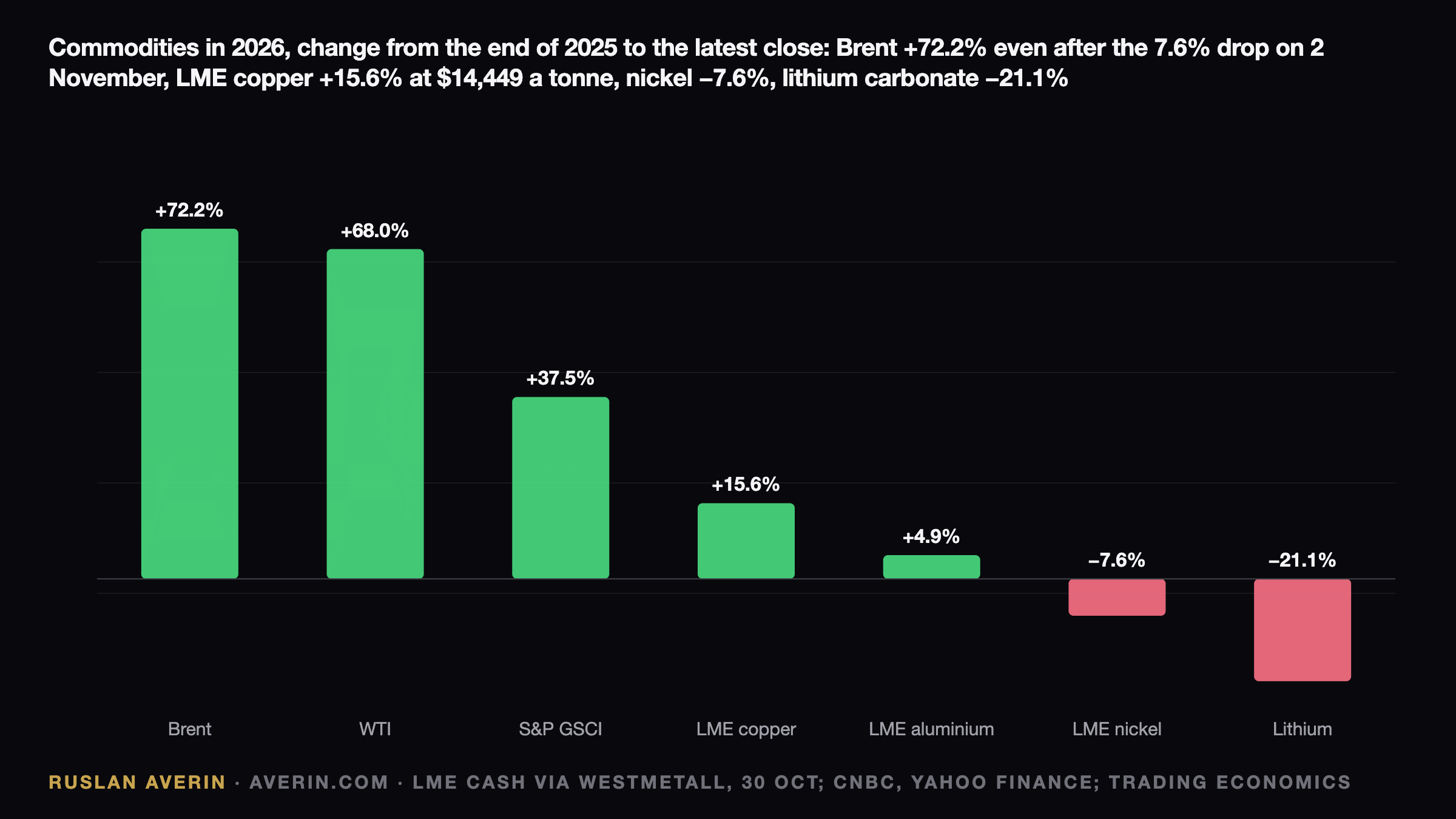
On Monday 2 November Brent crude lost 7.6% to settle at $104.77 a barrel and WTI dropped 7.4% to $96.46, the steepest daily decline since 27 July, CNBC reported, as mediators advanced talks on ending the US–Iran war. Copper hardly moved and lithium kept sliding, a split that tests whether the "commodity supercycle" is one trade or several.
The London Metal Exchange official cash price for copper settled at $14,449 a tonne on Friday 30 October, up 15.6% for 2026 and 2.7% below the year's high of $14,850 set on 17 August, per LME data published by Westmetall and the International Copper Study Group (ICSG).
The scoreboard across energy and metals
| Market | Latest close | Date | Change since end-2025 | Source |
|---|---|---|---|---|
| Brent, front month | $104.77 a barrel | Mon 2 Nov | +72.2% | CNBC, Yahoo Finance |
| WTI, front month | $96.46 a barrel | Mon 2 Nov | +68.0% | CNBC, Yahoo Finance |
| LME copper, cash | $14,449 a tonne | Fri 30 Oct | +15.6% | LME via Westmetall |
| COMEX copper, front month | $6.46 a pound | Fri 30 Oct | +14.7% | Yahoo Finance |
| LME aluminium, cash | $3,114 a tonne | Fri 30 Oct | +4.9% | LME via Westmetall |
| LME nickel, cash | $15,240 a tonne | Fri 30 Oct | −7.6% | LME via Westmetall |
| Lithium carbonate, China | CNY 93,500 a tonne | Mon 2 Nov | −21.1% | Trading Economics |
| S&P GSCI | 754.41 | Fri 30 Oct | +37.5% | Yahoo Finance |
Year-to-date changes are calculated from the 31 December 2025 closes in the same sources. On COMEX, copper's record close for 2026 was $6.80 a pound on Wednesday 9 September, Yahoo Finance data show.
The warehouse paradox in copper
Combined inventories at the LME, COMEX and Shanghai exchanges reached 992,865 tonnes at the end of September, the highest level since June 2003, with most of the build on COMEX. In October LME stocks alone climbed another 24,600 tonnes to 274,000 tonnes, Westmetall data show.
The ICSG counted an apparent refined surplus of 218,000 tonnes for January–August. In a release dated Wednesday 14 October, after its Lisbon meeting, the group forecast a surplus of about 104,000 tonnes in 2026, widening to 368,000 tonnes in 2027.
Why the mines still matter more
Upstream the picture flips. Global mine output fell 0.9% in the first eight months of 2026, the ICSG reported on Friday 23 October. Indonesian concentrate production sank 29% as Grasberg remains constrained by the September 2025 mud rush, and DRC output dropped 26% on lower production at Kamoa after a 2025 seismic event.
Chilean mine output fell 7% on reduced volumes at El Teniente, Escondida and Spence, and the ICSG has trimmed its 2026 mine growth estimate from 1.6% in April to 1.3%. Banks side with the mine: Goldman Sachs lifted its end-2026 forecast to $14,700 a tonne from $13,735 and its 2027 average to $15,400 from $13,800, Newsquawk reported on 20 October.
Demand: big on paper, slow in practice
The structural case rests on electrification. The International Energy Agency expects data-centre electricity use to more than double, from about 415 TWh in 2024 to around 945 TWh by 2030, with waiting times for transformers and cables roughly doubled in three years.
Yet the IEA's Global Critical Minerals Outlook 2026 now sees a copper supply deficit of about 25% by 2035, down from around 30% a year earlier, as DRC and Zambian projects advance. Chinese apparent usage rose 2.8% in January–August while usage elsewhere fell 0.6%, per the ICSG, and China takes 59% of world refined copper.
Battery metals: the broken leg
Lithium carbonate in China fell 25.2% over the past month to CNY 93,500 a tonne on 2 November, Trading Economics data show, after SMM raised its estimate of Chinese inventories by 175,000 tonnes and Australia's Bald Hill mine restarted.
LME nickel is down 7.6% in 2026 and 21.6% below its 6 May high of $19,450. Aluminium, up 4.9% for the year, is 19.2% below its 2 June peak of $3,855. The June rally on peace-deal hopes has largely unwound outside copper.
Oil: a premium that can vanish
President Donald Trump said Iran wants to "make a deal and that could happen", and Foreign Minister Abbas Araghchi said an agreement is possible if Washington "demonstrates goodwill", CNBC reported. Qatari mediation and a plan to reopen the Strait of Hormuz sit at the centre of the talks.
"We do not anticipate a complete erosion of the risk premium via diplomacy headlines alone," Ryan McKay, director of commodity strategy at TD Securities, told CNBC. Even after Monday's drop, Brent is about 72% above its end-2025 level, and the energy-heavy S&P GSCI is up 37.5% this year.
Ukraine's pumps lag the barrel
Ukrainian pump prices track oil with a delay and through the hryvnia. On 2 November the national average was UAH 90.08 a litre for A-95, UAH 104.50 for diesel and UAH 58.41 for autogas, per A-95 Consulting Group data published by Minfin. A one-day Brent drop will not reach the forecourt; a sustained decline would ease diesel first.
Verdict: structural, cyclical, oversupplied
Analyst Ruslan Averin sees no single supercycle. Copper looks structural as long as mine output keeps missing forecasts, but a 368,000-tonne refined surplus in 2027 would make prices near $14,500 hard to defend. Oil looks cyclical: a signed deal that reopens Hormuz would remove most of the war premium, while a breakdown would restore it. Lithium and nickel need supply cuts, not demand headlines.
The signal to watch, in his reading, is inventories rather than forecasts: a true supercycle shows falling stocks alongside rising prices. Copper now has rising prices and the highest exchange stocks in more than two decades, a supply-shock premium that can still correct, as rates, the dollar, Chinese industry and inventories can force sharp moves.
Dates on the calendar
- Tuesday 3 November: US midterm elections.
- Every Wednesday from 4 November: US EIA weekly crude inventories.
- Late November: ICSG monthly release with September data.
- Tuesday 8 – Wednesday 9 December: the next Fed meeting.
- April 2027: the next ICSG forecast meeting in Lisbon.