A policy meeting wedged against a ballot
The Federal Open Market Committee publishes its decision on Wednesday 28 October. Americans vote in the midterm elections on Tuesday 3 November, six days later. That six-day gap has turned an ordinary data debate into a question about institutional optics, and it arrived precisely when the September consumer price index gave the hawks fresh ammunition.
According to 24/7 Wall St., the Fed has tightened within seven days of an election only once since 1990: the 75 basis point hike delivered on 2 November 2022, six days before that year's midterms. UBS strategist Simon Penn described an October move as "politically untenable" on 29 September, well before the inflation data landed.
The 2022 precedent proves the central bank can act on election eve. It also shows the conditions under which it did so: core inflation was then running at 6.6%, not the 2.6% recorded in September. When the next step is framed as timing rather than direction, delaying until 9 December costs almost nothing and removes the awkward headline.
Twenty-four hours that doubled the probability
On Tuesday 13 October, CME FedWatch assigned roughly a 22% chance to a hike at the 27–28 October meeting. The September CPI, released the following morning, changed that arithmetic quickly. Pricing then overshot and partly retraced through the session, leaving a market that still favours a hold but no longer treats it as settled.
| Source | Timing | Hike probability |
|---|---|---|
| CME FedWatch | Before the CPI release | 22.1% |
| CME FedWatch | 12:20 p.m. ET, 14 October | 41.5% |
| KuCoin market wrap | Intraday peak / settled | near 55% / around 40% |
| Realtor.com (via Yahoo Finance) | Later on 14 October | 35% |
| Polymarket | Spike / settled | nearly 50% / closer to 30% |
The volatility fits a longer swing. Odds sat near 70–73% on 23–24 September and collapsed to about 19% by 9 October after a softer PCE report. Futures had shifted the next move to December, pricing roughly 70% for a hike at the 8–9 December meeting on 9 October, according to FXStreet. A range of 4.00–4.25% is already expected by year-end.
Energy carried the headline
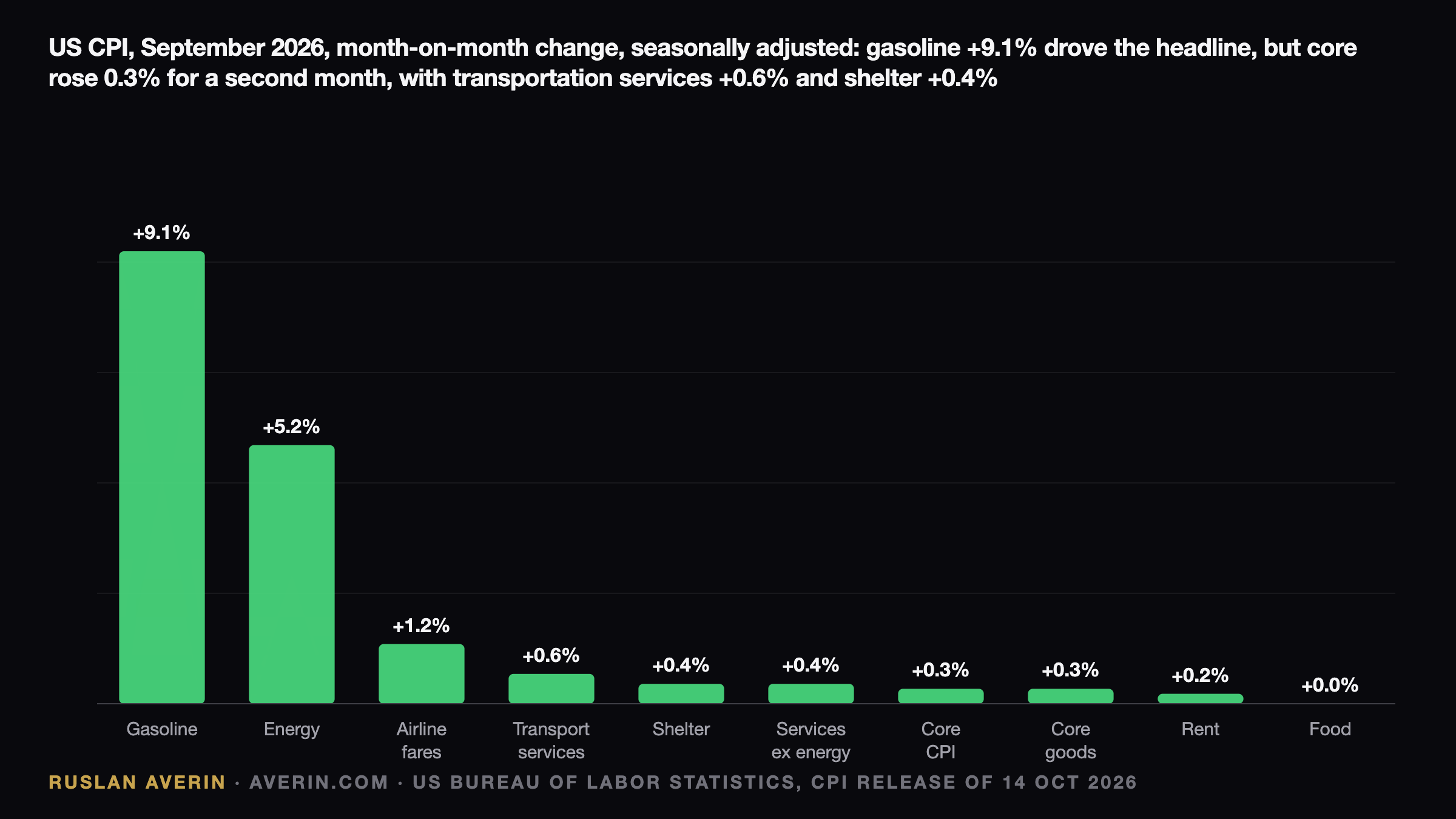
Annual inflation climbed to 3.7% from 3.4% in August, above the 3.6% consensus, with prices up 0.6% on the month. The energy index jumped 5.2% in September and stands 20.4% higher on the year. Gasoline rose 9.1% on the month, seasonally adjusted, and 34.2% year on year. Food was flat monthly and 2.5% higher annually.
Shelter, the heaviest component, rose 0.4% after 0.3% in August and 3.2% on the year. Yet rent of primary residence advanced only 0.2% and owners' equivalent rent 0.3%. The acceleration therefore came from smaller lines outside the two rent measures, which argues against a renewed housing-cost spiral.
Where the fuel shock becomes a core problem
Core CPI rose 0.3% on the month and 2.6% on the year, against expectations of 0.2% and 2.5%. It was the second consecutive 0.3% monthly reading, a sequence the Fed cannot dismiss as an energy artefact. Services less energy services gained 0.4% monthly and 3.1% annually, the clearest channel through which fuel costs reach the core with a lag.
Transportation services rose 0.6% after 0.5% in August, while airline fares increased 1.2% on the month and 22.4% on the year. Medical care services added 0.3%. Core goods rose 0.3%, the fastest of the three months shown, though just 0.7% annually, with used cars up 0.7%.
In the view of analyst Ruslan Averin, the report is hot exactly where policymakers must respond and benign where the long-run trend is decided: rents at 0.2% a month describe no spiral, but two straight 0.3% core readings describe a shock that is spreading.
The September decision and the voices since
The FOMC voted 12–0 on 16 September to lift the target range a quarter point to 3.75–4.00%, the first increase since July 2023 and the first under Chair Kevin Warsh. The dot plot put the median end-2026 rate at 4.1%, and 16 of 18 participants projected at least one further hike this year. Minutes released on 7 October confirmed that majority.
Governor Christopher Waller said on 8 October that additional hikes are needed but "don't have to come at back-to-back meetings", as reported by FXStreet. St. Louis Fed President Alberto Musalem favoured increases over the next six to nine months. Cleveland's Beth Hammack, a voter, told Barron's on 12 October she prefers smaller, more frequent moves.
New York Fed President John Williams said only one more hike should be necessary this year, according to Realtor.com. Vice Chair Philip Jefferson, Waller and Williams had all signalled patience before the CPI. Warsh speaks late on Thursday 15 October New York time in Bangkok, alongside IMF Managing Director Kristalina Georgieva, with the blackout starting Saturday 17 October.
How assets repriced on 14 October
Equities suffered their worst session since July, AP reported. The S&P 500 closed at 7,718.94, down 1.1%, its fifth loss in six sessions after a record high. The Nasdaq Composite fell 1.9% to 26,692.87 and the Russell 2000 dropped 1.9% to 2,729.53. The Dow lost 0.1% at 51,621.48, with AI names leading the slide.
The curve flattened. Treasury par yields put the 2-year at 4.82% from 4.79%, the 10-year at 5.19% from 5.21% and the 30-year at 5.52% from 5.56%. The dollar index touched 102.88 intraday, up as much as 0.7%, closing near 102.55 per Trading Economics. December gold fell 1.7% to $4,107.90; WTI rose 1.0% to $95.09.
The household arithmetic
Mortgage pricing tracks the 10-year rather than the policy rate. The Mortgage News Daily 30-year fixed index finished 14 October at 7.45%, down 0.01 on the day and below its 52-week high of 7.61%. A hike alone would not push mortgage costs higher while long yields decline on growth concerns.
Cash holders are already compensated: the 3-month Treasury bill yielded 4.28% on 14 October, above the top of the Fed's range. A move in October or December would add roughly a quarter point to money market and savings yields. Variable-rate borrowers pay about $25 more annually per $10,000 outstanding.
Three ways 28 October can end
A hold paired with a hawkish statement remains the base case, keeping the range at 3.75–4.00% while flagging December. A hike to 4.00–4.25% becomes likelier if Warsh leans that way on Thursday or the 15 October producer price index runs hot, which would flatten the curve further.
The third path, a hold with a softer tone, requires cooler incoming data and would benefit the 10-year and mortgage borrowers most. Analyst Ruslan Averin notes that the practical question is no longer direction but sequencing, and the calendar supplies an unusually cheap reason to wait.