The gap that has to be explained
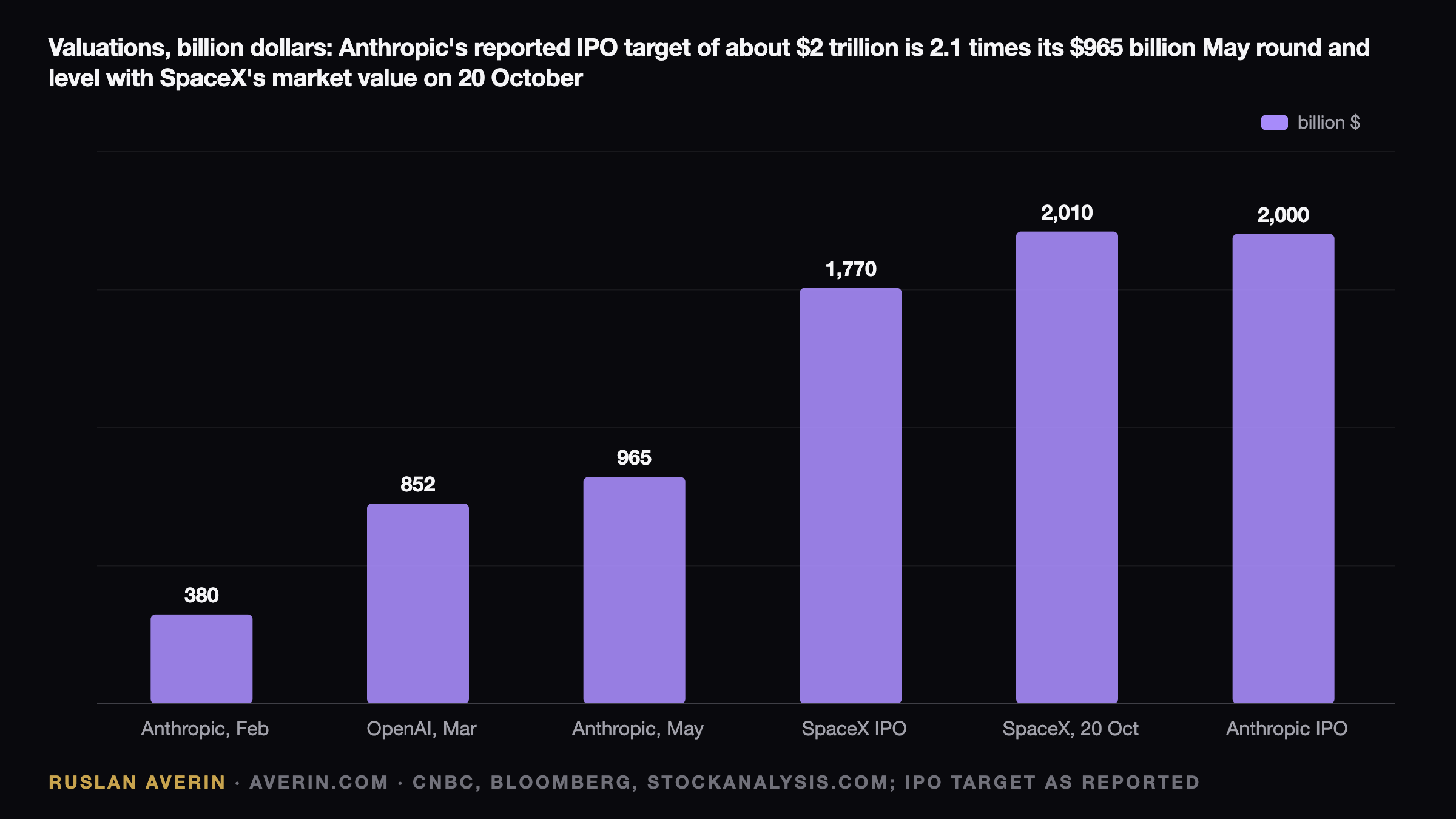
Every large flotation carries a question that the prospectus must answer, and for Anthropic it is unusually blunt. Private investors paid at a $965 billion valuation on 28 May. Reports now point to a listing at about $2 trillion. That is roughly 2.1 times the private mark in five months, with no public audited filing yet available to justify the step.
CNBC reported on 13 October that the Claude developer "is plowing ahead with what could be a $2 trillion listing". Forbes Ukraine repeated the figure on 21 October, citing international media. Reuters, quoted by CNBC, pointed to November. People familiar with the plans could not confirm a date, and no prospectus has been made public.
The record as it currently stands
| Item | Figure | Source |
|---|---|---|
| Confidential S-1 filed | 1 June 2026 | Anthropic statement, via CNBC |
| Last private round | $65 billion Series H at $965 billion, 28 May | Anthropic, via CNBC |
| IPO valuation sought | about $2 trillion | CNBC, 13 October |
| Listing month | November | Reuters, via CNBC |
| Exchange | Nasdaq | CNBC, after Business Insider |
| Q3 2026 revenue | $16.8 billion | CNBC, Bloomberg, The Information |
| 2025 revenue / net loss | $4.6 billion / $42 billion | leaked prospectus, Reuters via CNBC |
Neither the bank syndicate nor the size of the offering has been confirmed in the reports reviewed here. Bloomberg reported on 11 September, citing Reuters, that Nvidia was weighing up to $10 billion of backing for the flotation. The Series H itself was led by Altimeter Capital, Dragoneer, Greenoaks and Sequoia, after a $380 billion valuation in February.
Growth is real, and it is decelerating
Anthropic told investors revenue reached $4.7 billion in the first quarter, $11.6 billion in the second and $16.8 billion in the third, and that the third quarter was profitable on an adjusted basis. Nine-month revenue therefore stands at $33.1 billion. The sequence looks spectacular until the increments are compared with one another.
The second quarter rose 146.8% on the first. The third rose 44.8% on the second. Annualising the third quarter produces $67.2 billion, close to the $65 billion run-rate the company cited in July. CNBC, citing The Wall Street Journal, wrote that investors expect about $110 billion of annualised revenue by year-end.
Against those figures, $2 trillion works out at roughly 30 times the annualised third quarter, or about 18 times the run-rate investors anticipate by December. SpaceX, by contrast, trades at about 87 times trailing revenue of $23.04 billion on stockanalysis.com data. The bearish outlier is New Constructs, which values Anthropic near $150 billion and calls it "the most ridiculous IPO of 2026", citing the $42 billion net loss on $4.6 billion of 2025 revenue.
Why the float matters more than the headline figure
Index demand is often assumed to follow automatically from size. Nasdaq's methodology makes that assumption unsafe. The Fast Entry provision applies to a newly listed company whose full market value ranks within the top 40 index members: it is evaluated at the end of the seventh trading day and typically added after 15 trading days, with the announcement after the tenth. The usual three-month seasoning requirement does not apply.
The weighting rule is where the arithmetic tightens. The market value used for weighting is the lesser of total shares or three times the free-floating shares. An offering of 5% of the company, about $100 billion at a $2 trillion valuation, would be weighted as though the company were worth roughly $300 billion if only those shares counted as float. Index funds would buy, but far less than the headline implies. S&P 500 inclusion remains a separate committee decision.
The calendar leaves little room
A confidential filing fixes nothing. Under the rule CNBC described in June, the public prospectus must reach investors at least 15 days before the roadshow begins. SpaceX filed confidentially on 1 April, published its prospectus on 20 May and priced in June. For a November debut, Anthropic's public S-1 has to surface within weeks.
That document will be the first with audited numbers, the share structure and the offering size. Until then, each valuation figure is a target described by people familiar with the plans rather than a price range.
The comparables investors are actually using
SpaceX sold 555 million shares at $135 in June at a $1.77 trillion valuation, with CNBC later putting the total raised at $85.7 billion including the underwriters' option. SPCX closed on Tuesday 20 October at $147.79, which is 9.5% above the offer price but 34.5% below the 52-week high of $225.64, for a market value near $2.01 trillion. OpenAI, valued at $852 billion in March, is seeking funding at about $1.4 trillion after delaying its own listing, Bloomberg reported on 29 September.
Amazon and Alphabet carry the mark-to-market
Amazon's 10-Q for the quarter to 30 June shows nonvoting preferred stock in Anthropic carried at about $92.5 billion and convertible notes at a fair value of about $97.9 billion, roughly $190.4 billion combined. The company booked $50.5 billion of upward adjustments in the second quarter alone. Its financing facility of up to $20 billion now stands at $15 billion after a $5 billion Series H investment, while AWS expanded its commitment by more than $100 billion over 10 years.
Amazon closed on 20 October at $262.63, a market value of about $2.83 trillion, so the stake equals roughly 6.7% of the company. The carrying marks include discounts for lack of marketability, meaning a $2 trillion price would not pass through one for one. Alphabet reported $124.3 billion of non-marketable equity securities as of 30 June, "primarily" one private holding that Bloomberg identified as Anthropic; at $340.28 and about $4.16 trillion, that is near 3%.
The financing question underneath it all
Reuters, drawing on the prospectus, reported plans to spend $518 billion on cloud, computing and other infrastructure in the coming year. October's sell-off was driven less by demand doubts than by funding costs, with CoreWeave bond yields near 15% and record spreads on AI-related high-yield debt.
Analyst Ruslan Averin argues the listing cuts in two directions. Equity is cheaper than the debt markets have begun to question, and the Financial Times reported $1.70 of revenue per dollar of compute in the third quarter. Yet a $2 trillion entrant creates a fresh claim on capital already committed to Nvidia, the hyperscalers and the neoclouds.
Five markers for the next few weeks
The public S-1 comes first: audited revenue, GAAP against adjusted profit, and the partner-revenue accounting that muddied OpenAI's figures. Then the price range, measured against $965 billion and against SpaceX's roughly $2.01 trillion. Then the float, which sets the index weight under the three-times rule.
Dilution follows. CNBC reported on 18 October that Anthropic plans to commit 5% of its shares to a public benefit fund, plus 2% for every 50% rise above a baseline. Finally, Amazon and Alphabet earnings will reveal how third-quarter marks moved, giving the first audited read on paper gains that already dominate both income statements.