A Week Without a Miss
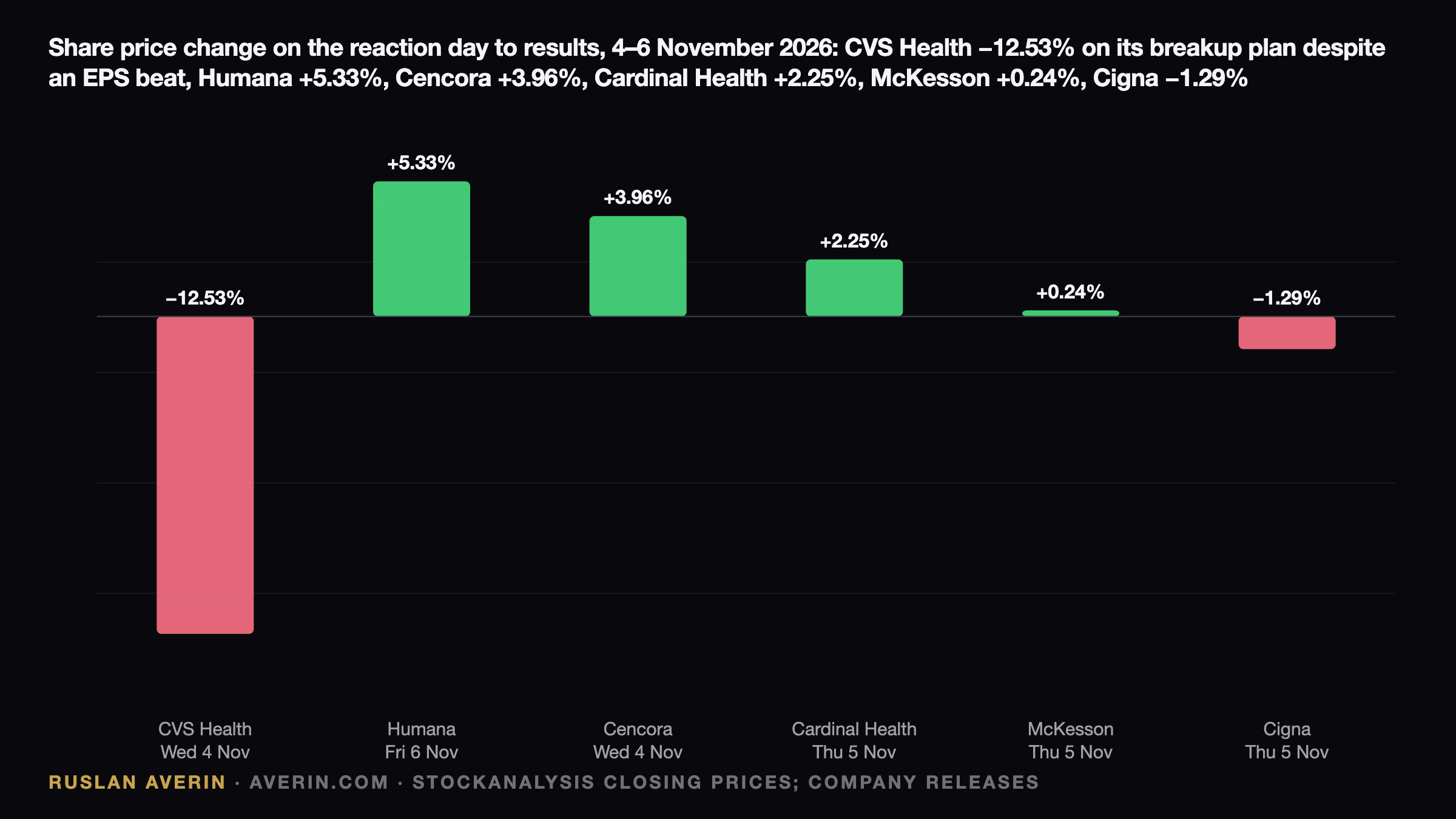
Between Wednesday 4 and Friday 6 November six large US healthcare companies reported, and every one beat the Zacks earnings consensus. Five also raised guidance. Yet reactions ranged from a 12.53% drop at CVS Health to a 5.33% gain at Humana, so the earnings line itself explained little this week.
Analyst Ruslan Averin reads the week as three separate verdicts: one on corporate structure at CVS, one on next-year guidance at the drug distributors, and one on cost control at the insurers. The scorecard shows how far apart they ended.
Actual Results Against Zacks
| Company | Adjusted EPS vs Zacks | Revenue vs Zacks | Guidance | Reaction-day close |
|---|---|---|---|---|
| CVS Health | $2.09 vs $1.62 | $108.40 billion vs $105.04 billion | 2026 at least $8.20 (was $7.90–8.10); 2027 at least $8.65 | $79.96, −12.53% (4 Nov) |
| Cencora | $4.66 vs $4.56 | $88.35 billion vs $88.16 billion | FY2027 $19.40–19.75 (Zacks $19.78) | $354.00, +3.96% (4 Nov) |
| McKesson | $11.68 vs $10.69 | $110.96 billion vs $110.11 billion | FY2027 $45.60–46.40 (was $44.20–45.00) | $1,072.00, +0.24% (5 Nov) |
| Cardinal Health | $3.26 vs $2.92 | $67.51 billion vs $66.96 billion | FY2027 $12.80–13.00 (was $12.40–12.60) | $267.82, +2.25% (5 Nov) |
| Cigna | $7.98 vs $7.46 | $73.79 billion vs $73.53 billion | 2026 at least $30.60 (+$0.15) | $301.48, −1.29% (5 Nov) |
| Humana | −$0.70 vs −$1.03 | $40.83 billion vs $40.46 billion | 2026 at least $9.50 (was at least $9.00) | $433.74, +5.33% (6 Nov) |
Distributors: GLP-1 Volume Meets Price Cuts
McKesson, reporting after the close on Wednesday 4 November, delivered the raise investors wanted. Adjusted EPS of $11.68 rose 18%, revenue grew 8% to $111.0 billion, and guidance moved to $45.60–46.40 from $44.20–45.00, clearing the $45.00 bar set in the rfc-base distributor preview.
Chief financial officer Kenny Cheung said GLP-1 distribution revenue reached $16 billion, up 26% and 8% from the June quarter, faster than the previous quarter's 24%. Oncology & Multispecialty revenue rose 24% to $15.0 billion, but its adjusted operating profit only 8%, after 41%. The stock hit a 2026 record of $1,069.44 on Wednesday, up 6.98%, and ended Friday at $1,060.84.
Cardinal Health posted the cleanest raise on Thursday 5 November. Adjusted EPS rose 28% to $3.26 on revenue up 5% to $67.5 billion, and fiscal 2027 guidance went to $12.80–13.00 from $12.40–12.60. Pharmaceutical and Specialty Solutions profit climbed 17% to $783 million. GLP-1 drugs added about 500 basis points of revenue growth, while Inflation Reduction Act price cuts removed about 400.
Cencora showed that tension more starkly: GLP-1 sales added $2.8 billion to quarterly revenue, and manufacturer price cuts took away the same $2.8 billion. It earned $4.66 in its fiscal fourth quarter and $17.97 for the year, but the fiscal 2027 guide of $19.40–19.75 has a midpoint of $19.575, below the $19.78 Zacks figure.
Revenue growth is guided at 3–5%, against 5.0% in fiscal 2026, with Specialty Pharmaceutical and Provider Services operating income up 18–21% and Pharmaceutical Distribution and Services only 2–4%. The stock rose 3.96% to $354.00 on Wednesday, then fell 4.05% and 1.80% to $333.56 on Friday, 2.0% below its pre-report close.
Insurers: Paid for Cost Control
Humana reported on Friday 6 November. Its adjusted loss of $0.70 a share compared with a Zacks consensus loss of $1.03 and its own guide of about $1.00. The Insurance segment benefit ratio was 93.7%, better than management's "slightly above 94%", and full-year guidance rose to at least $9.50 from at least $9.00.
Chief financial officer Celeste Mellet expects Part D cost trend of 14–15% in 2027, against 11–12% this year, and core medical trend of 8–9% against 7–8%. The shares still rose 5.33% to $433.74, a sign that investors valued the quarter's discipline over next year's cost warning.
Cigna, on Thursday, beat with $7.98 against $7.46, but its Cigna Healthcare medical care ratio rose to 85.0% from 84.8%, and Pharmacy Benefit Services pre-tax adjusted income fell 22% to $765 million on large client renewals. The stock lost 1.29% that day and 2.62% on Friday, to $293.59.
CVS: The Quarter Was Not the Problem
Aetna's medical benefit ratio was 91.3%, against 92.4% expected by Zacks and 92.8% a year earlier. Health Care Benefits adjusted operating income rose to $912 million from $314 million, although guidance had implied a second-half loss. Reserve help was modest, about $0.1 billion in the quarter.
Prior-year claims developed favourably by $1.3 billion in nine months against $1.2 billion in the first half, and days claims payable rose 0.2 days to 41.9. The 2026 guide rose to at least $8.20 from $7.90–8.10; chief financial officer Brian Newman set 2027 at least $8.65, above the earlier $8.44 floor and the $8.51 Zacks consensus.
Caremark is the soft spot: Health Services should earn at least $7 billion in 2027. "We are confident 2027 will reflect trough earnings for this segment," Newman said. The same morning CVS announced a split into two listed companies by the first half of 2028, intended to be tax-free.
CVS Health would keep Aetna, Caremark, CVS Specialty, Oak Street Health and Signify Health under chief executive David Joyner; CVS Pharmacy would take about 9,000 stores, mail pharmacy, MinuteClinic and Health100 under Prem Shah. CNBC reported the shares fell about 12% on the announcement.
After gains of 1.71% on Thursday and 3.10% on Friday, the stock closed at $83.85, still 8.3% below the $91.41 close of 3 November. Every condition of the constructive case in the rfc-base preview was met; the breakup was simply not in it. In his view, the market is pricing separation costs and a Caremark trough, not weakness in the quarter.
Dates to Watch
- 13 November: record date for Cencora's dividend, raised 10% to $0.66 and payable 30 November.
- 7 December: Medicare open enrollment ends, setting 2027 membership at Aetna and Humana.
- First half of 2028: CVS separation target, subject to a Form 10 filing and board approval.