The break-even test for UAH 100,000
The most useful way to read Investment Capital Ukraine's new forecast is backwards, starting from the saver's desk. On 16–17 October a twelve-month hryvnia deposit priced off the UIRD index pays 14.09%, which falls to 10.85% once the 23% tax on interest is applied. UAH 100,000 placed on those terms becomes roughly UAH 110,850 in a year.
The dollar alternative looks thin. Converted at the bank cash selling rate of 45.19, the same sum buys $2,212.88. A twelve-month dollar deposit yields 1.13%, or 0.87% after tax, lifting the holding to $2,232.13. The two strategies draw level only if the dollar trades near UAH 49.7 in October 2027.
Government paper raises the bar further. Military bonds maturing in September 2027 were placed in September at weighted average yields of 15.16–15.18%, exempt from tax, and ICU notes that the Ministry of Finance has not raised primary-market yields. Against a one-year bond at 15.17%, the dollar would need about UAH 51.6 to compete.
What ICU actually published on 14 October
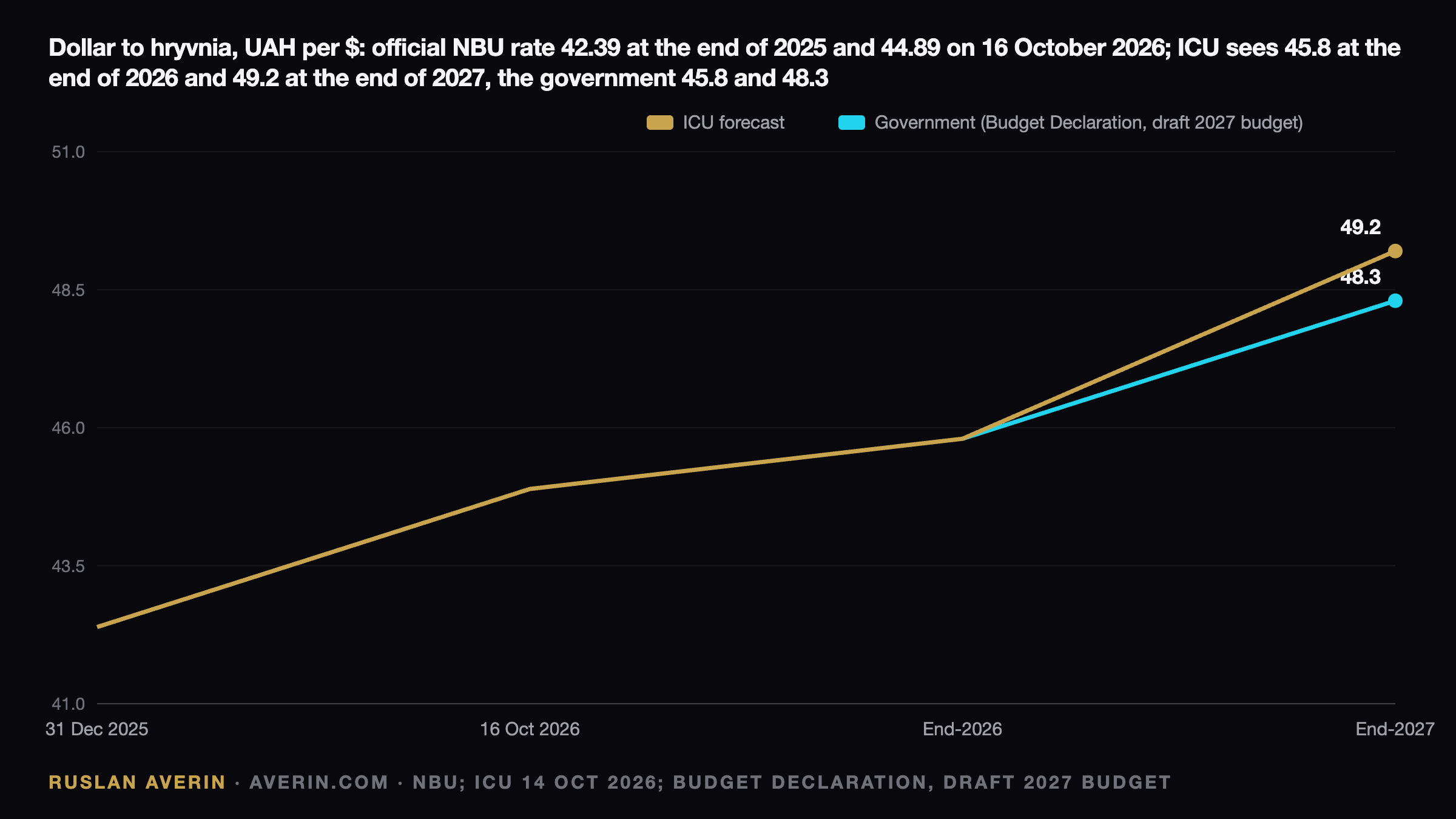
The macro review dated Wednesday 14 October is the first in which ICU models a shrinking economy in two consecutive years. Drawn as a straight line between its own end-of-period marks, the house path implies roughly UAH 48.6 in October 2027 — below both break-even levels. On that trajectory the hryvnia deposit earns about 10.85%, converted dollars about 8.5%, and the bond about 15.2%.
Two figures are routinely confused in retellings. UAH 45.8 belongs to the end of 2026 and is not new: ICU carried it over unchanged from June. UAH 49.2 belongs to the end of 2027. The 12% is a winter peak used as the December reading, not an annual average.
| Indicator | End-2026 | End-2027 |
|---|---|---|
| Dollar, official | UAH 45.8 | UAH 49.2 |
| Dollar, annual average | UAH 44.3 | UAH 47.1 |
| Consumer inflation, December | 12.0% | 8.2% |
| Real GDP | −0.6% | −1.9% |
| NBU key rate | 16.5% | 15.5% |
| International reserves | $59.7 billion | $53.2 billion |
ICU expects one more step of 50 basis points in October, to 16.5%, held until the end of the first half of 2027. Prices return to single digits only in the third quarter of 2027, with a 2027 average of 10.4%. The GDP line for 2026 was +0.8% in June. The whole construction assumes no peace agreement in the medium term and very limited Russian territorial gains.
Where the hryvnia sits in mid-October
The National Bank set the official rate for Friday 16 October at UAH 44.8871 per dollar, applying the same level on Saturday 17 and Sunday 18 October, then UAH 44.8625 for Monday 19 October. The record low remains UAH 45.0802, the official rate of 14 October. At the end of 2025 the rate stood at UAH 42.3878.
Minfin's average bank cash quotes on Saturday 17 October were UAH 44.70 to buy and 45.19 to sell, while the cash market traded at 45.00 and 45.12. Measured from end-2025, the 45.8 target implies roughly 8% of dollar strength across 2026; from the current official rate it is about 2% over ten weeks. The 49.2 adds a further 7.4%.
ICU describes this as a continuation of "managed and slow devaluation", with monthly swings that rarely exceed 1.0–1.5%. Conversion costs matter against such small moves: a round trip at bank cash rates of 44.70 and 45.19 destroys about 1.1%, while the cash market spread of 45.00 and 45.12 costs about 0.3%.
Four pressures behind the downgrade
ICU calls this the hardest period since 2022. Strikes on industry and logistics pushed industrial output down 6.1% year on year in August, with construction and transport also contracting. The Black Sea route shows in trade data: goods exports fell 19% year on year in August while imports rose 23%, largely weapons and components financed through the defence tranche of the EU's Ukraine Support Loan.
Prices are rising on costs rather than demand. ICU attributes the inflation jump almost entirely to logistics and fuel, noting that September's 2.1% monthly increase was the largest for a September since 2015.
Financing is the fourth strain. Partners have pledged no more than $25 billion of budget support for next year against a need of over $50 billion, leaving the government to source more than $25 billion. Reserves fell 18% in the first nine months of 2026 to $47.1 billion; ICU expects at least $22 billion of budget support by year-end to restore them to roughly $60 billion. Should the 2028 gap look unresolved, ICU warns the NBU would have to accelerate devaluation in the second half of 2027.
ICU against the official projections
The National Bank publishes no exchange-rate forecast. Its July Inflation Report, released on 6 August, sees inflation of 10% in 2026, 6.9% at end-2027 and 5% in 2028, real GDP growth of 1.8% in 2026 and 2.8–3% annually in 2027–2028, and reserves of $70–74 billion across 2026–2028. September already matched the December inflation mark: 2.1% monthly, 10.0% year on year, core inflation 8.8%. The next decision and updated forecast fall on Thursday 29 October.
Government assumptions sit between the two. The Budget Declaration for 2027–2029, approved in June, used UAH 45.8 at end-2026 and UAH 48.3 at end-2027. Draft budget bill No. 16000 assumes an average of UAH 47.1, GDP growth of 1.3% and inflation of 8.0%, according to TSN's summary. The Ministry of Finance treats the rate as a calculation input, not a market call.
The 2027 averages are identical at UAH 47.1. The year-end gap is 90 kopecks. The genuine divergence lies in output and prices: ICU models contraction and places inflation two percentage points above the NBU's July path at the end of this year.
Real returns and what to watch
Nominal yields flatter. At ICU's 12% winter peak, a deposit paying 10.85% after tax loses about 1% in real terms; measured against the 8.2% projected for December 2027, it gains about 2.4%. In the view of analyst Ruslan Averin, the forecast argues for anchoring hryvnia savings in instruments that clear inflation — chiefly tax-free OVDP — while treating dollars as insurance against the very scenario ICU sketches, a 2028 funding hole forcing faster devaluation. Household OVDP holdings reached UAH 167.5 billion on 1 October.
The near-term calendar is short. On 29 October the NBU decides on a key rate currently at 16%, with ICU expecting 16.5%, and publishes a refreshed forecast whose inflation path may drift from 10% towards 12%. Weekly intervention data and the official rate's distance from the 45.08 record remain the live signals, alongside the $22 billion of external support ICU expects by year-end and the first reading of the 2027 budget.