The missing tenth of global refining capacity
The defining number in the third quarter of 2026 was not a crude price. It was the share of the world's refining capacity sitting idle. With roughly 10% of that capacity offline in Russia and the Middle East, crude demand softened while product supply tightened, and the two largest U.S. oil companies collected the spread.
Exxon Mobil (NYSE:XOM) and Chevron (NYSE:CVX) released third-quarter figures on Friday 30 October, before the U.S. open. Both cleared the consensus compiled by LSEG, and both did so for the same mechanical reason: crude was cheaper than in the second quarter, while refining margins reached records.
How the shares were trading into the print
Exxon closed on Thursday 29 October at $183.29 and Chevron at $231.46, according to stockanalysis.com. In pre-market trading Exxon was quoted at $186.34 at 8:30 a.m. New York time, up 1.66%, and Chevron at $234.32 at 8:32 a.m., up 1.24%, on the same source. Those are indications rather than closing prints.
Side by side with the LSEG numbers
| Line | Exxon Mobil | Chevron |
|---|---|---|
| Adjusted EPS | $4.23 | $5.28 |
| LSEG consensus EPS | $4.08 | $4.89 |
| GAAP EPS | $3.72 | $5.06 |
| GAAP net income | $15.4 billion | $9.9 billion |
| Revenue and other income | $113.2 billion | $67.8 billion |
| LSEG revenue consensus | $103.1 billion | $61.6 billion |
| Cash flow from operations | $25.7 billion | $16.0 billion |
Company figures come from the two earnings releases, with consensus from LSEG as reported by CNBC and Reuters. Exxon's adjusted earnings of $17.5 billion beat the $16.6 billion LSEG estimate, Reuters said. The adjusted EPS beats work out at about 3.7% for Exxon and about 8% for Chevron.
The year-ago comparison is starker. Exxon earned $7.5 billion, or $1.76 a share, and Chevron $3.5 billion, or $1.82. Headline profit therefore roughly doubled at Exxon and nearly tripled at Chevron.
Chevron pushed a record volume of barrels through its plants
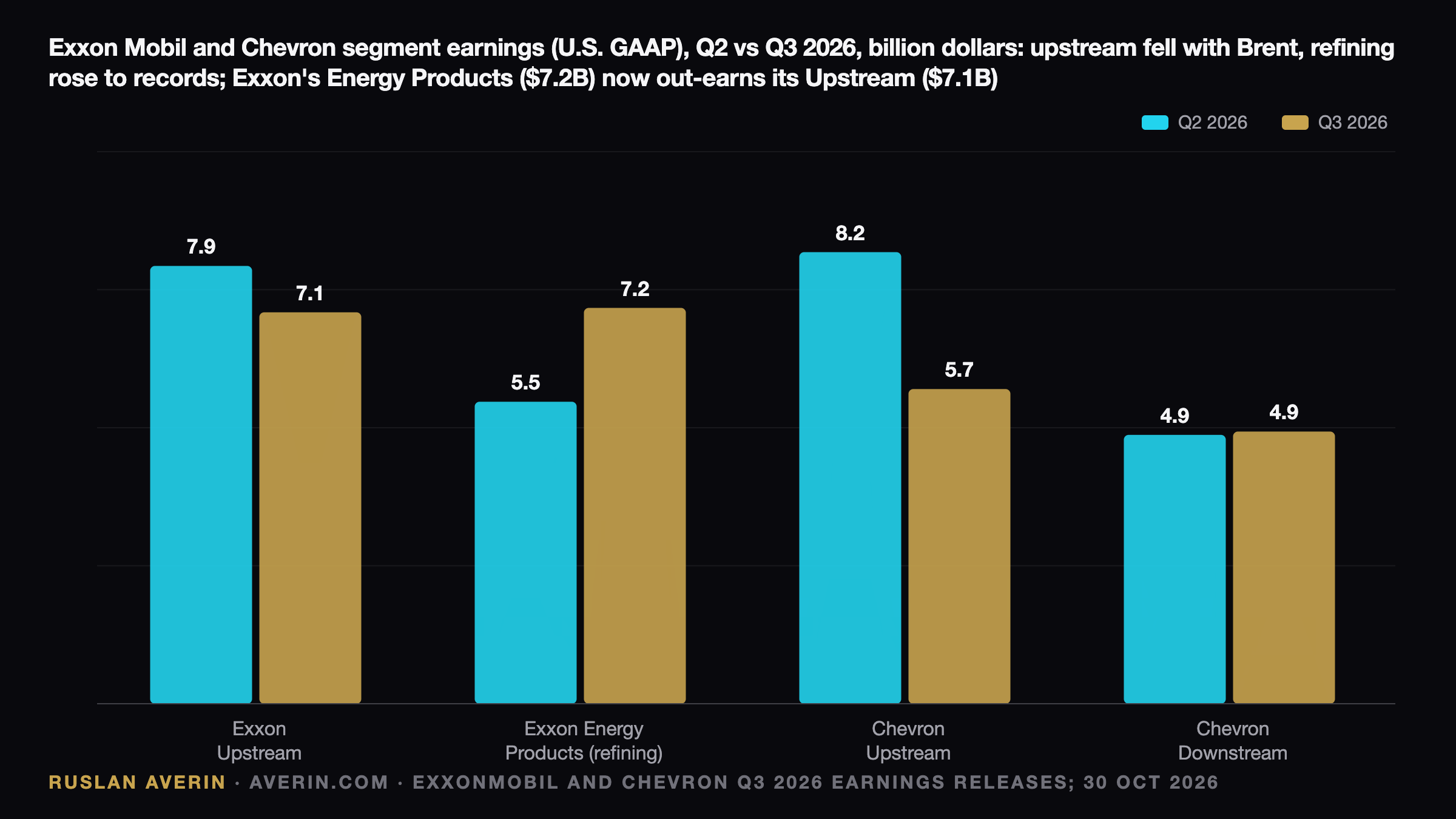
Chevron's adjusted earnings reached $10.4 billion, or $5.28 a share, against $1.85 a year earlier. The downstream division produced $4.93 billion versus $1.14 billion in the same quarter of 2025. U.S. refineries processed a record 1.09 million barrels a day at close to 98% utilisation.
Production told a different story. Net output of 3,980 thousand barrels of oil equivalent a day (koe/d) fell from 4,086 a year earlier. U.S. volumes of 2,043 koe/d were flat and stayed above 2 million for a fifth consecutive quarter, while international production dropped 109 koe/d as higher prices trimmed entitlement barrels and Middle East conflict disrupted operations.
The Hess acquisition shapes the comparison more than any single disclosed line. The year-ago quarter carried Hess severance and transaction costs that have now rolled off, and the claim that U.S. production is up 27% from two years ago largely reflects the deal. Guyana volumes are not broken out. Chevron also flagged plans by its Venezuelan joint ventures to invest $7 billion over five years.
Exxon's refining arm has overtaken its wells
Exxon's Energy Products segment earned $9.05 billion on an adjusted basis, against $4.10 billion in the second quarter. Its indicative refining margin, a Platts-based marker, averaged $50.3 a barrel versus $29.0 in the second quarter, and Gulf Coast refineries ran at 100% crude unit utilisation. On a GAAP basis the segment delivered $7.2 billion against $7.1 billion upstream.
Upstream moved in the opposite direction. Adjusted upstream earnings slipped to $7.31 billion from $9.19 billion on weaker prices and what the company describes as an accelerated Guyana entitlement impact. Output of 4,496 koe/d compared with 4,514 in the second quarter, and the nine-month average of 4,534 koe/d trailed 4,651 a year earlier.
Two regions frame the volume picture. Permian production ran "just above 1.8 million" barrels of oil equivalent a day, consistent with 2026 guidance. Middle East output was about 550 koe/d, split between 250 in Qatar and 300 in the UAE; disruptions there cost roughly $2.9 billion of nine-month earnings, and Exxon assumes about 350 koe/d stay offline in the fourth quarter. Guyana passed one billion barrels of cumulative production, with a fifth FPSO due late in the quarter.
The gap between headline and adjusted profit
Both companies absorbed large negative timing effects, the mark-to-market on derivatives hedging physical cargoes still at sea. Exxon's amounted to $2.54 billion, partly offset by $449 million of net identified items that included a $675 million gain on asset sales. Chevron's came to $1.58 billion, alongside a $160 million legal reserve and a $110 million impairment.
Those effects unwind when the cargoes arrive, which is precisely why management teams and the sell side anchor on adjusted earnings rather than the GAAP line.
Cash returns and the 2027 buyback commitment
Exxon generated $19.1 billion of free cash flow on $7.0 billion of cash capital spending, taking the nine-month figure to $20.0 billion and keeping the year inside its planned range. Net debt fell by more than $9 billion to $22.1 billion, a net-debt-to-capital ratio of 7.5%.
Distributions totalled $9.4 billion, comprising $4.3 billion of dividends and $5.1 billion of buybacks, lifting the year-to-date figure to $28.0 billion. The fourth-quarter dividend rises 4% to $1.07 a share, a 44th consecutive annual increase, equal to $4.28 a year and a 2.3% yield on Thursday's close. Reuters noted the 2027 buyback target of $20 billion, matching 2026, "assuming reasonable market conditions".
Chevron produced $16.0 billion of operating cash flow, or $16.6 billion before working capital, and $12.0 billion of free cash flow on $4.0 billion of capital spending. It paid $3.48 billion of dividends, repurchased $2.50 billion of stock, bringing nine-month buybacks to $8.19 billion, and cut total debt by $3.5 billion. The quarterly dividend of $1.78 annualises to $7.12, a 3.1% yield.
The crude path the averages conceal
Brent averaged $97.01 a barrel in the third quarter on Exxon's marker table, down from $104.52 in the second; Chevron's Platts figure shows the same $97 against $104. The averages mask a sharp climb: EIA monthly Brent spot was $83.76 in July and $114.16 in September. October ran higher still, with front-month Brent settling at $108.82 on 21 October around the Shaybah drone strike.
Europe reported the same pattern a day earlier
Shell delivered $10.81 billion, or $1.93 a share, against an implied figure of about $10.2 billion, and raised its buyback to $5.0 billion for the coming quarter from $4.2 billion. TotalEnergies posted adjusted net income of $9.10 billion versus roughly $7.6 billion implied by Benzinga's consensus, with refining and chemicals doubling to $3.6 billion. European cash, however, now faces new windfall-tax proposals.
Three variables that decide the fourth quarter
In analyst Ruslan Averin's view, this was a refining quarter wearing an oil quarter's clothes. Three items deserve attention. First, refining margins as Russian and Middle East capacity is repaired, with Exxon's $50.3 marker the most exposed figure. Second, Middle East volumes, where the assumption of about 350 koe/d still offline is the swing factor.
Third, timing effects: Exxon's $2.54 billion and Chevron's $1.58 billion should reverse if prices steady, flattering fourth-quarter GAAP profit. On these cash flows the distributions look comfortable, since Exxon's $19.1 billion of quarterly free cash flow covers its $9.4 billion of payouts twice over.