One mover, two bystanders
Three monetary authorities published decisions inside a single day, and only Kyiv touched its policy lever. The National Bank of Ukraine lifted the key rate by 0.5 percentage points on Thursday 29 October, to 16.5% from 16%, effective Friday 30 October. The Federal Reserve held on Wednesday 28 October, the European Central Bank held on Thursday. The official hryvnia rate for 30 October was fixed at UAH 45.5293 per dollar.
The decisions side by side
| Central bank | Decision | Level | Vote |
|---|---|---|---|
| NBU | Hike of 0.5 percentage points | 16.5% from 16% | Published 9 November |
| Fed | Hold | 3.75–4.00% target range | 10–2 |
| ECB | Hold | 2.50% deposit, 2.65% refi, 2.90% lending | Unanimous |
What the extra half point buys savers
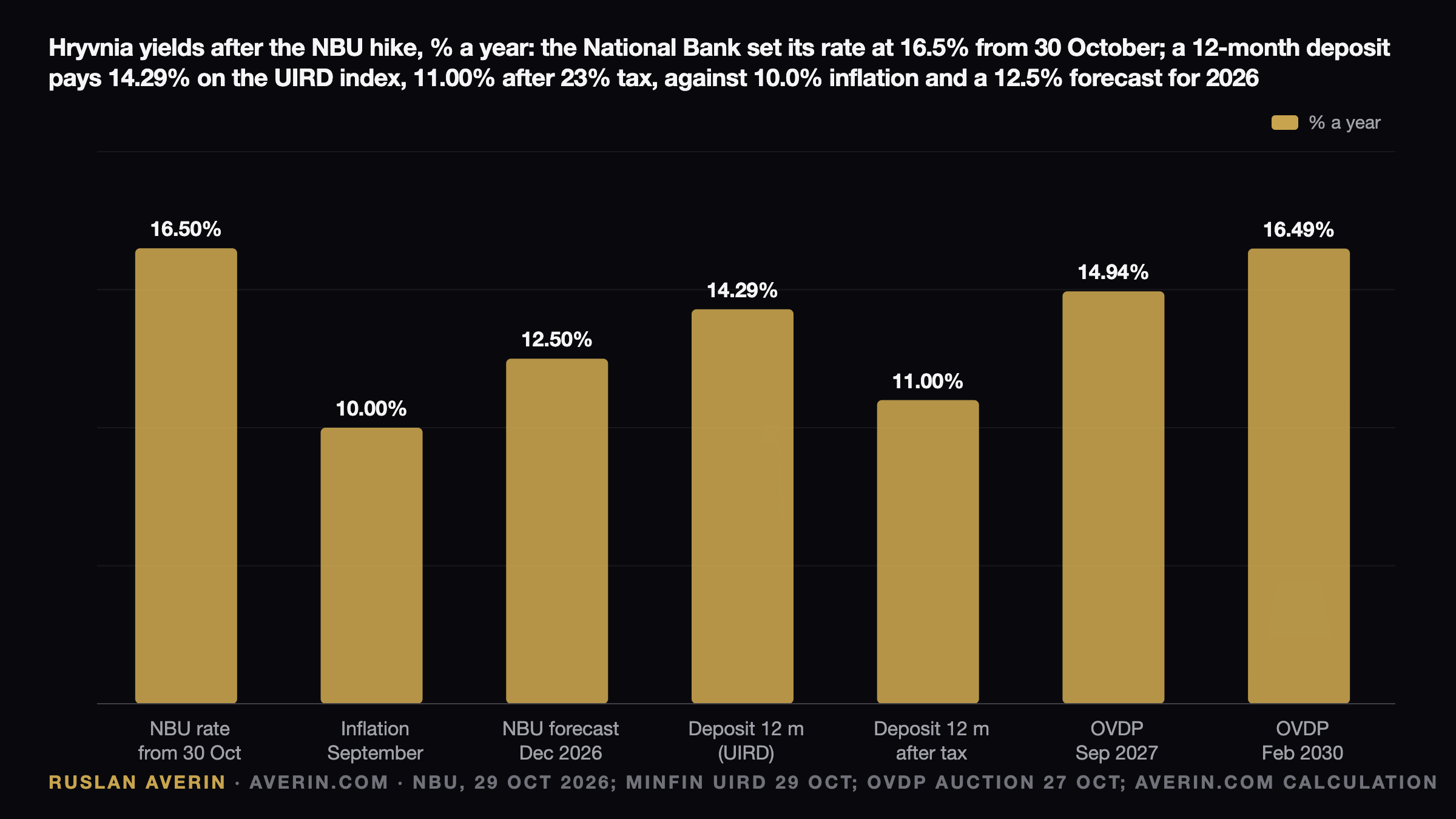
Banks started repricing before the vote was cast. The UIRD index on 29 October read 14.02% for three months, 14.56% for six, 14.96% for nine and 14.29% for twelve, against 13.88%, 14.49%, 14.75% and 14.09% on 16 October, according to Minfin. The nine-month tenor pays more than a full year, a sign that treasurers expect the peak to pass.
The arithmetic facing a household is thinner than the headline. After the 23% tax, 14.29% leaves 11.00%. That is one percentage point above September inflation of 10.0%, yet below the 12.5% the National Bank now projects for the end of 2026. Real protection therefore depends on whether the inflation forecast proves too pessimistic.
Individual offers already span a wide band. Minfin's 21 October review recorded PrivatBank raising six- and nine-month rates by 3.5 percentage points to 13.5%, while KominBank pays 17% for a year and monobank 16%. Dmytro Zamotaiev of Globus Bank told Minfin before the meeting that average rates could stay mostly at 15–15.5%, with gradual and selective changes even after a hike.
OVDP: the tax-free comparison
Government paper pays interest free of tax, which changes the ranking. At the 27 October auction, two days before the decision, the Ministry of Finance placed UAH 2.0 billion of bonds maturing in September 2027 at a weighted average 14.94%, against demand of UAH 8.98 billion. Paper maturing in February 2030 cleared at 16.49%, but only UAH 593.7 million of the UAH 1 billion offered was sold.
Why the National Bank moved again
The press release cites "a significant increase in price pressures and a deterioration in inflation expectations". Inflation reached 10.0% in September and core inflation 8.8%, with the NBU saying the trend continued into October on its own estimates. Fuel prices driven by the war in the Middle East and Russian strikes on warehouses and logistics are named directly; the attacks alone add about 0.7 percentage points to annual inflation.
A forecast marked down on every line
Inflation is now seen at 12.5% at the end of 2026, 7.3% in 2027 and back to the 5% target in 2028. GDP fell 0.5% year on year in the third quarter, and the 2026 forecast was cut to a decline of 0.4%, followed by growth of 0.4% in 2027 and 2.2% in 2028. Reserves are projected above $62 billion in 2026–2027.
That reserve path assumes about $50 billion of direct budget support and more than $32 billion under the defence component of the Ukraine Support Loan this year. The regulator also expects to keep rates at the new level until the second quarter of 2027 and announced no change to reserve requirements. The full Inflation Report follows on 5 November, the committee summary on 9 November.
An RFC preview had treated a hold at 16% as the base case and a 0.5 percentage point increase as the main alternative; the alternative materialised. The preview correctly anticipated a forecast lifted well above 10% and a longer stay at a high level, but underweighted how heavily expectations would count.
Washington: a hold with two hawkish dissents
The Fed statement is terse: "Economic activity is expanding at a strong pace" and "inflation remains elevated", with "the accumulation of more information" to guide the stance and a closing pledge that "the Committee will deliver price stability". Governor Lisa Cook and Cleveland Fed President Beth Hammack voted for a quarter-point hike.
Chair Kevin Warsh said "inflation is too high" and that energy prices "have moved higher again in recent weeks". Asked why not act immediately, he replied that quashing inflation "is not about some fixed individual date on a calendar". On December: "I don't believe in forward guidance absent exigent circumstances, absent a crisis." From 2027 one meeting a year will be devoted to strategy, with no rate vote.
Bond markets read the event as less hawkish than feared. The two-year Treasury yield fell from 4.70% on 27 October to 4.61% on 29 October, while the ten-year slipped from 4.99% to 4.98% after touching 5.05% on decision day, per the Treasury par yield curve.
Frankfurt: a hike debated, unanimity on waiting
Christine Lagarde said the Governing Council "debated whether a hike was appropriate" but "unanimously decided that we were well positioned enough at this stage to hold". The statement flags indirect and second-round effects of the energy shock, notes tighter financing conditions and repeats that the ECB is "not pre-committing to a particular rate path". Euro area inflation was 3.8% in September, energy inflation 18.9%, unemployment 6.4% in August.
The same day, Lagarde informed the Governing Council she will step down on 7 February 2027, after the February meeting, leaving the European Council to appoint a successor. A preview expecting a double hold, with about 10% hike odds for the Fed and 5.3% for the ECB plus at least two Fed dissents, proved correct on all three counts, though the predicted dollar lift failed to appear: the ECB reference rate moved from $1.1150 on 27 October to $1.1130 on 29 October.
The hryvnia between interventions and the euro
The official dollar rate eased to UAH 45.5293 for 30 October from 45.6008 on 28 October, the year's high, leaving it 8.0% above the 2 January level of 42.1701. The euro costs UAH 50.6796, up 2.3% since 2 January, held back by a softer euro against the dollar. The two quotes imply $1.113 per euro.
In analyst Ruslan Averin's view, the hike alters the cost of holding dollars more than the exchange rate itself: a twelve-month dollar deposit pays 1.17% on the UIRD index against 14.29% in hryvnia. The National Bank sets the dollar rate through interventions while the euro follows EUR/USD, so energy and the French bond market now drive the euro leg.
Dates that matter
- 5 November: the NBU Inflation Report with the full rate path.
- 9 November: the committee summary and the vote split.
- Weekly: NBU intervention data and Tuesday OVDP auctions.
- 9 December: the next Fed decision.
- 17 December: ECB and NBU decisions on the same day.