A decision built on a new forecast, not on a tweak
Thursday 29 October 2026 is not a routine date in the National Bank of Ukraine's calendar. Four times a year the Board rules with a freshly revised macroeconomic forecast in front of it, and October is one of those four. The briefing starts at 14:00 Kyiv time, after Monetary Policy Committee consultations on 27–28 October, and the complete Inflation Report lands on 5 November.
That sequencing matters. A forecast meeting does not simply set a number for the next six weeks; it redraws the projected trajectory of the key rate for the quarters ahead. The rate itself stands at 16%, lifted from 15.5% by the decision of 17 September and effective from 18 September.
The dashboard as of 22 October
The figures the Board carries into the room describe an economy where price pressure has outrun the plan while the currency is held steady by official supply.
- Key rate: 16% since 18 September.
- Inflation: 10.0% year on year in September; core inflation 8.8%.
- International reserves: $47.1 billion on 1 October, 3.2% lower over the month.
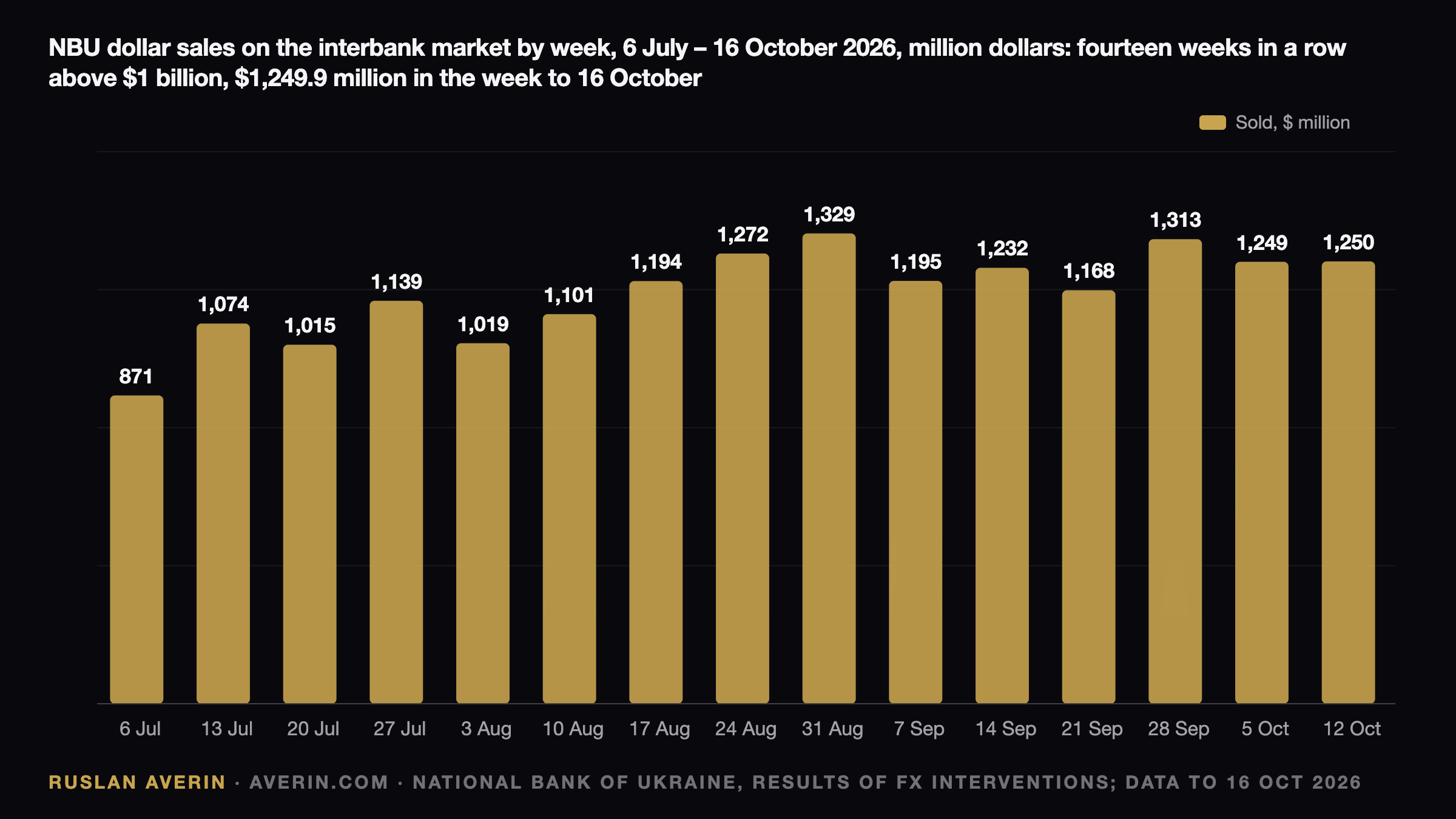
- NBU dollar sales: $1,249.9 million in the week to 16 October, a fourteenth consecutive week above $1 billion.
- Official rate on 22 October: UAH 45.0256 per dollar and UAH 50.5601 per euro.
September's price shock changed the arithmetic
August inflation ran at 8.1%. One month later the annual figure was 10.0%, driven by a 2.1% increase within a single month. The NBU's own commentary conceded that headline inflation significantly exceeded the path drawn in the July Inflation Report, and that core inflation also overshot.
The composition explains the force of the move. Fuel prices were 46.2% higher year on year as global petroleum product swings passed into wholesale and retail. Services rose 13.7%, pushed by university tuition and rents amid internal migration. Administered prices added 13.6% through public transport fares, water tariffs and alcohol. Processed food climbed 10.7%, raw food 6.7%.
The July forecast had pencilled in 10% for December 2026. That mark was reached in September, a full quarter ahead of schedule, and the NBU has warned that elevated transport and storage costs together with damaged warehouses will keep feeding pressure in the months ahead.
Expectations are the variable the Board actually targets
A supply shock becomes a monetary problem only when it migrates into expectations. The NBU's third-quarter survey of 664 companies found firms anticipating 11.5% inflation over the next twelve months, barely moved from 11.6% in the second quarter, and an average exchange rate of UAH 46.90 per dollar against 46.12 previously.
Governor Andriy Pyshnyy made the same point at the IMF regional economic outlook event on 16 October: the central task of central banks is preventing temporary supply shocks from de-anchoring inflation expectations on a lasting basis.
How divided the committee already was
September's statement avoided any commitment to a path. It stated readiness to respond flexibly to shifts in the balance of risks — additional measures if price risks and expectations intensify significantly, consideration of easier monetary conditions if the security situation cools consumer demand and the labour market.
The committee summary of 28 September revealed the split: seven members backed 16%, three preferred holding at 15.5%. Looking forward, seven argued that 16% delivers sufficiently tight conditions, that further tightening will not be needed, and that cautious easing becomes possible in 2027. Two said the October forecast may envisage at least one additional increase. One saw grounds for cuts as early as the end of 2026. All of that was recorded before the September inflation print.
The hryvnia is managed, not calm
Stability near 45 is purchased. In the week of 12–16 October the NBU sold $1,249.9 million and bought $0.3 million; since January it has sold $41.27 billion. Reserves slipped 3.2% in September as $5.45 billion of sales exceeded partner inflows, leaving $47.1 billion, equal to 4.0 months of future imports.
The official rate opened the year at UAH 42.1701 on 2 January, reached its weakest print so far at UAH 45.0802 on 14 October and stood at UAH 45.0256 on 22 October, roughly 6.8% weaker year to date. A higher key rate keeps hryvnia instruments attractive; September's release credited the July hike with supporting deposit and bond demand, which limited FX market pressure.
Two scenarios and their transmission
| Hold at 16% | Hike by 0.5 percentage points or more | |
|---|---|---|
| Signal | September majority prevails; new forecast extends 16% | Forecast revised upward; another increase priced in |
| Deposits | Gradual drift higher, mainly at smaller banks | Three to twelve-month offers repriced over weeks |
| OVDP | Primary yields near current levels | Ministry of Finance pays more at auctions |
| Mortgages | Market loans steady; єОселя fixed by programme | Market loans dearer; єОселя still fixed |
| Hryvnia | Interventions continue carrying the load | Marginal support for hryvnia assets |
A cut is barely conceivable with inflation at 10.0% and a single committee voice favouring easing before the September data. In analyst Ruslan Averin's reading, the base case is a hold at 16% paired with a raised inflation forecast and a longer plateau, with a 0.5 percentage point increase as the leading alternative.
What savers and borrowers should calculate
Deposit interest is taxed at 23% — 18% personal income tax plus the 5% military levy. A twelve-month deposit at 14% therefore yields 10.78% net, a real return near 0.7% against 10.0% inflation.
Government bonds are tax-free for individuals. On 20 October the Ministry of Finance placed 329-day paper at a weighted average 15.01% and 882-day paper at 16.38%, raising about UAH 2.03 billion. Five weeks earlier, on 15 September, comparable issues cleared at 15.17% and 16.10%. A 15.01% coupon against 10.0% inflation implies a real yield of roughly 4.6%.
Mortgage pricing under єОселя stays outside the rate cycle: 3% for military personnel, veterans, medics, teachers and scientists, 7% for other eligible borrowers, fixed by the state for the first ten years. The NBU lending survey of 21 October recorded falling mortgage demand for the first time since end-2024, while approval rates on household loans rose.
Separately, NABU conducted searches at NBU premises on 21 October. No detentions or notices of suspicion have followed, and the presumption of innocence applies.
The dates that settle the argument
Consultations run 27–28 October. The decision, press release and revised forecast arrive on 29 October at 14:00 Kyiv time. The Inflation Report on 5 November carries the updated key rate path from today's 16%, and the committee summary on 9 November discloses how the votes fell. Weekly intervention data remains the cleanest live gauge of dollar demand around the decision.