A reporting cadence that removes most of the surprise
Few large insurers publish monthly figures. Progressive does, which means two of the three months in the quarter ending 14 October are already in the public record. The release scheduled before the open on Wednesday 14 October therefore narrows to a single question: what September looked like, and whether the quarter tilted toward volume or toward margin.
That transparency changes how the print should be read. Investors are not waiting for a quarterly reveal; they are testing one month against a bar that the first two months already set. The shares closed on Monday 12 October at $220.28, which sits 3.3% below the last close of 2025 at $227.72.
The headline decline overstates the damage. On 2 January the stock went ex-dividend for the $13.50 annual variable dividend plus the regular $0.10. Counting the $13.90 of dividends paid during 2026, holders are roughly 3% ahead on the year, a very different picture from the price chart alone.
Monthly scorecard: what July and August already said
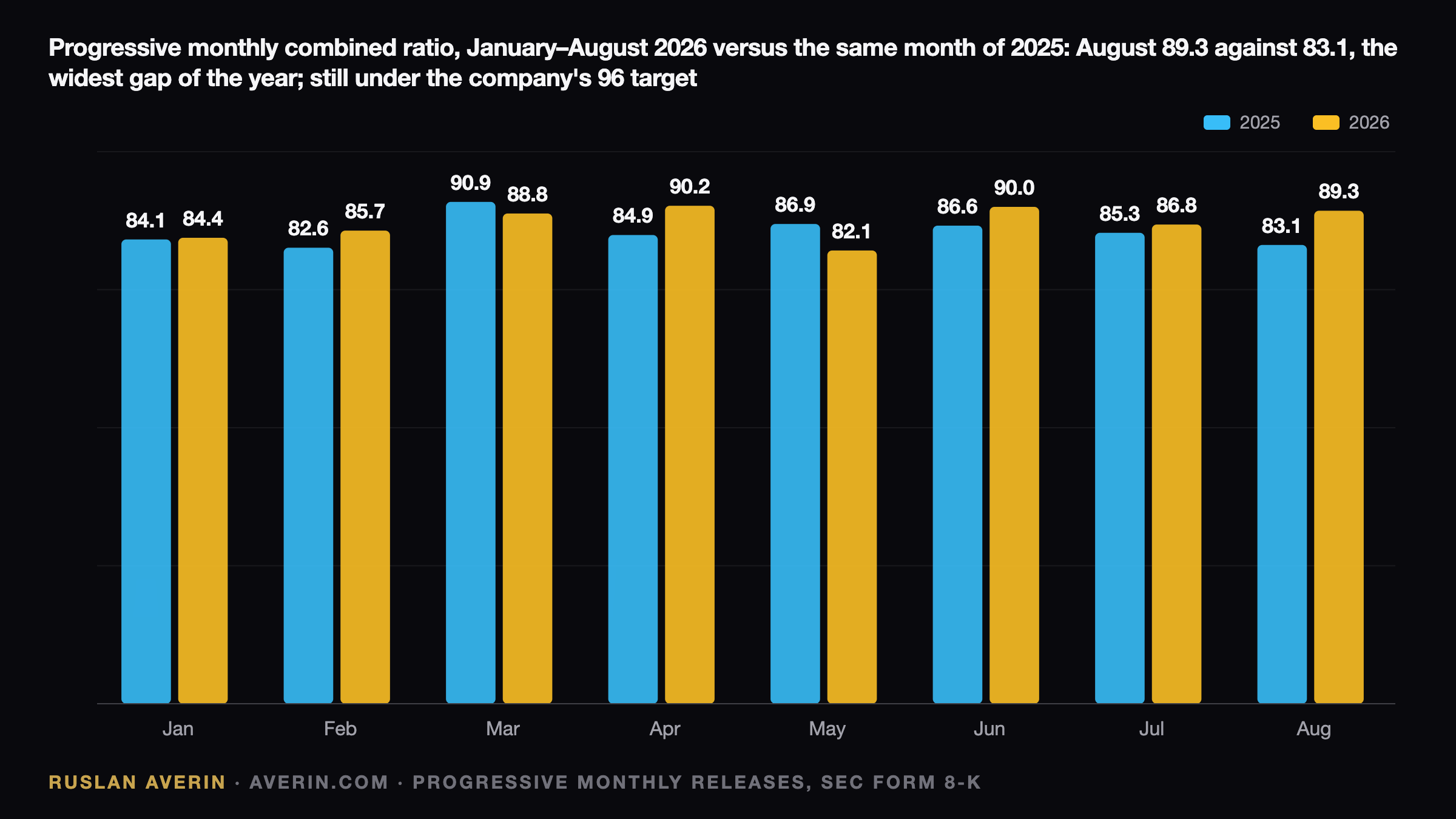
Growth held up while margin thinned. Net premiums written reached $7.44 billion in July and $7.61 billion in August, gains of 5% and 6% year on year. The combined ratio, however, moved the wrong way in both months, and August produced the widest year-over-year deterioration recorded so far in 2026.
| Metric | July 2026 | August 2026 | July 2025 | August 2025 |
|---|---|---|---|---|
| Net premiums written | $7.44 billion | $7.61 billion | — | — |
| Net premiums written growth | 5% | 6% | — | — |
| Combined ratio | 86.8 | 89.3 | 85.3 | 83.1 |
| GAAP EPS | $1.65 | $1.63 | $1.85 | $2.07 |
The August combined ratio of 89.3 against 83.1 a year earlier is a gap of 6.2 points, and weather does not account for it. The net catastrophe loss ratio was 1.9 points in August and 2.1 points in July. Commercial Lines ran at 97.5, above the long-standing 96 goal, while direct personal auto printed 90.5 against 85.9 in the agency channel.
The arithmetic bar September has to clear
Stripping out realised investment gains, July and August together produced roughly $3.20 a share. Reaching the $4.38 consensus therefore requires about $1.18 from September. On August's cost structure, that is consistent with a September combined ratio near 92, leaving room for a softer month but not for a poor one.
Yahoo Finance's consensus comes from 19 analysts and spans $3.99 to $4.72, with revenue pegged at $22.5 billion. Zacks, as quoted on Nasdaq, carries $4.35 from 10 analysts and counts eight upward revisions over the past four weeks against a single cut. Both numbers exclude realised investment gains.
The comparison base is unusually soft. Zacks places the year-ago quarter at $4.05, while Progressive's reported GAAP figure for the third quarter of 2025 was $4.45. September 2025 carried a $950 million policyholder credit expense, booked because Florida personal auto profit for 2023–2025 was expected to exceed the state's statutory limit. That month closed at a 100.4 combined ratio, with the quarter at 89.5.
Cheaper policies meeting costlier claims
Policies in force stood at 40.5 million at the end of August, up 7%. Direct auto rose 9% to 16.88 million and agency auto 7% to 11.34 million. In September 2025 those same growth rates were 17% and 13%, so the franchise is still expanding, but at roughly half the pace of a year earlier.
Progressive is funding that slower growth on two fronts. In the second quarter it cut personal auto rates by less than 1% countrywide, and average written premium per personal auto policy fell 2% year on year according to the 10-Q. Advertising spend reached $1.4 billion in the second quarter, up 16%, and $2.9 billion across the first half, up 18%.
Loss costs moved against that pricing. Total personal auto severity rose 4% in the second quarter, with bodily injury up 7% on higher medical costs, more large losses and more attorney-represented claims, while frequency fell 2%. Falling prices alongside rising severity is precisely the combination that carried the combined ratio from 83.1 to 89.3.
Hurricanes: a calm quarter, then Isaias
The third quarter was light on named-storm damage. According to the National Hurricane Center archive, every Atlantic system before Isaias remained a tropical storm. Two reached the US coast during the quarter, both in Louisiana: Bertha on 22 July and Edouard on 1 September. The August release attributed catastrophe losses to severe weather across the country rather than one event.
Isaias belongs to the fourth quarter. NHC advisories ran from 6 to 11 October, and the storm came ashore near Destin on the Florida Panhandle during the night of 9–10 October with winds of about 105 mph. Progressive's property reinsurance, renewed on 1 June, retains $75 million for a first Florida event and $300 million elsewhere; personal auto is not reinsured outside regulated programs.
Capital, buybacks and the December decision
Book value per share was $60.92 at the end of August, with trailing 12-month return on equity of 33.4%, putting Monday's close at about 3.6 times book. Rising yields left net unrealised losses on fixed maturities of $1.80 billion, $1.95 billion worse than in December, even as investment income reached $346 million in August at a 4.3% book yield.
Repurchases have resumed in earnest. Progressive bought 650,241 shares in July at an average $209.46 and 630,912 in August at $210.93, following roughly $1.05 billion of open-market purchases in the first half against $12 million a year earlier. The board sets the annual variable dividend in December; for 2025 it was $13.50, up from $4.50.
Price action and the four variables that decide the reaction
The 2026 closing high was $234.48 on 13 July. Two days later the June release showed a 90.0 combined ratio and 3% monthly premium growth, and the shares dropped 9.4% to $205.22. The low close was $190.40 on 29 May. From $207.31 on 30 September the stock has climbed 6.3%, including a 1.3% gain on Monday.
In analyst Ruslan Averin's view, four readings frame the response: the September combined ratio against roughly 92, where 90 or better recasts August as a one-off; net premiums written growth, with anything near July's 5% suggesting rate cuts are buying less; a second Commercial Lines month near 97.5; and any Isaias estimate, where losses near the Florida retention are manageable while auto damage remains the open risk.
A September resembling July would likely produce a muted move, given the 6% recovery already priced in. The asymmetric outcome pairs a combined ratio above 92 with decelerating premiums, reviving the question that triggered July's selloff: whether Progressive is discounting into rising severity.