One article of the Tax Code, one national ceiling, and five completely different bills depending on the city where the apartment stands. An owner in Kharkiv pays nothing at all for identical square metres that cost an owner in Dnipro UAH 120 each. That gap, not the rate itself, is the first thing worth understanding about Ukraine's residential property tax in 2026.
The rate is local, the ceiling is national
Article 266 lets a local council set the rate at up to 1.5% of the minimum wage as of 1 January of the reporting year, per square metre per year. Payment always runs a year behind. The 2026 bill covers 2025, when the base was UAH 8,000, producing a ceiling of UAH 120 per m². For 2026, payable in 2027, the base is already UAH 8,647 and the ceiling UAH 129.71.
| City | Rate for apartments | UAH per m² (payable in 2026) |
|---|---|---|
| Kyiv | 1.5% | 120 |
| Dnipro | 1.5% | 120 |
| Lviv | 0.25–1% by zone | 20–80 |
| Odesa | 0.1% | 8 |
| Kharkiv | 0% | 0 |
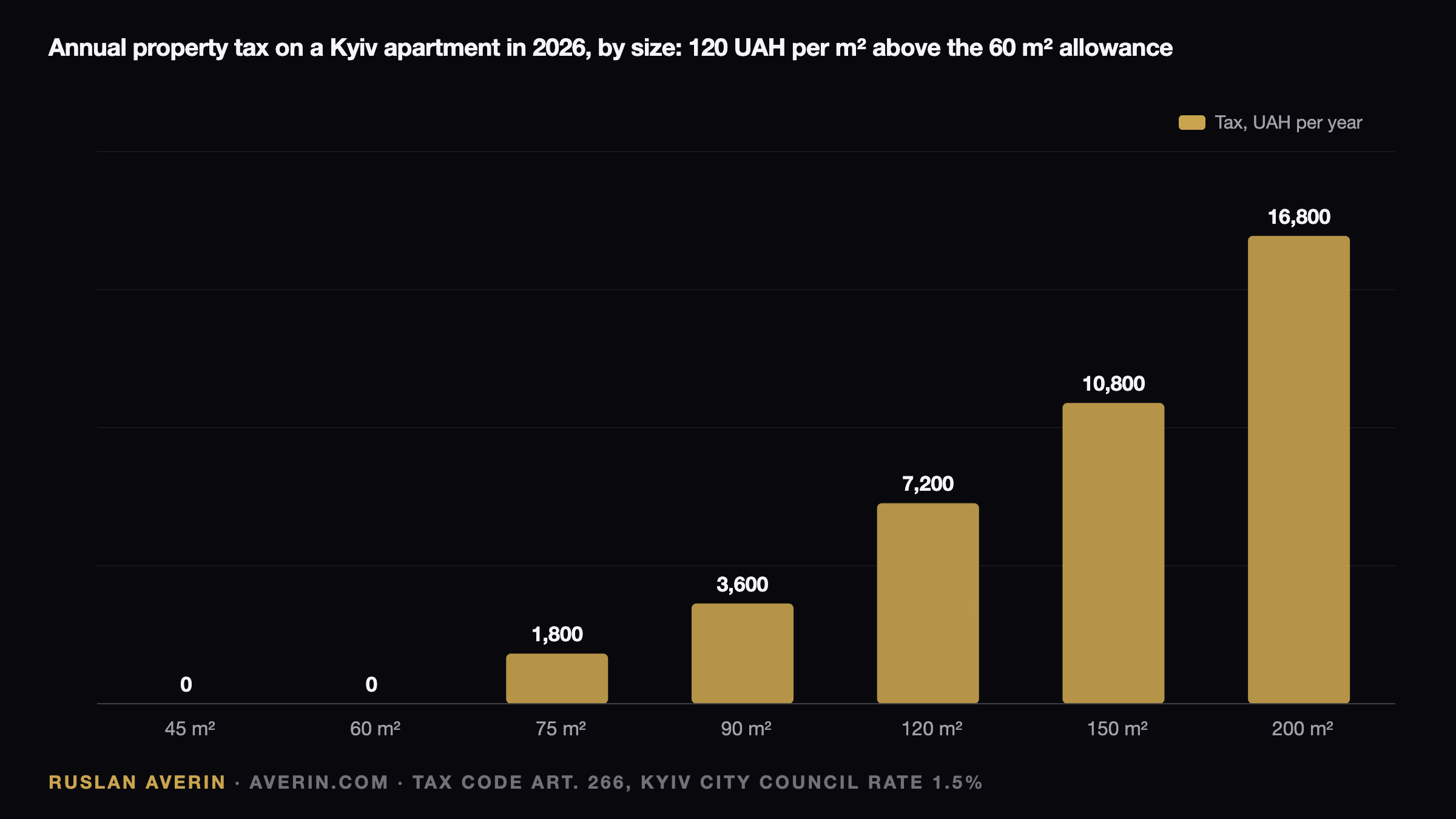
Kyiv applies the maximum for housing and 0.4% for garages, which works out at UAH 32 per m². For a capital apartment the arithmetic never gets more complex than (area − 60) × 120.
Only the surplus metres are taxable
The Code exempts the first 60 m² of an apartment, the first 120 m² of a house and 180 m² in total where an owner holds both. Charges apply only above that threshold, and the threshold is granted once to the person, not once to each object. That single design feature is the source of most misunderstandings.
Three practical consequences follow. An owner of one 58 m² apartment owes nothing, while an owner of 75 m² pays for 15 m². Two apartments of 45 m² are taxed on 30 m², because the allowance covers the 90 m² total. And the allowance disappears entirely once the property is let or used in business, leaving the whole area taxable.
Size also triggers a separate surcharge. An apartment above 300 m² or a house above 500 m² adds UAH 25,000 a year to the bill for each such object, regardless of how the general allowance was applied.
Three Kyiv scenarios
A 75 m² apartment held as the only property: 15 m² multiplied by UAH 120 gives UAH 1,800 a year.
A 120 m² apartment in Pechersk: 60 taxable metres produce UAH 7,200. Against a market value of roughly $330,000, that is about 0.05% of the asset per year, some 20 to 40 times lighter than comparable holding taxes in Germany or the United States.
Two apartments of 45 m² and 68 m², with the larger one let: the rented flat forfeits the allowance, so 68 m² × 120 = 8,160. The 45 m² unit sits inside the allowance and adds zero, giving UAH 8,160. Had the family occupied both, the calculation would be (113 − 60) × 120 = 6,360. For scale, UAH 8,160 a year is less than half of one month's median rent on a one-room Kyiv apartment.
Deadlines, and the price of missing them
Owners do not calculate anything themselves. The tax service issues a notice-decision by 1 July, delivered to the registered address or the Electronic Cabinet, and payment falls due within 60 days of receipt. No notice means no immediate liability, but three prior years remain open to assessment, which makes a quick check of the "Status of settlements with the budget" section the sensible habit.
Late payment costs 5% of the amount within the first 30 days and 10% after that. From the 91st day, interest accrues daily at 120% of the NBU policy rate; with the rate at 15.5%, that equals 18.6% a year on the debt. Deliberate non-payment attracts a fine of 25–50%.
Arrears tend to surface at the worst moments: when a notary requests a no-arrears certificate before a sale, or at the border once the debt has moved to enforcement.
Wartime exemptions and local relief
Since 1 January 2023, no tax is charged on objects located in areas of active hostilities or temporarily occupied territories included on the Ministry of Development list, nor on destroyed and uninhabitable housing recorded in the Register of Damaged and Destroyed Property. The relief covers the months during which the territory appears on the list.
Neither Kyiv nor Kyiv region is on that list in 2026, so capital owners pay the full amount. Targeted relief for large families and orphans is a matter for local councils, and Kyiv City Council left it at the basic level for 2026.
The signal behind the sum
The charge is administrative rather than economic: roughly 0.05% of value annually against 5–8% in transaction costs means it never decides a purchase. Analyst Ruslan Averin treats its real function as informational, a confirmation that the apartment is visible to the state.
That visibility is sharpening. From 2026, notaries report transactions quarterly and the property register is cross-checked against income data. An unpaid UAH 1,800 then becomes a reason to ask whether rental income was declared. Averin's conclusion is blunt: paying is simpler than explaining.