A forecast that argues with the market
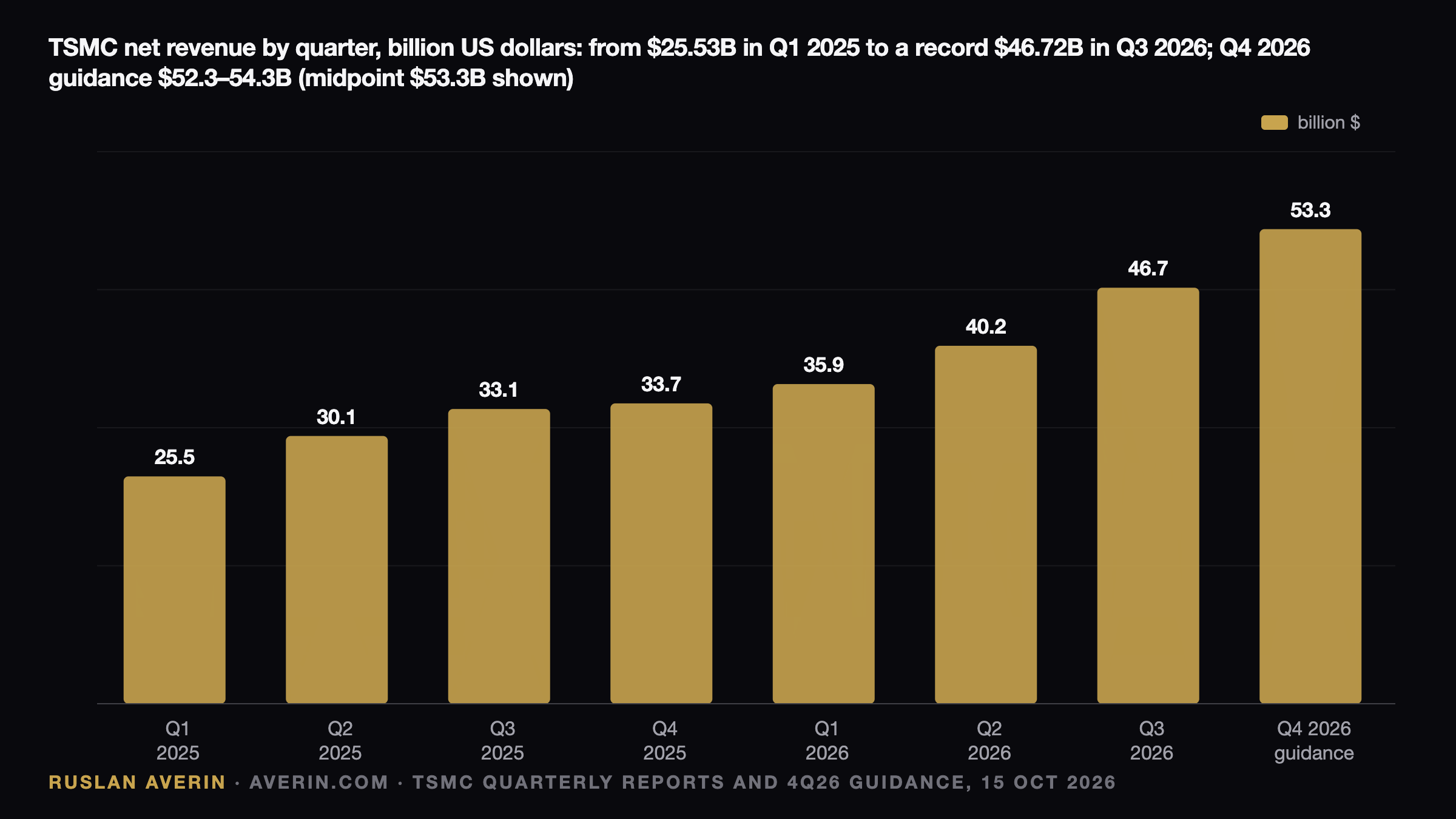
TSMC published third-quarter 2026 results on Thursday 15 October, ahead of its 2 p.m. Taipei conference, and the headline for the next six months was the outlook rather than the quarter. Management guided fourth-quarter revenue to $52.3–54.3 billion. The $53.3 billion midpoint sits 14% above the third quarter and 58% above the $33.73 billion booked in the fourth quarter of 2025.
That arrived on a day when Asian semiconductor equities were being sold hard. The KOSPI lost 7.57% to close at 5,554.22, Samsung Electronics fell 9.48% and SK hynix 11.06%. The world's largest contract manufacturer was, in effect, telling investors the opposite of what their screens were showing: artificial-intelligence demand is not cooling.
Every reported line cleared the range
| Metric | Consensus / guidance | Actual |
|---|---|---|
| Revenue, US$ | $44.6–45.8B (guidance) | $46.72B |
| Revenue, NT$ | NT$1.47T (LSEG SmartEstimate) | NT$1,494.24B |
| Net income | NT$746.34B (LSEG SmartEstimate) | NT$763.06B |
| EPS per ADR | $4.42 (consensus via Investing.com) | $4.60 |
| Gross margin | 65.0–67.0% (guidance) | 66.4% |
| Operating margin | 56.0–58.0% (guidance) | 58.7% |
Revenue of NT$1,494.24 billion rose 50.9% from a year earlier and 17.6% from the second quarter. Measured in dollars the same growth was 41.2% and 16.2%. The difference is currency: the Taiwan dollar averaged 31.98 per US dollar in the quarter against 29.91 a year before. Net income exceeded the LSEG SmartEstimate cited by CNBC by roughly 2.2%.
Where the sequential profit leakage came from
Earnings advanced 8.0% quarter on quarter while sales advanced 17.6%. Two items account for the gap. Non-operating income dropped to NT$34.59 billion from NT$95.83 billion, since the prior quarter captured gains on shares of Vanguard International Semiconductor. Gross margin also eased to 66.4% from 67.7%.
The management report attributes that margin slip "primarily" to the initial ramp of 2nm. Even so, operating margin of 58.7% finished above the top of the guided band, which means operating leverage on the larger revenue base more than offset the extra cost absorbed at the gross line.
The node mix rotates faster than usual
2nm delivered 8% of wafer revenue, against 3% three months earlier and nothing a year ago. 3nm climbed to 33% from 30%, while 5nm receded to 28% from 33%. 7nm held 10%. Together, geometries of 7nm and below represented 79% of wafer revenue, the clearest sign yet of where capacity is being pointed.
Chief executive C.C. Wei told the call TSMC expects "our N2 family technologies annual capacity to more than double in 2027." He described A14 risk production as "well on track for 2027", with volume production following in 2028. Chief financial officer Wendell Huang guided fourth-quarter gross margin down about 40 basis points to 66% at the midpoint, "primarily due to the continued margin dilution from the steep ramp-up of our 2 nanometer technology."
AI platforms now carry two-thirds of sales
High-performance computing, the segment that contains AI accelerators, grew 22% sequentially and reached 68% of net revenue, up from 66% in the second quarter and 57% a year earlier. Smartphones contributed 21% after a 10% quarterly gain. Automotive expanded 23% but remains just 4% of the total. Customers headquartered in North America supplied 79% of revenue.
Wei left little room for interpretation. "The demand is extremely robust. We did not see any sign of slowdown," he said. Asked whether AI demand might exceed the mid-to-high-50s percent compound growth rate the company had previously sketched, he replied: "Whether it is a high 50 CAGR, it does not matter. It probably will be higher." He added: "There is no ceiling for TSMC's profitability, but a dramatic increase will not happen overnight either."
Full-year arithmetic and the spending commitment
Wei now expects 2026 revenue growth of "around 44% year-over-year in U.S. dollar term." Applied to roughly $122.4 billion of 2025 revenue, that points to about $176 billion this year. With $122.8 billion recorded in the first nine months, the fourth quarter needs approximately $53.5 billion, sitting close to the guidance midpoint rather than above it.
Capital spending was $13.84 billion in the quarter and $40.64 billion over nine months. Huang reaffirmed the 2026 budget of $60–64 billion, lifted from $52–56 billion in July, implying $19.4–23.4 billion in the final quarter. He said capex from 2026 to 2028 "is expected to be significantly higher than the past three years." Free cash flow reached NT$476.56 bill